(b) Ammonium nitrate is not used in the preparation of ammonia.
(c) Conc H2SO4 is a good drying agent, yet it is not used to dry NH3.
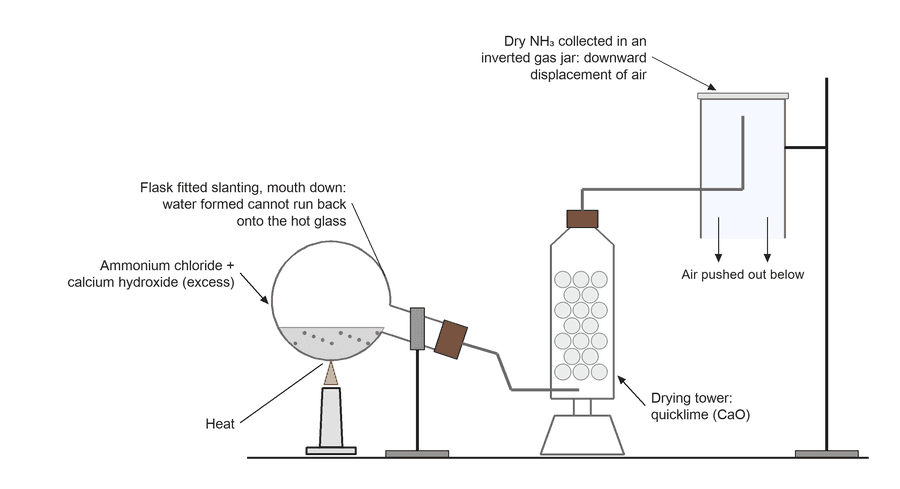
(d) In the lab. preparation of ammonia
(i) calcium hydroxide is used in excess.
(ii) Flask is fitted in slanting position.
Solution:
Concept: Each reason comes from one property: ammonium compounds are very soluble, ammonium nitrate is explosive, ammonia is basic, ammonium chloride sublimes, and water is formed in the preparation.
Step 1 — (a) Explain why ammonium compounds are not minerals.
Ammonium compounds are highly soluble in water. Any that formed in the ground would be dissolved by rain water and washed away, so they do not occur as minerals.
Step 2 — (b) Explain why ammonium nitrate is not used.
Ammonium nitrate is explosive on heating. Instead of giving ammonia, it decomposes into nitrous oxide and steam:
NH4NO3ΔN2O+2H2O
Step 3 — (c) Explain why conc. sulphuric acid is not used.
Conc. sulphuric acid is a good drying agent, but ammonia is basic and reacts with the acid to form ammonium sulphate. The ammonia itself would be absorbed:
2NH3+H2SO4→(NH4)2SO4
Step 4 — (d)(i) Explain the excess of calcium hydroxide.
Ammonium chloride sublimes on heating. Taking an excess of the alkali makes sure that all the ammonium chloride reacts before any of it is lost by sublimation.
Step 5 — (d)(ii) Explain the slanting flask.
Water is formed in the reaction. The flask is fitted slanting, mouth downwards, so this water runs towards the mouth. It cannot trickle back onto the hot bottom of the flask, which could crack the glass.
Watch out: The flask slants downwards towards the mouth, so the water runs away from the heated part.
Therefore, (a) ammonium compounds are too soluble to stay in the ground; (b) NH₄NO₃ is explosive; (c) conc. H₂SO₄ reacts with ammonia; (d)(i) excess Ca(OH)₂ uses up all the subliming NH₄Cl; (d)(ii) the slant stops water running back onto the hot glass.