Solution:
Concept: In the Haber process, nitrogen and hydrogen combine in a reversible, exothermic reaction in which 4 volumes of gas (1 + 3) become 2 volumes of ammonia. The conditions are a balance between getting enough ammonia and getting it fast enough.
Step 1 — (a) State the conditions and the equation.
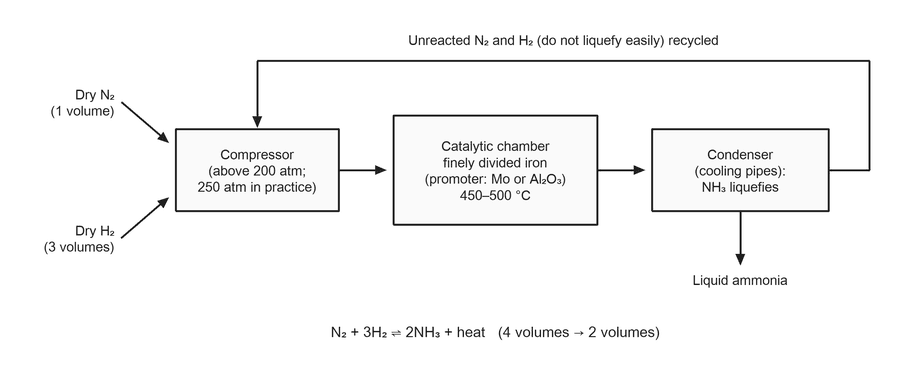
The gases combine at a temperature of 450–500 °C, a pressure above 200 atm (about 250 atm in practice), over a catalyst of finely divided iron with molybdenum (or aluminium oxide) as promoter:
N2+3H2Fe catalyst, Mo promoter⇌450–500 °C, above 200 atm2NH3+heat
Step 2 — (b) Give the ratio by volume.
Gases react in the same volume ratio as their coefficients in the equation (Gay-Lussac's law). So nitrogen : hydrogen = 1 : 3 by volume.
Step 3 — (c) Name a source of each reactant.
Nitrogen comes from the fractional distillation of liquid air. Hydrogen comes from water gas by the Bosch process (or from natural gas).
Step 4 — (d) Decide on the pressure.
High pressure favours ammonia, because the forward reaction reduces 4 volumes of gas to 2 volumes, and high pressure favours the side with fewer volumes.
Step 5 — (e) Remove the ammonia from the unchanged gases.
Two ways are used:
- liquefaction: on cooling, ammonia liquefies easily, while nitrogen and hydrogen do not;
- dissolving in water: ammonia is very soluble in water, while nitrogen and hydrogen are almost insoluble.
Step 6 — (f) Give the functions of iron and molybdenum.
(i) Finely divided iron is the catalyst. It speeds up the reaction, and being finely divided it offers a large surface area. (ii) Molybdenum is the promoter. It increases the efficiency of the iron catalyst.
Step 7 — (g) State the percentage formation.
Only about 15% of the gas mixture is changed into ammonia in one pass through the catalytic chamber.
Step 8 — (h) Increase the percentage formation.
The unreacted nitrogen and hydrogen are recirculated over the catalyst again and again, until nearly all of them (about 98%) has been converted. Using high pressure and removing ammonia as soon as it forms also favour more ammonia.
Watch out: Molybdenum is not the catalyst; it is the promoter. Platinum is the catalyst of the Ostwald process, not of the Haber process.
Therefore, ammonia is made from N₂ and H₂ (1 : 3) at 450–500 °C and above 200 atm over finely divided iron with a molybdenum promoter; high pressure, removal of ammonia and recirculation raise the yield from about 15%.
