Answer: (A) (1)
Concept: In an assertion-reason question, first judge the Assertion (A) true or false, then the Reason (R), and only if both are true decide whether R correctly explains A. The codes are: (1) both true and R explains A; (2) both true but R does not explain A; (3) A true, R false; (4) A false, R true. Ammonia is basic, so it reacts with acidic or neutral drying agents.
Step 1 — Judge the assertion.
Ammonia is dried by passing it through a tower of quicklime (CaO). A is true.
Step 2 — Judge the reason.
Being basic, ammonia reacts with the other common drying agents. For example, conc. sulphuric acid and anhydrous calcium chloride both absorb it:
2NH3+H2SO4→(NH4)2SO4
CaCl2+4NH3→CaCl2⋅4NH3
R is true.
Step 3 — Decide whether R explains A.
Quicklime is chosen precisely because it is basic and does not react with ammonia, while the others do. So R explains A.
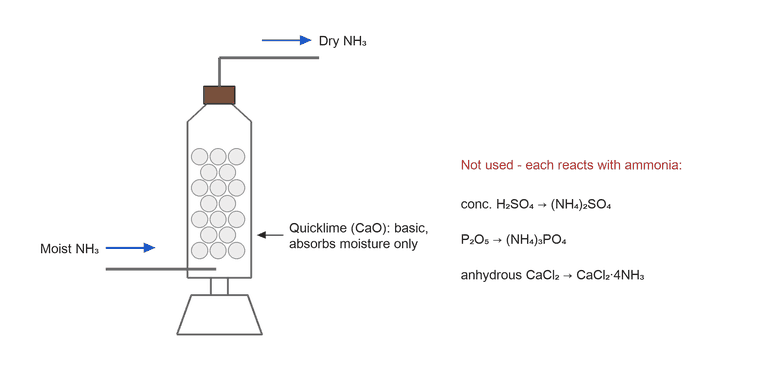
Why the other options are wrong:
- (B) (2): code (2) says R does not explain A, but R is exactly why CaO is chosen.
- (C) (3): code (3) says R is false, but R is true.
- (D) (4): code (4) says A is false, but A is true.
Therefore, both statements are true and R explains A, so the answer is code (1), option (A).
