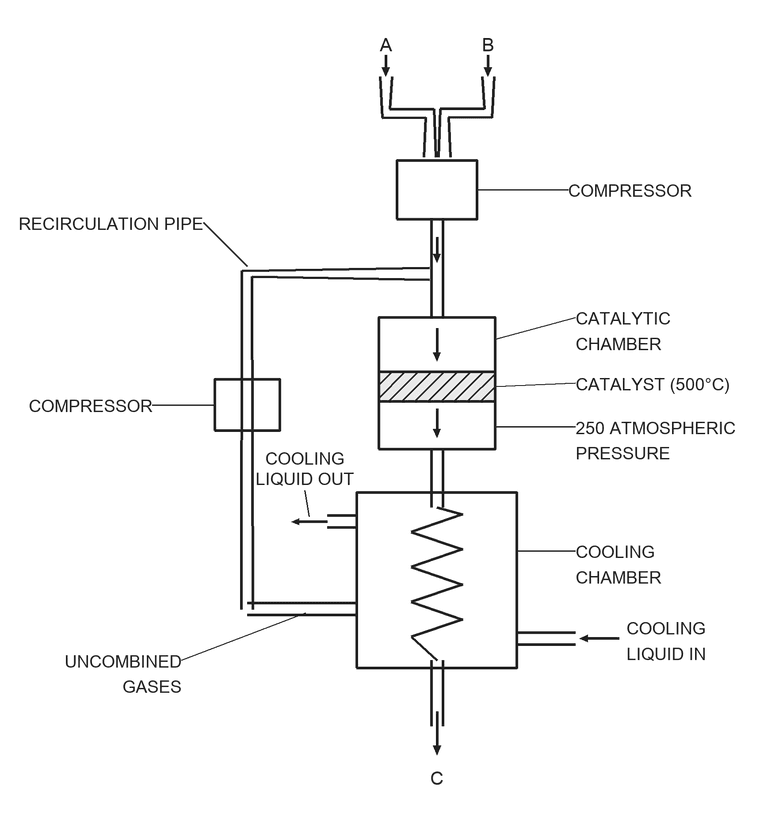
Solution:
Concept: Two gases combined over a catalyst at about 500 °C and high pressure, with the product liquefied in a cooling chamber and the uncombined gases recirculated, is the Haber process for ammonia.
Step 1 — (a) Name the process.
The process is Haber's process.
Step 2 — (b) Identify A, B and C.
A = nitrogen and B = hydrogen enter the compressor; C = (liquid) ammonia leaves the cooling chamber.
Step 3 — (c) State the ratio.
A is nitrogen and B is hydrogen, so the ratio A : B is 1 : 3 by volume.
Step 4 — (d) Write the equation and conditions.
Temperature 450–500 °C, pressure above 200 atm (250 atm in the diagram), catalyst finely divided iron with molybdenum as promoter:
N2+3H2Fe catalyst, Mo promoter⇌450–500 °C, above 200 atm2NH3+heat
Step 5 — (e) Separate the product.
The hot gas (about 15% ammonia) is cooled. Ammonia liquefies easily and is drawn off; the unreacted nitrogen and hydrogen do not liquefy and are recirculated to the catalytic chamber through the compressor.
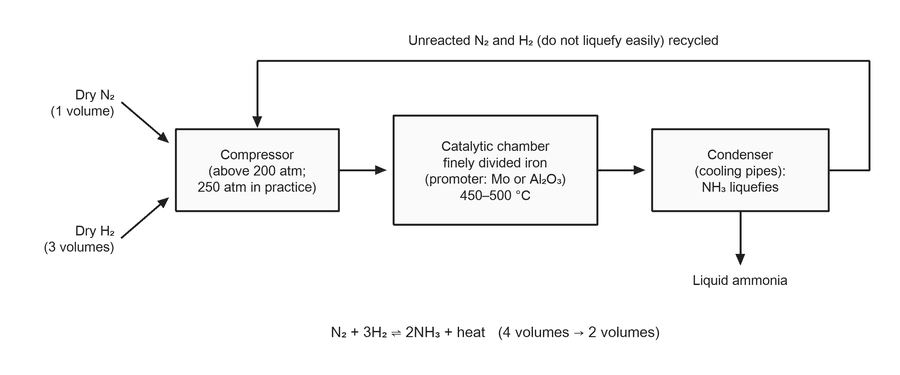
Therefore, the process is Haber's, A is nitrogen, B is hydrogen, C is ammonia (1 : 3), and ammonia is separated by liquefaction while unreacted gases are recycled.