
Question 365 marksMedium
Copy and complete the following equations.
(a) (b)
(c) (d)
(i) Which property of ammonia is illustrated by equation (c) ?
(ii) What important fertiliser is prepared from equation (d) ? State the conditions.
Confirming your payment
Sign up now and get 250 free tokens.
Study of Compounds – Ammonia · Question 36 of 67
Copy and complete the following equations.
(a) (b)
(c) (d)
(i) Which property of ammonia is illustrated by equation (c) ?
(ii) What important fertiliser is prepared from equation (d) ? State the conditions.
Solution:
Concept: Complete each equation from the known reaction, then balance it by counting every kind of atom on both sides.
Step 1 — (a) Aluminium nitride with water.
The nitride is hydrolysed to aluminium hydroxide and ammonia:
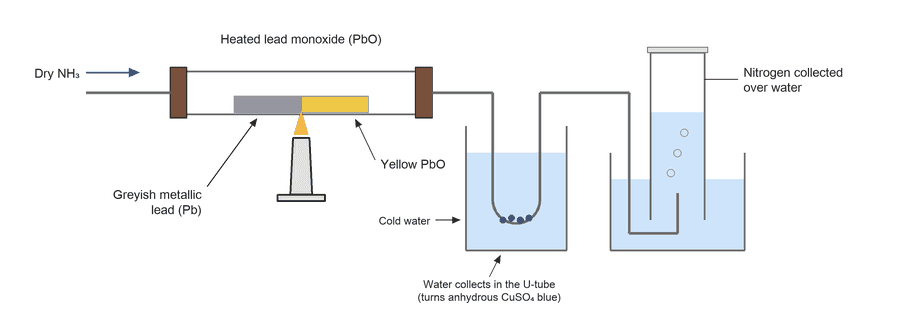
Step 2 — (b) Ammonia with lead monoxide.
Ammonia reduces heated yellow lead monoxide to greyish lead:
Step 3 — (c) Ammonia with chlorine.
Chlorine (3 molecules to 1 of ammonia, an excess) removes all the hydrogen of ammonia:
Step 4 — (d) Ammonia with carbon dioxide.
Ammonia and carbon dioxide combine under heat and pressure to give urea and water:
Step 5 — (i) Name the property shown by (c).
In (c), chlorine takes the hydrogen away from ammonia, so ammonia is oxidised and chlorine is reduced to hydrogen chloride. This shows that ammonia is a reducing agent.
Step 6 — (ii) Name the fertiliser from (d).
The fertiliser is urea, , made at about 150 °C and 150 atm pressure.
Watch out: Check that 3Cl₂ means chlorine is in excess; that is why the product is NCl₃, not NH₄Cl.
Therefore, the equations are completed as above; (c) shows that ammonia is a reducing agent, and (d) gives urea at about 150 °C and 150 atm.