
Opening your dashboard
Class 10 Chemistry Chapter 9 Study of Compounds – Ammonia: Practice Questions
43 questions on Chapter 9, each worked through on its own page with the AI tutor. Class 10 Chemistry, ICSE 2026-27.
43 questions
1–5 marks · Mixed difficulty
- 11 mark
Question 1
Bloom's level: Remember
In a molecule of ammonia, , the nitrogen atom is surrounded by:
- 21 mark
Question 2
Bloom's level: Remember
In Haber's process, the substance added in traces to increase the efficiency of the finely divided iron catalyst (the promoter) is:
- 31 mark
Question 3
Bloom's level: Understand
One volume of water dissolves about 702 volumes of ammonia at 20 °C and 1 atm. Which statement is a direct consequence of this property?
- 41 mark
Question 4
Bloom's level: Understand
A few drops of phenolphthalein are added to aqueous ammonia. Dilute hydrochloric acid is then added drop by drop until it is in excess. What colour change is seen, and why?
- 51 mark
Question 5
Bloom's level: Apply
A student has to prepare dry ammonia gas starting from ammonium sulphate. Which choice of alkali and drying agent is correct?
- 61 mark
Question 6
Bloom's level: Apply
Ammonium hydroxide is added drop by drop, and then in excess, to a colourless salt solution S. A white gelatinous precipitate forms first and then dissolves in the excess. Solution S is most likely:
- 71 mark
Question 7
Bloom's level: Apply
In a Haber's plant, 40 L of nitrogen is mixed with hydrogen in the correct ratio and passed once over the catalyst. If only 15% of the nitrogen reacts, the volume of ammonia formed, measured at the same temperature and pressure, is:
- 81 mark
Question 8
Bloom's level: Understand
Which statement correctly compares ammonia with chlorofluorocarbons (CFCs) as a refrigerant?
- 91 mark
Question 9
Bloom's level: Apply
Two white salts, ammonium chloride and sodium chloride, are in unlabelled bottles. Which reagent will distinguish between them?
- 101 mark
Question 10
Bloom's level: Understand
Read the Assertion (A) and the Reason (R) and choose the correct option.
Assertion (A): While preparing aqueous ammonia, the delivery tube is joined to an inverted funnel whose rim just touches the water.
Reason (R): The funnel provides a large surface area for ammonia to dissolve and prevents back suction of water into the hot flask.
- 111 mark
Question 11
Bloom's level: Evaluate
Read the Assertion (A) and the Reason (R) and choose the correct option.
Assertion (A): Ammonia gas burns in air with a greenish-yellow flame.
Reason (R): Ammonia is not a supporter of combustion.
- 121 mark
Question 12
Bloom's level: Analyse
Read the Assertion (A) and the Reason (R) and choose the correct option.
Assertion (A): In Haber's process the reacting gases are kept at about 450–500 °C and not at a lower temperature.
Reason (R): The combination of nitrogen and hydrogen to form ammonia is an exothermic reaction.
- 132 marks
Question 13
Bloom's level: Remember
(a) Where does ammonia occur in the free state in nature?
(b) Name two compounds in which ammonia occurs in the combined state.
- 142 marks
Question 14
Bloom's level: Remember
What is liquor ammonia fortis? Why is it also called 880 ammonia, and how is it stored?
- 152 marks
Question 15
Bloom's level: Understand
Explain why a pungent smell is noticed near a heap of decaying organic matter or an unclean toilet. Write the balanced equation for the change involved.
- 162 marks
Question 16
Bloom's level: Understand
In the fountain experiment with ammonia, explain:
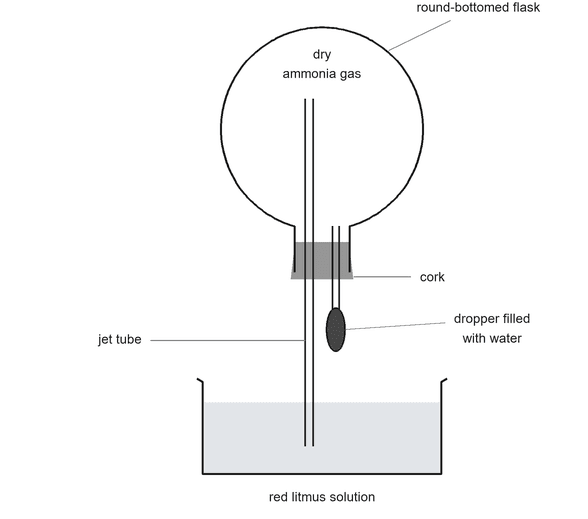
(a) why the red litmus solution rushes up into the flask, and
(b) why the fountain is blue even though the trough contains red litmus solution.
- 172 marks
Question 17
Bloom's level: Understand
Dry ammonia gas has no action on dry red litmus paper, but aqueous ammonia turns red litmus blue. Explain this with equations, and state why aqueous ammonia is called a weak base.
- 182 marks
Question 18
Bloom's level: Apply
Write balanced equations for the preparation of ammonia from:
(a) ammonium sulphate and caustic potash, on warming;
(b) calcium nitride, , and warm water.
- 192 marks
Question 19
Bloom's level: Apply
8.5 g of dry ammonia is passed slowly over excess heated copper (II) oxide.
Calculate (a) the volume of nitrogen formed at S.T.P., and (b) the mass of copper formed. (N = 14, H = 1, Cu = 63.5)
- 202 marks
Question 20
Bloom's level: Apply
Urea is made from ammonia and carbon dioxide.
(a) Write the balanced equation for this reaction with its conditions.
(b) Calculate the percentage of nitrogen in urea, . (C = 12, O = 16, N = 14, H = 1)
- 212 marks
Question 21
Bloom's level: Evaluate
A student makes two claims:
(a) "Aqueous ammonia removes grease, so it is ideal for cleaning copper vessels."
(b) "Ammonia is lighter than air, so a leak from an ammonia refrigeration plant is completely harmless."
Judge each claim and justify your answer.
- 222 marks
Question 22
Bloom's level: Analyse
A white salt X dissolves in water. Its solution:
- when warmed with sodium hydroxide solution, gives a gas that turns moist red litmus blue;
- with silver nitrate solution, gives a white precipitate insoluble in dilute nitric acid.
Identify X, and write the equation for each test.
- 234 marks
Question 23
Bloom's level: Apply
A school laboratory assistant finds four unlabelled bottles. She knows they contain solutions of iron (II) sulphate, lead nitrate, zinc nitrate and copper (II) sulphate. She has only ammonium hydroxide solution to identify them.
(a) One solution gives a dirty green precipitate. Name the solution and write the balanced equation.
(b) Two solutions give white precipitates. Explain how she can tell which is lead nitrate and which is zinc nitrate.
(c) Predict what she observes with the fourth solution when ammonium hydroxide is added first in small amounts and then in excess, and name the substance responsible for the final colour.
- 245 marks
Question 24
Bloom's level: Apply
An engineer at a fertiliser plant manages the unit that makes ammonia by Haber's process.
(a) State the temperature, pressure and catalyst (with promoter) she should use, and write the equation for the reaction.
(b) The gases leaving the catalyst chamber contain only about 15% ammonia. Explain how the ammonia is separated from the unreacted gases and what is done with the unreacted gases.
(c) Calculate the volumes of nitrogen and hydrogen that must react to make 500 L of ammonia (all at the same temperature and pressure). If only 15% of the gas mixture is converted in one pass over the catalyst, what volume of the mixture must be passed to obtain these 500 L in a single pass?
- 254 marks
Question 25
Bloom's level: Analyse
Ammonia and chlorine react in two different ways depending on which gas is in excess.
(a) Write the balanced equation for the reaction when ammonia is in excess, and when chlorine is in excess.
(b) Compare the number of molecules of ammonia that react with three molecules of chlorine in the two cases, and use this to explain why the products differ.
(c) In both reactions, which substance is reduced and which acts as the reducing agent? State the visible difference in the products.
- 264 marks
Question 26
Bloom's level: Analyse
The table shows the approximate volume of each gas that dissolves in 1 volume of water at 20 °C and 1 atm.
Gas Volume dissolved in 1 volume of water Ammonia 702 Hydrogen chloride 450 Carbon dioxide 0.9 Oxygen 0.03 (a) Which of these gases can be used to perform a fountain experiment? Give a reason.
(b) Which gases need an inverted-funnel arrangement when they are dissolved in water to make a solution? Explain why.
(c) Which gas in the table can most suitably be collected over water?
(d) Explain step by step how the funnel prevents water from being sucked back into the flask while aqueous ammonia is being prepared.
- 274 marks
Question 27
Bloom's level: Analyse
Study the observations below.
- A white crystalline salt P, when heated alone, gives two colourless gases that recombine on cooling to form P again.
- P heated with slaked lime gives a pungent gas Q, which turns moist red litmus blue.
- When Q is passed over a heated black solid R, a reddish-brown solid is left and a neutral gas S is collected over water.
- Gas S is also formed when Q burns in oxygen with a greenish-yellow flame.
(a) Identify P, Q, R and S.
(b) Write balanced equations for the second, third and fourth observations.
(c) Name the type of change shown in the first observation.
- 284 marks
Question 28
Bloom's level: Evaluate
Three students plan the laboratory preparation of dry ammonia gas.
- Student 1: Heat ammonium nitrate with sodium hydroxide; dry the gas over quicklime; collect it in an inverted jar.
- Student 2: Heat ammonium chloride with calcium hydroxide; dry the gas by bubbling it through concentrated sulphuric acid; collect it over water.
- Student 3: Heat a mixture of ammonium chloride with excess calcium hydroxide in a flask fitted in a slanting position, mouth downwards; pass the gas through a tower of quicklime; collect it by downward displacement of air.
Judge each plan. Point out every mistake with a reason, and say which plan is correct.
- 294 marks
Question 29
Bloom's level: Create
Design a simple experiment, using a gas jar of dry ammonia, to show in one set-up that ammonia is (i) lighter than air and (ii) alkaline in water. Your answer should list the apparatus and materials, give the steps, and state the observation that proves each property. Include one safety precaution.
- 305 marks
Question 30
Bloom's level: Create
A fertiliser company wants to turn nitrogen from the air into the fertiliser ammonium nitrate, , using only nitrogen, hydrogen, oxygen and water as raw materials.
Plan the sequence of reactions it should use. For each step write a balanced equation, state the conditions or catalyst where needed, and name the industrial process involved. End by stating one reason why ammonium nitrate is a valuable fertiliser.
- 311 mark
Question 31
A bottle of liquor ammonia is left open on a laboratory bench. Name the gas that escapes from it.
- 322 marks
Question 32
Write a balanced equation for each reaction.
(a) Warm water is added to magnesium nitride.
(b) Ammonia is mixed with chlorine, the chlorine being in excess.
- 332 marks
Question 33
State one thing you would see in each experiment.
(a) A jet of ammonia gas is lit in a jar of oxygen.
(b) A mixture of ammonia and oxygen is passed over heated platinum, and the gases formed are led into a flask containing air.
- 341 mark
Question 34
The formation of ammonia from nitrogen and hydrogen is a reversible reaction in which heat is given out and the volume decreases. Which set of conditions favours the formation of more ammonia ?
- 351 mark
Question 35
The vapour density of ammonia is : (H = 1, N = 14)
- 361 mark
Question 36
Assertion (A): In the laboratory preparation of ammonia from ammonium chloride and calcium hydroxide, the flask is fitted in a slanting position with its mouth pointing downwards.
Reason (R): Ammonia gas is lighter than air.
- 372 marks
Question 37
5.35 g of ammonium chloride is heated with excess of calcium hydroxide. (H = 1, N = 14, Cl = 35.5 ; one mole of a gas occupies 22.4 litres at S.T.P.)
(i) Write the balanced equation for the reaction.
(ii) Calculate the volume of ammonia obtained, measured at S.T.P.
- 382 marks
Question 38
Two unlabelled bottles contain the white solids ammonium nitrate and sodium nitrate.
(i) Describe a test, using sodium hydroxide solution, by which the two solids can be told apart. State the observation with each solid.
(ii) Write the balanced equation for the reaction which takes place.
- 392 marks
Question 39
Dry ammonia gas is passed over heated lead (II) oxide.
(i) State the change in colour of the solid.
(ii) Write the balanced equation for the reaction, and name the substance which is oxidised.
- 402 marks
Question 40
Ammonia is used to manufacture nitrogenous fertilisers such as ammonium sulphate. (H = 1, N = 14, O = 16, S = 32)
(i) Write the balanced equation for the formation of ammonium sulphate from ammonia and dilute sulphuric acid.
(ii) Calculate the percentage of nitrogen in ammonium sulphate.
- 414 marks
Question 41
Ammonia is manufactured by Haber's process.
(i) Write the balanced equation for the reaction, and state the temperature and the catalyst used.
(ii) Name the promoter used, and state how the ammonia is separated from the nitrogen and hydrogen which have not reacted.
(iii) A mixture of 150 cm of nitrogen and 450 cm of hydrogen is passed over the catalyst. When it leaves, 20% of the nitrogen has reacted. Calculate the volume of each of the three gases in the mixture which leaves, all volumes being measured at the same temperature and pressure.
- 424 marks
Question 42
The diagram shows an experiment in which dry ammonia and dry oxygen are passed over a heated coil of a metal X. A reddish-brown gas is seen in the flask.
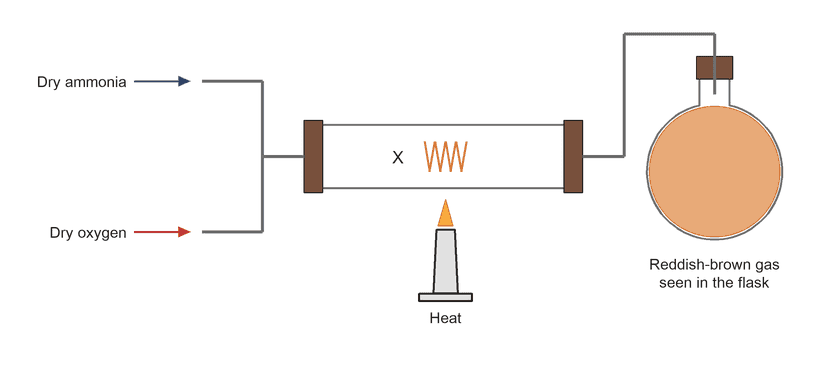
(i) Name the metal X and state its function.
(ii) Write the balanced equation for the reaction which takes place over X.
(iii) Explain, with an equation, how the reddish-brown gas is formed in the flask. State why the coil X continues to glow even after the burner is removed.
- 433 marks
Question 43
Aqueous ammonia is prepared by dissolving ammonia gas in water, using an inverted funnel joined to the delivery tube.
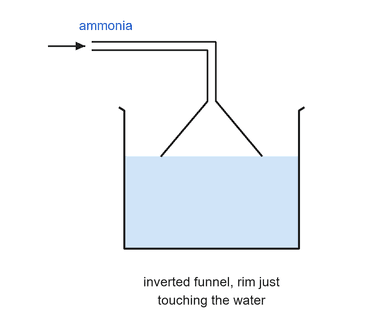
(i) Write the equation for the reaction of ammonia with water and name the product.
(ii) A few drops of phenolphthalein are added to the solution. State the colour produced and name the ion responsible for it.
(iii) Explain why the rim of the funnel is made to just touch the surface of the water and is not dipped deep into it.