
Question 485 marksMedium
Distinguish between the following (using ammonia solution) :
(a) Calcium chloride and zinc chloride,
(b) Ferric salt and ferrous salt,
(c) Zinc nitrate and lead nitrate.
Confirming your payment
Sign up now and get 250 free tokens.
Study of Compounds – Ammonia · Question 48 of 67
Distinguish between the following (using ammonia solution) :
(a) Calcium chloride and zinc chloride,
(b) Ferric salt and ferrous salt,
(c) Zinc nitrate and lead nitrate.
Solution:
Concept: Ammonium hydroxide gives hydroxyl ions, which precipitate the metal hydroxide from a salt solution. The colour of the precipitate, and whether it dissolves in excess, tell us which metal ion is present. Add ammonium hydroxide drop by drop, then in excess. It gives no precipitate with calcium salts, and its precipitate dissolves in excess only with zinc (and copper) salts.
Step 1 — (a) Calcium chloride and zinc chloride.
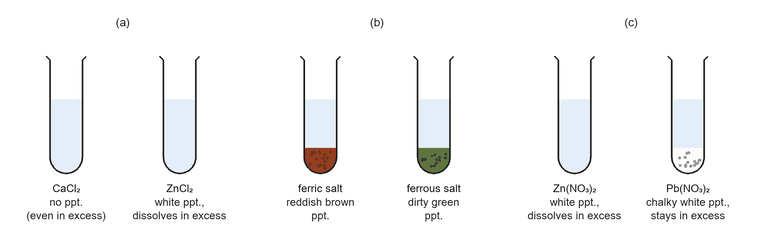
Calcium chloride gives no precipitate, even in excess. Zinc chloride gives a white gelatinous precipitate:
which dissolves in excess ammonium hydroxide:
Step 2 — (b) Ferric salt and ferrous salt.
A ferric salt gives a reddish brown precipitate of iron (III) hydroxide; a ferrous salt gives a dirty green precipitate of iron (II) hydroxide. Both stay in excess:
Step 3 — (c) Zinc nitrate and lead nitrate.
Zinc nitrate gives a white gelatinous precipitate that is soluble in excess (colourless solution). Lead nitrate gives a chalky white precipitate that is insoluble in excess:
Watch out: Calcium hydroxide is fairly soluble, and ammonium hydroxide is too weak an alkali to precipitate it, so there is no precipitate at all.
Therefore, ammonia solution tells the pairs apart: (a) no precipitate against a white one that dissolves; (b) reddish brown against dirty green; (c) white soluble in excess against chalky white insoluble.