Solution:
Concept: For each conversion, choose a known reaction of ammonia (or of a nitride) that gives the named product, then balance it.
Step 1 — (a) Ammonia to nitrogen using an acidic gas.
Chlorine, whose solution is acidic, oxidises excess ammonia to nitrogen:
8NH3+3Cl2→6NH4Cl+N2
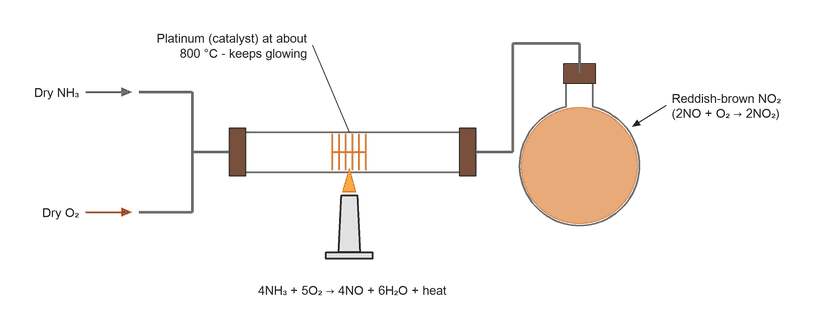
Step 2 — (b) Ammonia to a brown gas.
Catalytic oxidation gives nitric oxide, which air turns into brown nitrogen dioxide:
4NH3+5O2Pt, 800 °C4NO+6H2O+heat
2NO+O2→2NO2
Step 3 — (c) Ammonia to nitrogen trichloride.
Excess chlorine removes all the hydrogen of ammonia:
NH3+3Cl2→NCl3+3HCl
Step 4 — (d) Ammonia solution to an amphoteric hydroxide.
Zinc hydroxide is amphoteric; ammonium hydroxide precipitates it from zinc sulphate:
ZnSO4+2NH4OH→Zn(OH)2↓+(NH4)2SO4
Step 5 — (e) A nitride of a trivalent metal to ammonia.
Aluminium (valency 3) nitride is hydrolysed by water:
AlN+3H2O→Al(OH)3+NH3↑
Step 6 — (f) Lead oxide to lead.
Ammonia reduces heated lead monoxide:
2NH3+3PbOΔ3Pb+3H2O+N2↑
Watch out: Add only a little ammonium hydroxide in (d): in excess, zinc hydroxide dissolves again.
Therefore, the six conversions are made by the balanced equations above.
