
Question 161 markMCQEasy
The gas collected by downward displacement of air is :
Confirming your payment
Sign up now and get 250 free tokens.
Study of Compounds – Ammonia · Question 16 of 67
The gas collected by downward displacement of air is :
(A) HCl
(B)
(C)
(D)
Answer: (B)
Concept: A gas lighter than air is collected by downward displacement of air: the jar is held mouth downwards and the gas pushes the air out at the bottom. The vapour density (V.D.) of a gas tells how heavy it is compared with hydrogen: V.D. = relative molecular mass ÷ 2. Air behaves like a gas of V.D. about 14.4. A gas with V.D. below 14.4 is lighter than air; above 14.4, heavier.
Step 1 — Find the vapour density of ammonia.
The relative molecular mass of ammonia is 14 + 3 = 17, so
\begin{aligned} \text{V.D. of NH_{3}} &= \dfrac{17}{2} \\ &= 8.5 \end{aligned}This is less than 14.4, so ammonia is lighter than air.
Step 2 — Compare the other gases.
Hydrogen chloride (18.25), carbon dioxide (22) and hydrogen sulphide (17) all have vapour densities above 14.4, so they are heavier than air.
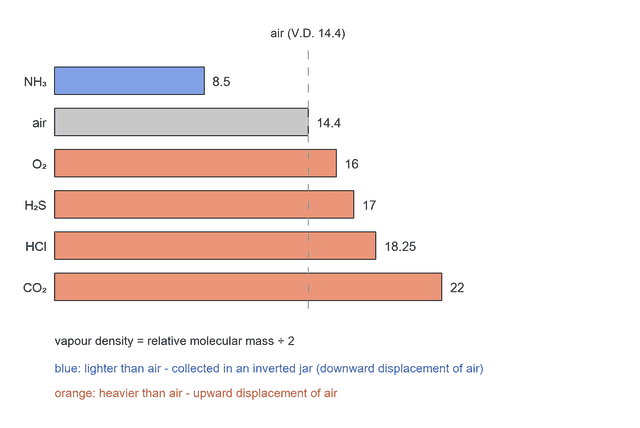
Watch out: 'downward displacement of air' means the AIR is pushed down and out; it is used for light gases, with the jar upside down.
Why the other options are wrong:
Therefore, the gas collected by downward displacement of air is ammonia, option (B).