Answer: (A) (1)
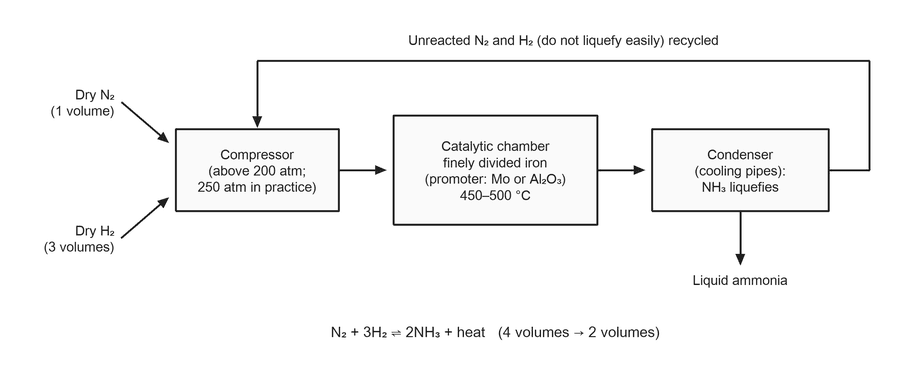
Concept: In an assertion-reason question, first judge the Assertion (A) true or false, then the Reason (R), and only if both are true decide whether R correctly explains A. The codes are: (1) both true and R explains A; (2) both true but R does not explain A; (3) A true, R false; (4) A false, R true. The gas leaving the catalytic chamber holds only about 15% ammonia, and it must be separated from the unreacted nitrogen and hydrogen.
Step 1 — Judge the assertion.
The gas mixture is cooled in the condenser, where ammonia liquefies and is drawn off. A is true.
Step 2 — Judge the reason.
Nitrogen and hydrogen liquefy only with great difficulty, while ammonia liquefies easily on cooling. R is true.
Step 3 — Decide whether R explains A.
Cooling separates ammonia because it alone liquefies, while the other two stay as gases and are recycled. So R explains A.
Why the other options are wrong:
- (B) (2): code (2) says R does not explain A, but the difference in liquefaction is exactly how ammonia is separated.
- (C) (3): code (3) says R is false, but R is true.
- (D) (4): code (4) says A is false, but A is true.
Therefore, both statements are true and R explains A, so the answer is code (1), option (A).
