Name : (a) the gas which is prepared by Haber's Process, (b) two gases which give dense white fumes with ammonia, (c)…
Question 285 marksMedium
Name :
(a) the gas which is prepared by Haber's Process,
(b) two gases which give dense white fumes with ammonia,
(c) one salt of ammonia in each case which is used in : (i) dry cell (ii) explosives (iii) medicine,
(d) an acidic gas which reacts with a basic gas liberating a neutral gas,
(e) a metallic chloride soluble in ammonium hydroxide,
(f) the gas obtained when ammonia burns in an atmosphere of oxygen without any catalyst,
(g) a nitride of a divalent metal which reacts with warm water liberating ammonia,
(h) an amphoteric oxide reduced by the basic gas,
(i) a white salt produced by an acidic gas and a basic gas.
(j) The gas that burns in oxygen with a green flame.
(k) The gas produced when excess ammonia reacts with chlorine.
(l) The white crystalline solid that is soluble in water which liberates a pungent smelling gas when heated with sodium hydroxide solution.
(m) An alkaline gas which produces dense white fumes when reacted with HCl gas.
Solution:
Concept: Every answer comes from the preparation, reactions and uses of ammonia. Ammonia is the common basic gas, it is a reducing agent, and its salts are used in dry cells, explosives and medicine.
Step 1 — (a) The gas made by Haber's process.
Nitrogen and hydrogen combine to give ammonia:
N2+3H2⇌2NH3+heat
Step 2 — (b) Two gases giving dense white fumes with ammonia.
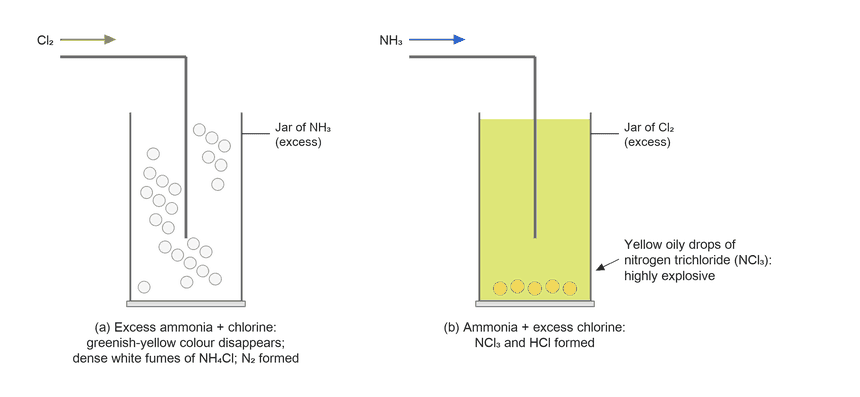
Hydrogen chloride gives white fumes of ammonium chloride directly, and chlorine gives them when ammonia is in excess:
NH3+HCl→NH4Cl
Step 3 — (c) Ammonium salts and their uses.
(i) dry cell: ammonium chloride; (ii) explosives: ammonium nitrate; (iii) medicine: ammonium carbonate (smelling salts, used to revive a person who has fainted).
Step 4 — (d) An acidic gas that sets free a neutral gas.
Chlorine (its solution is acidic) reacts with ammonia, the basic gas, and sets free nitrogen, a neutral gas:
8NH3+3Cl2→6NH4Cl+N2
Step 5 — (e) A metal chloride soluble in ammonium hydroxide.
Silver chloride dissolves in ammonium hydroxide, forming a soluble ammine complex.
Step 6 — (f) The gas from burning ammonia in oxygen.
Without a catalyst, ammonia burns to give nitrogen (and water vapour):
4NH3+3O2→2N2+6H2O
Step 7 — (g) A nitride of a divalent metal.
Magnesium nitride, Mg3N2 (magnesium has valency 2), gives ammonia with warm water:
Mg3N2+6H2O→3Mg(OH)2+2NH3↑
Step 8 — (h) An amphoteric oxide reduced by the basic gas.
Lead (II) oxide, PbO, is amphoteric. Ammonia reduces the yellow oxide to greyish lead:
2NH3+3PbOΔ3Pb+3H2O+N2↑
Step 9 — (i) A white salt from an acidic gas and a basic gas.
Ammonium chloride forms from hydrogen chloride (acidic) and ammonia (basic).
Step 10 — (j) The gas that burns in oxygen with a green flame.
Ammonia burns in oxygen with a greenish yellow flame.
Step 11 — (k) The gas from excess ammonia and chlorine.
Nitrogen is set free (with white fumes of ammonium chloride), as in the equation in (d).
Step 12 — (l) The white crystalline solid.
Ammonium chloride is a white, water-soluble solid that gives pungent ammonia when warmed with sodium hydroxide:
NH4Cl+NaOHΔNaCl+H2O+NH3↑
Step 13 — (m) An alkaline gas that fumes with HCl.
Ammonia gives dense white fumes of ammonium chloride with hydrogen chloride gas.
Watch out: In (d) and (k) the product with chlorine depends on which gas is in excess: excess ammonia gives N₂ and NH₄Cl; excess chlorine gives NCl₃.
Therefore, the answers are (a) ammonia, (b) HCl and Cl₂, (c) NH₄Cl, NH₄NO₃, (NH₄)₂CO₃, (d) chlorine, (e) silver chloride, (f) nitrogen, (g) Mg₃N₂, (h) PbO, (i) NH₄Cl, (j) ammonia, (k) nitrogen, (l) NH₄Cl and (m) ammonia.