
Opening your dashboard
Class 10 Chemistry Chapter 9 Study of Compounds – Ammonia: Competency-Based Questions (CBQ)
40 questions on Chapter 9, each worked through on its own page with the AI tutor. Class 10 Chemistry, ICSE 2026-27.
40 questions
1–5 marks · Mixed difficulty
- 11 mark
Question 1
Cognitive domain: Understanding · CISCE Competency-Focused Practice Questions 2024, Q3
Prateek added warm water to magnesium nitride, and a colourless gas evolved, which, when tested with phenolphthalein, turned it pink. The gas evolved is:
- 21 mark
Question 2
Cognitive domain: Analysis · CISCE Competency-Focused Practice Questions 2024, Q34
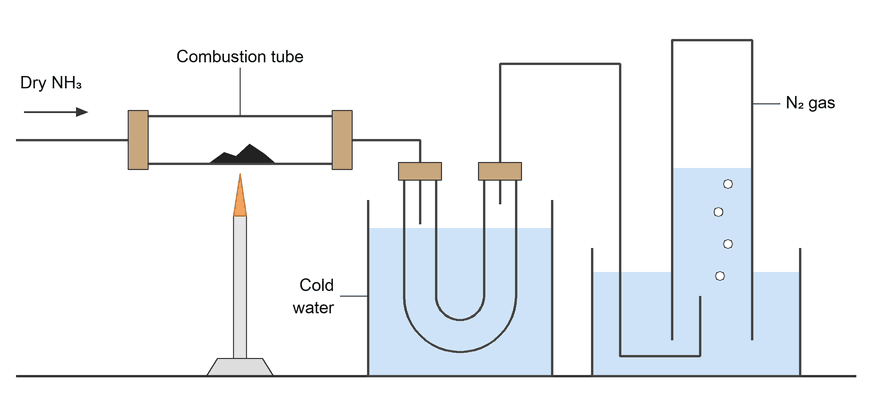
Study the above diagram and choose the correct option related to the content given below:
Compound X reacts with ammonia in the combustion tube, which leaves a residue Y. Identify X and Y, as well as the property Z of ammonia demonstrated in this particular reaction.
- 31 mark
Question 3
Cognitive domain: Understanding & Application · CISCE Competency-Focused Practice Questions 2024, Q39
Fill in the blanks by choosing the correct options given in the brackets:
An aqueous solution of gas X turns red litmus blue, so it must contain (i) ________ (hydrogen / hydroxyl) ions. When this solution is added in excess to copper sulphate solution, it turns to (ii) ________ (deep blue / pale blue) solution. Gas X is also a good (iii) ________ (oxidising / reducing) agent, which in excess reacts with a greenish-yellow gas to form dense white fumes of (iv) ________ (hydrogen chloride / ammonium chloride).
- 41 mark
Question 4
Cognitive domain: Understanding · CISCE Competency-Focused Practice Questions 2024, Q40
Ammonia can convert heated copper oxide to copper. This shows that ammonia is a ________ (reducing agent / oxidising agent).
- 55 marks
Question 5
Cognitive domain: Recall & Application · CISCE Competency-Focused Practice Questions 2024, Q56
Match the given processes in column A with the corresponding product formation steps in column B.
Column A Column B (a) Haber's process (i) Dissolution of the gas in water (b) Ostwald process (ii) Condensation of the gas (c) Hall-Héroult's process (iii) Coating of metal on cathode (d) Contact process (iv) Molten metal collected from cathode (e) Electroplating (v) Dissolution of the gas in a non-aqueous solvent - 62 marks
Question 6
Cognitive domain: Understanding · CISCE Competency-Focused Practice Questions 2024, Q92
Ammonia gas is passed into water as shown below:
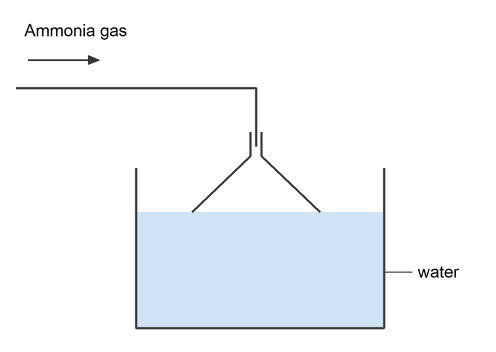
(a) When a red litmus paper was dropped into the resulting solution, it turned blue. Which ions in the solution would have resulted for the colour change in the litmus paper?
(b) Why is the funnel kept in an inverted position?
- 72 marks
Question 7
Cognitive domain: Application · CISCE Competency-Focused Practice Questions 2024, Q93
In the Haber's process, the optimum yield of ammonia is obtained when a temperature of 450 °C – 500 °C, a pressure of 200 atmospheres, an iron catalyst and promoter molybdenum are used.
How and why would the yield of ammonia be affected if the temperature was raised to 600 °C?
- 82 marks
Question 8
Cognitive domain: Recall & Understanding · CISCE Competency-Focused Practice Questions 2024, Q97
Platinum catalyst is used in the catalytic oxidation of ammonia.
(a) Write an equation for the reaction that occurs in the above case.
(b) Why does the platinum continue to glow even after the heating is discontinued?
- 93 marks
Question 9
Cognitive domain: Understanding · CISCE Competency-Focused Practice Questions 2024, Q109
Write complete and balanced equations for the reactions occurring in the following cases:
(a) Passing dry ammonia gas over heated lead oxide placed in a combustion tube to produce a silvery grey metal.
(b) When concentrated nitric acid is reacted with zinc to produce a reddish-brown gas.
(c) When concentrated sulphuric acid oxidises sulphur to produce a gas which turns acidified potassium dichromate paper green.
- 103 marks
Question 10
Cognitive domain: Understanding & Application · CISCE Competency-Focused Practice Questions 2024, Q121
When two dry gases, oxygen and X, are passed over heated platinum, reddish-brown fumes are seen in the receiving flask, as shown in the figure.
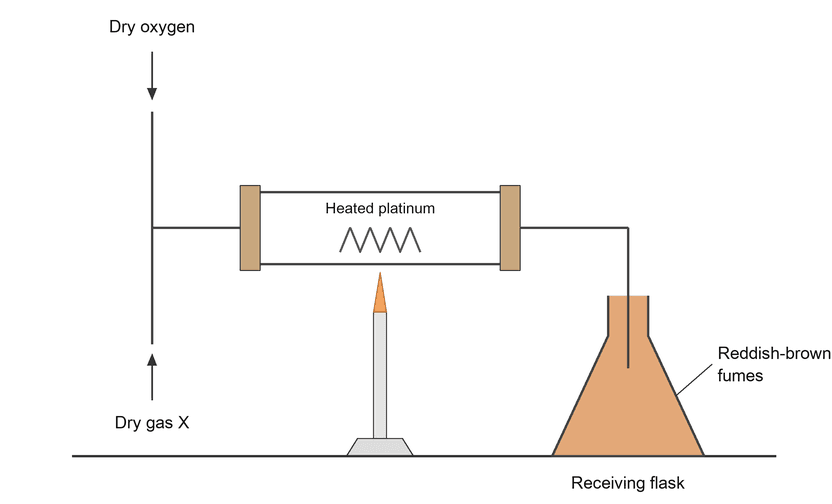
(a) Name the gas X.
(b) Give equation(s) for the reaction(s) that resulted in the formation of brown fumes.
- 111 mark
Question 11
Cognitive domain: Application
Kavya keeps goldfish at home. Her water-testing kit has a dropper bottle labelled Nessler's solution (a slightly alkaline solution of potassium mercuric iodide, ). She adds a few drops of it to three samples of water.
Sample Where the water came from After adding Nessler's solution P boiled and cooled drinking water stays colourless Q tank water that was changed this morning stays colourless R tank water left unchanged for three weeks, with uneaten food rotting at the bottom turns brown What does the result for sample R show?
- 121 mark
Question 12
Cognitive domain: Understanding
Assertion (A): A bottle of liquor ammonia fortis is cooled in ice or cold water before its stopper is taken out.
Reason (R): Cooling makes ammonia much less soluble in water, so most of the gas leaves the solution before the bottle is opened.
- 131 mark
Question 13
Cognitive domain: Analysis
Assertion (A): A glass rod dipped in concentrated hydrochloric acid gives dense white fumes when it is held at the mouth of a jar of ammonia.
Reason (R): One volume of water can dissolve about 702 volumes of ammonia at 20 °C.
- 142 marks
Question 14
Cognitive domain: Application
Farida's grandmother keeps a small bottle of smelling salts (ammonium carbonate) in her medicine box, to revive a person who feels faint. Ammonium carbonate decomposes slowly, even at room temperature, into ammonia, carbon dioxide and water.
(a) Write the balanced equation for this decomposition.
(b) Farida holds a strip of moist red litmus paper at the mouth of the open bottle. State what she will see, and explain why the bottle must always be kept tightly stoppered.
- 154 marks
Question 15
Cognitive domain: Application
A cold storage for potatoes on the outskirts of a town is cooled by liquid ammonia, which circulates through steel pipes. One night a valve on one of the pipes starts to leak. The watchman notices a sharp, choking smell and his eyes begin to water. The fire brigade sprays a fine curtain of water around the valve, opens the ventilators in the roof and tells the people living nearby to cover their noses with wet cloths. Next morning, the water lying in the drain beside the plant turns red litmus paper blue.
(a) Why were a spray of water and wet cloths useful against the leaking gas?
(b) Why did the firemen open the ventilators in the roof, and not only the doors at ground level?
(c) Explain, with equations, why the water in the drain turned red litmus blue. What colour would this water give with phenolphthalein?
- 165 marks
Question 16
Cognitive domain: Analysis
The soil test of Gurpreet's field shows that the soil is acidic, so he is advised to spread slaked lime on it. To save time, he mixes the slaked lime with a 50 kg bag of ammonium sulphate fertiliser in his trolley the evening before. By the next afternoon, which is hot and humid, the damp heap gives off a sharp, pungent smell that makes his eyes water. The agriculture officer tells him that part of the nitrogen he has paid for is escaping into the air, and that lime and this fertiliser should be applied some weeks apart.
(a) Name the gas escaping from the heap. Describe one chemical test by which Gurpreet's daughter, a Class 10 student, could confirm it.
(b) Write the balanced equation for the reaction taking place in the heap. Which general method of preparing this gas does it resemble?
(c) Assume that the bag contains pure ammonium sulphate. Calculate the mass of nitrogen in the bag, and the mass of the gas lost if one-tenth of the ammonium sulphate reacts. (H = 1, N = 14, O = 16, S = 32)
- 175 marks
Question 17
Cognitive domain: Evaluation
Three groups of a class set up the fountain experiment. Each group uses a round-bottomed flask of ammonia fitted with a jet tube and a dropper full of water, inverted over a trough of red litmus solution.
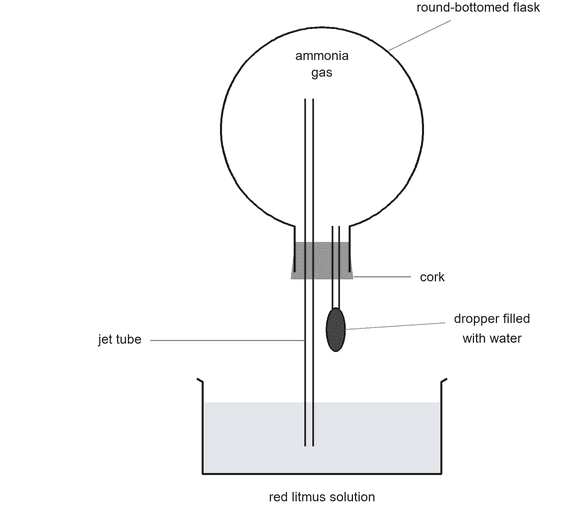
Their notes are given below.
Group How the flask was filled and fitted What happened when the dropper was squeezed 1 Dry flask held with its mouth upwards while ammonia was passed in; stopper fitted tightly Only a few drops of liquid rose into the jet tube 2 Dry flask held with its mouth downwards while ammonia was passed in; stopper fitted loosely A weak fountain started, a hissing sound was heard at the stopper and the fountain stopped in a few seconds 3 Dry flask held with its mouth downwards while ammonia was passed in; stopper fitted tightly A strong blue fountain played until the flask was almost full (a) Explain why Group 1 got almost no fountain.
(b) Explain why the fountain of Group 2 stopped so soon.
(c) Group 3 writes in its report: "The fountain proves that ammonia is alkaline." Evaluate this conclusion.
(d) A small bubble of gas was left at the top of Group 3's flask. Suggest what this gas is, and one change in the method that would make the bubble smaller.
- 181 mark
Question 18
Cognitive domain: Application
Ravi's family keeps cattle. For a science project he fills two open beakers with mL of distilled water each and floats a strip of red litmus paper on the water in each. He keeps one beaker overnight in the closed cattle shed, where dung and urine lie on the floor, and the other in the open garden. Next morning the strip in the shed beaker is blue, and the strip in the garden beaker is still red. (Hypothetical observation.)
What explains the blue colour in the shed beaker?
- 191 mark
Question 19
Cognitive domain: Analysis
Arjun heats a little solid ammonium chloride at the bottom of a dry hard-glass test tube, which is clamped in a slanting position. A strip of damp red litmus paper is held inside the mouth of the tube. He notes three observations.
Observation What he sees 1 The solid disappears from the hot bottom of the tube. 2 A white solid forms on the cooler upper part of the tube. 3 The damp red litmus turns blue first, and after some time it turns red again. (Vapour density of ammonia = ; vapour density of hydrogen chloride = .)
Which explanation fits all three observations?
- 201 mark
Question 20
Cognitive domain: Analysis
A student has four pairs of colourless solutions and only one reagent, dilute ammonium hydroxide, which she adds first a few drops at a time and then in excess. For one pair, the reagent gives the same result with both solutions, so it cannot tell them apart.
For which pair is this true?
- 211 mark
Question 21
Cognitive domain: Analysis
A chemical engineer measures the percentage of ammonia in the gas leaving a converter, in which nitrogen and hydrogen are passed over a catalyst, at different temperatures and at two pressures. (Hypothetical data.)

Which statement about the graph is correct?
- 221 mark
Question 22
Cognitive domain: Understanding
Assertion (A): In Haber's process, using finely divided iron as the catalyst increases the percentage of ammonia in the mixture that finally leaves the converter, at the same temperature and pressure.
Reason (R): A catalyst increases the speed of the forward reaction and the speed of the backward reaction by the same amount.
- 231 mark
Question 23
Cognitive domain: Application
In a demonstration, cm of dry ammonia is burnt completely in a plentiful supply of oxygen. The flame is greenish yellow. All gas volumes are measured at the same temperature and pressure, and the water formed condenses to a liquid.
What volume of oxygen is used and what volume of nitrogen is formed?
- 241 mark
Question 24
Cognitive domain: Evaluation
A farmer wants to buy the cheapest nitrogen for his crop, and he can choose among three fertilisers, each of which is made from ammonia. Each is sold in a kg bag. (Hypothetical prices.) (H = 1, N = 14, O = 16, S = 32, Cl = 35.5)
Fertiliser Formula Price of one bag Ammonium sulphate ₹ Ammonium nitrate ₹ Ammonium chloride ₹ Which statement is correct?
- 251 mark
Question 25
Cognitive domain: Understanding
Assertion (A): In Haber's process the nitrogen and hydrogen that leave the converter unchanged are sent back to it.
Reason (R): Only about of the nitrogen and hydrogen entering the converter is changed into ammonia in one passage over the catalyst.
- 261 mark
Question 26
Cognitive domain: Application
A laboratory technician adds an excess of warm water to g of aluminium nitride. Aluminium hydroxide and ammonia are formed. (N = 14, Al = 27; one mole of a gas occupies dm at S.T.P.)
What volume of ammonia is obtained at S.T.P.?
- 272 marks
Question 27
Cognitive domain: Evaluation
Sanjay's mother keeps a bottle of household ammonia solution, which she uses to clean glass, on a shelf next to the LPG stove. Sanjay says, "Ammonia is a gas that burns, so if the bottle leaks near the flame there will be a big fire."
(a) Evaluate Sanjay's statement.
(b) Under what condition does ammonia burn? State the colour of the flame and write the balanced equation.
- 282 marks
Question 28
Cognitive domain: Analysis
A cylinder with a movable piston holds cm of nitrogen and cm of hydrogen over a catalyst. The temperature and the pressure are kept constant by letting the piston move. After some time, cm of the nitrogen has reacted.
(a) Find the volume of ammonia formed and the total volume of gas in the cylinder now.
(b) The piston moves in. What does this show about the effect of high pressure on the process?
- 292 marks
Question 29
Cognitive domain: Application
Rita finds a bag of white fertiliser labelled ammonium sulphate. She puts a pinch in a test tube, adds sodium hydroxide solution and warms it gently. A damp red litmus strip held at the mouth of the tube turns blue. She says, "This proves that the fertiliser is ammonium sulphate."
(a) Write the balanced equation for the reaction.
(b) State what her test does prove, and name one further test, with its result, that she must do to support her claim.
- 302 marks
Question 30
Cognitive domain: Analysis
A hard-glass tube containing black copper(II) oxide is weighed. Dry ammonia gas is then passed over the heated oxide until the black solid has changed completely to a reddish brown solid. The tube is allowed to cool and weighed again. (Hypothetical data.)
Mass of tube and contents before heating Mass of tube and contents after the reaction g g The steam leaves the tube. Find the mass of ammonia that reacted and the volume of nitrogen formed at S.T.P. (H = 1, N = 14, O = 16; one mole of a gas occupies dm at S.T.P.)
- 312 marks
Question 31
Cognitive domain: Evaluation
The manager of an ammonia plant is told that the iron catalyst has to be replaced. A junior engineer proposes, "Buy the same mass of solid lumps of iron instead of finely divided iron, because it is the same metal and the lumps will last longer and cost less."
(a) Evaluate this proposal, with a reason.
(b) What is added to the iron to make it work better?
- 322 marks
Question 32
Cognitive domain: Understanding
When ammonia gas and hydrogen chloride gas are mixed, dense white fumes of ammonium chloride are formed. Ammonium chloride contains three different kinds of chemical bond.
(a) Name the three kinds of bond and say where each is found in the compound.
(b) Explain how a hydrogen ion becomes joined to a molecule of ammonia.
- 333 marks
Question 33
Cognitive domain: Analysis
A student wants to know how many times the gases must go through the converter to reach the plant's eventual yield of . He builds a simple model. Each time the nitrogen and hydrogen go through the converter, of what enters is converted into ammonia. This ammonia is removed completely, and all the unchanged gas is sent back to the converter. (Hypothetical model.)
(a) What percentage of the original nitrogen and hydrogen is still unchanged after , and passes?
(b) What is the smallest number of passes for which at least has been converted?
(c) Why is it better to recycle the unchanged gases than to run a single pass and throw the gases away?
- 343 marks
Question 34
Cognitive domain: Analysis
Meena sets up the reduction of black copper(II) oxide by ammonia. She is told to use dry ammonia, so she passes the gas from the generator through a wash-bottle of concentrated sulphuric acid before it goes to the heated hard-glass tube. After heating for ten minutes, the black solid is unchanged and no water drops appear at the cool end of the tube. She concludes, "Ammonia cannot reduce copper(II) oxide."
(a) Why does the black solid not change?
(b) Write the equation for the reaction in the wash-bottle.
(c) Name a correct drying agent and state what Meena would then see in the tube.
- 353 marks
Question 35
Cognitive domain: Application
A school wants to prepare dm of dry ammonia, measured at S.T.P., by heating ammonium sulphate with slaked lime. (H = 1, N = 14, O = 16, S = 32, Ca = 40; one mole of a gas occupies dm at S.T.P.)
(a) Write the balanced equation for the reaction.
(b) Calculate the mass of ammonium sulphate needed.
(c) Calculate the mass of slaked lime that reacts with it.
- 363 marks
Question 36
Cognitive domain: Application
At a plant, an operator sets the valves wrongly, and a mixture of m of nitrogen and m of hydrogen enters the converter instead of the mixture in the ratio . Assume that the reaction goes to completion and that all gas volumes are measured at the same temperature and pressure.
(a) Which gas is used up completely?
(b) What is the greatest volume of ammonia that can be formed?
(c) What volume of which gas is left over?
- 373 marks
Question 37
Cognitive domain: Evaluation
Three students make statements about aqueous ammonia (ammonium hydroxide solution).
Student 1: "Aqueous ammonia is as strong an alkali as sodium hydroxide solution of the same concentration."
Student 2: "If a pink solution of aqueous ammonia and phenolphthalein is boiled for several minutes, it stays pink, because the alkali does not evaporate."
Student 3: "Aqueous ammonia turns red litmus blue because it contains hydroxide ions."
Say whether each statement is correct, and give a reason in each case.
- 385 marks
Question 38
Cognitive domain: Application
A fertiliser plant in Gujarat makes ammonia by Haber's process. The nitrogen comes from the air, and the hydrogen is obtained from natural gas. On one day, the control room records the quantities in the table. (Hypothetical data.)
Quantity recorded for the day Mass Liquid ammonia sent to storage tonnes Nitrogen fed to the plant tonnes Hydrogen fed to the plant tonnes The plant manager says that, with the recycling of unchanged gases, the eventual yield is , which means that of the nitrogen and hydrogen fed is converted into ammonia. (H = 1, N = 14)
(a) Write the balanced equation for the process, with the conditions, and give the mass ratio of nitrogen, hydrogen and ammonia in it.
(b) Calculate the mass of nitrogen and the mass of hydrogen that are needed to make tonnes of ammonia if the yield were .
(c) Is the feed of the day enough for tonnes of ammonia at a yield of ? Show your working.
- 394 marks
Question 39
Cognitive domain: Analysis
A teacher wants ammonia gas from a bottle of concentrated aqueous ammonia, and she knows that ammonia is very soluble in water. The graph shows the mass of ammonia that dissolves in g of water at atm, at different temperatures. (Hypothetical data.)

(a) What does the graph show about the effect of temperature on the solubility of ammonia?
(b) How can this be used to obtain ammonia gas from the bottle? A student says that a solution saturated with ammonia at will give off ammonia gas if it is cooled to . Is he right? Use the graph to give a reason.
(c) g of water is saturated with ammonia at . It is then heated to . Find the mass of ammonia that escapes.
- 404 marks
Question 40
Cognitive domain: Creativity
The science club of a school looks after a small pond in the school garden. Fertiliser from the nearby field often runs into it. To judge how much ammonium is in the water, the club adds a few drops of Nessler's solution to mL samples, and compares the colour with a chart that the club made from standard solutions. (Hypothetical data.)
Standard solution Ammonium ions in litre of water Colour with Nessler's solution 1 mg pale yellow 2 mg yellow 3 mg orange-brown 4 mg deep brown The pond sample gives a colour that is between standards 3 and 4. A sample of boiled and cooled tap water, used as a comparison, stays colourless.
(a) What is Nessler's solution used to detect, and what does a brown colour show?
(b) Between which two amounts is the ammonium content of the pond sample, and why was the tap water sample used?
(c) A sample taken where the drain from the field enters the pond gives a colour deeper than standard 4, so it cannot be read from the chart. Design a way for the club to estimate its ammonium content with the same chart. If the club's diluted sample matches standard 3, calculate the ammonium content of the drain sample.