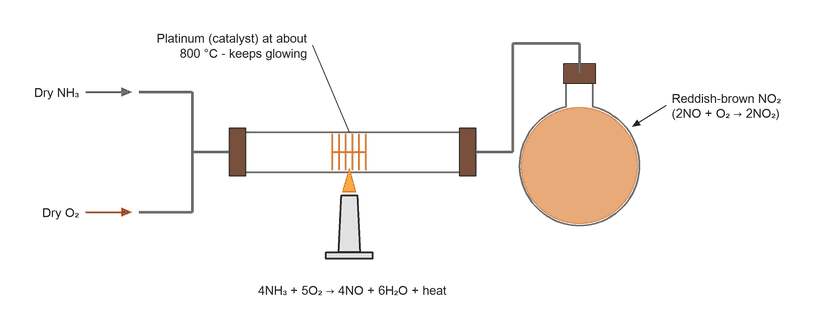
A gas 'A' reacts with another gas 'B' in the presence of a catalyst to give a colourless gas 'C'.
Question 583 marksMedium
A gas 'A' reacts with another gas 'B' in the presence of a catalyst to give a colourless gas 'C'. The gas 'C' when comes in contact with air produces a brown gas 'D'. The solution of 'A' in water turns red litmus blue. Explain the observations.
Solution:
Concept: A basic gas oxidised over a catalyst to a colourless gas that turns brown in air is the catalytic oxidation of ammonia (Ostwald process).
Step 1 — Identify gas A.
The solution of A turns red litmus blue, so A is a basic gas: A = ammonia. Its solution contains hydroxyl ions:
NH3+H2O⇌NH4++OH−
Step 2 — Identify gases B and C.
B = oxygen. Over platinum at about 800 °C, ammonia is oxidised to C = nitric oxide (NO), a colourless gas:
4NH3+5O2Pt, 800 °C4NO+6H2O+heat
Step 3 — Identify gas D.
Nitric oxide combines with the oxygen of the air to form D = nitrogen dioxide, a reddish brown gas:
2NO+O2→2NO2
Watch out: Nitric oxide (NO) is colourless; only nitrogen dioxide (NO₂) is brown.
Therefore, A is ammonia, B is oxygen, C is nitric oxide and D is nitrogen dioxide.