
Question 615 marksEasy
(a) Of the two gases, ammonia and hydrogen chloride, which is more dense ? Name the method of collection of this gas.
(b) Give one example of a reaction between the above two gases which produces a solid compound.
Confirming your payment
Sign up now and get 250 free tokens.
Study of Compounds – Ammonia · Question 61 of 67
(a) Of the two gases, ammonia and hydrogen chloride, which is more dense ? Name the method of collection of this gas.
(b) Give one example of a reaction between the above two gases which produces a solid compound.
Solution:
Concept: The vapour density (V.D.) of a gas tells how heavy it is compared with hydrogen: V.D. = relative molecular mass ÷ 2. Air behaves like a gas of V.D. about 14.4. A gas with V.D. below 14.4 is lighter than air; above 14.4, heavier. A gas heavier than air is collected in an upright jar (upward displacement of air).
Step 1 — (a) Find both vapour densities.
The relative molecular masses are 17 for ammonia and 1 + 35.5 = 36.5 for hydrogen chloride, so
Step 2 — (a) Compare and choose the method.
18.25 > 8.5, so hydrogen chloride is more dense. It is also heavier than air (14.4), so it is collected by upward displacement of air in upright gas jars.
Step 3 — (b) React the two gases.
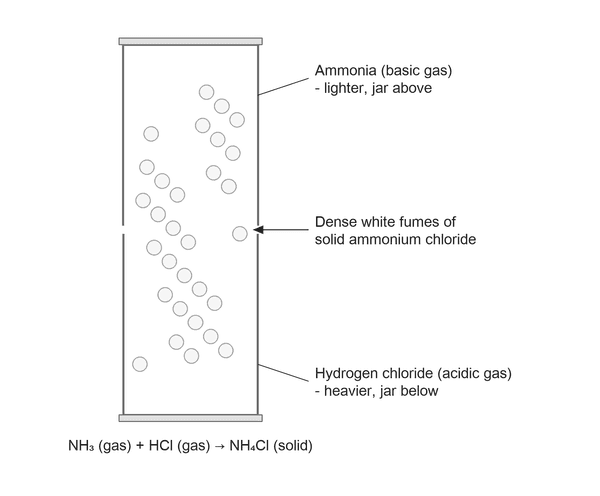
The two colourless gases combine directly to form solid ammonium chloride, seen as dense white fumes:
Watch out: Upward displacement of air is for heavy gases (jar upright); downward displacement of air is for light gases (jar inverted).
Therefore, hydrogen chloride is more dense and is collected by upward displacement of air, and NH₃ + HCl → NH₄Cl gives a solid.