
Opening your dashboard
Class 10 Chemistry Chapter 13: Practical Work Solutions
41 textbook questions with step-by-step answers, free to read, for ICSE 2026-27.
Get talked through Ch 13, not just shown the answer
Reading a finished solution is not the same as being able to do it. The AI tutor takes one question at a time and works it with you, in your own words, until you can.
- Ask it out loud, in your own words
- It gives you the next step, not the answer
- Stuck on part (ii)? Start there
41 questions with solutions
1–5 marks · Mixed difficulty
- 15 marks
Question 1
(a) Give only one suitable chemical test to identify the following gases.
(i) Ammonia (ii) Sulphur dioxide (iii) Hydrogen chloride (iv) Chlorine (v) Carbon dioxide (vi) Oxygen (vii) Hydrogen
(b) Select a basic gas mentioned in Q.1 (a). How is the basic nature suspected ?
(c) Select acidic gases from the gases mentioned in Q.1(a). How is the acidic nature suspected?
(d) The two gases A and B are bleaching agents. A is greenish yellow and bleaches due to its oxidising property while B a colourless gas bleaches due to reduction. Identify A and B.
(e) Which gas turns blue cobalt chloride paper light pink ?
(f) Give one similarity in test between (i) and HCl (ii) and .
Solve with AIWritten solution
Solution:
Concept: Each common laboratory gas is confirmed by one observation that no other common gas gives. A colour or a smell only makes us suspect a gas; a chemical test confirms it. Litmus tells us whether a gas is acidic or basic.
Step 1 — (a) (i) Ammonia.
We bring a glass rod dipped in concentrated hydrochloric acid near the gas. Dense white fumes of ammonium chloride form, because the two gases combine directly:
Step 2 — (a) (ii) Sulphur dioxide.
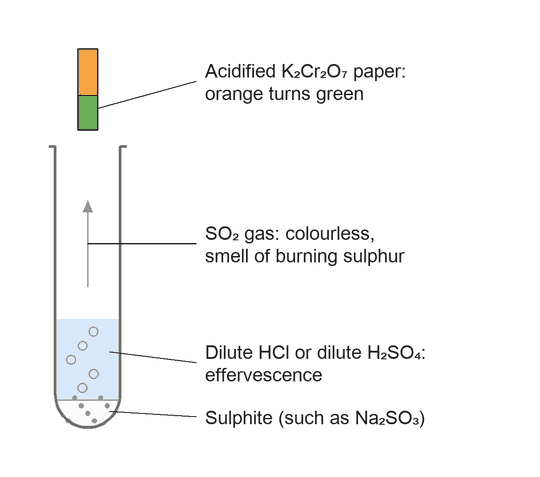
We pass the gas through acidified potassium dichromate () solution, or hold a filter paper soaked in it in the gas. The solution turns from orange to green. Sulphur dioxide is a reducing agent: it reduces orange dichromate to green chromium (III) sulphate:
Step 3 — (a) (iii) Hydrogen chloride.
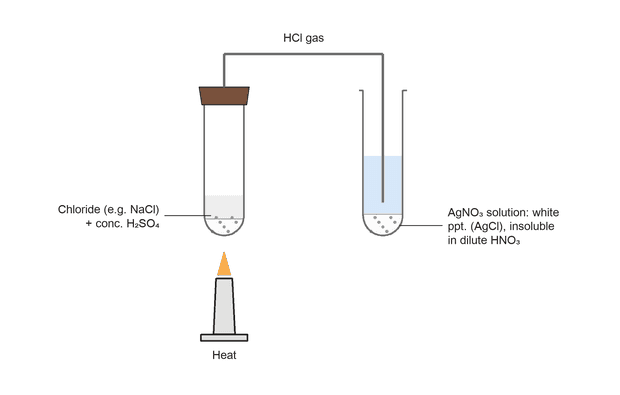
We pass the gas into silver nitrate solution. A curdy white precipitate of silver chloride forms; it does not dissolve in dilute nitric acid but dissolves in ammonium hydroxide:
Step 4 — (a) (iv) Chlorine.
We hold moist starch iodide paper in the gas. The paper turns blue-black, because chlorine sets free iodine from potassium iodide, and iodine turns starch blue-black:
Step 5 — (a) (v) Carbon dioxide.
We pass the gas through lime water. The lime water turns milky, because insoluble white calcium carbonate forms:
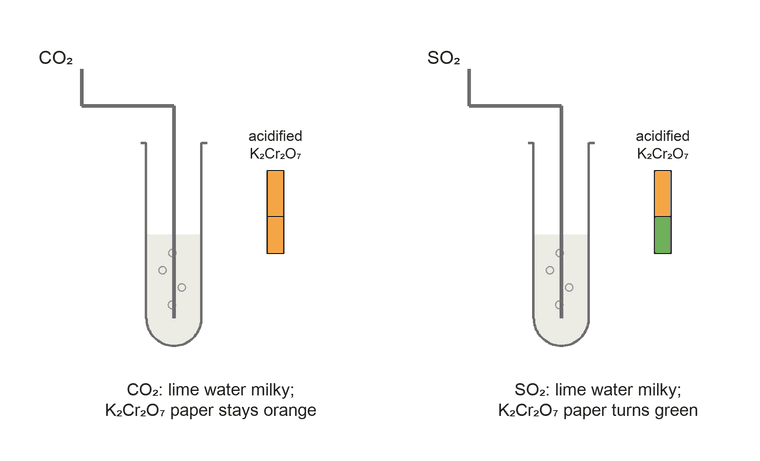
Sulphur dioxide also turns lime water milky, so we also check that the gas leaves acidified potassium dichromate () orange.
Step 6 — (a) (vi) Oxygen.
We put a glowing splinter into the gas. The splinter rekindles (bursts into flame), because oxygen supports combustion.
Step 7 — (a) (vii) Hydrogen.
We bring a burning splinter to the mouth of the test tube. The gas burns with a pop sound, because a mixture of hydrogen and air burns rapidly.

Step 8 — (b) The basic gas.
Of the seven gases, only ammonia is basic. We suspect its basic nature when it turns moist red litmus paper blue: it dissolves in the water on the paper to form the alkali ammonium hydroxide:
Step 9 — (c) The acidic gases.
Sulphur dioxide, hydrogen chloride, chlorine and carbon dioxide are acidic. We suspect their acidic nature when they turn moist blue litmus paper red, because they dissolve in water to form acids (sulphurous acid, hydrochloric acid and carbonic acid; chlorine gives hydrochloric and hypochlorous acids). Chlorine then goes on to bleach the paper. Oxygen and hydrogen are neutral and leave litmus unchanged.
Step 10 — (d) The two bleaching gases.
The greenish yellow gas that bleaches by oxidation is A = chlorine: with water it gives nascent oxygen, which oxidises the dye. The colourless gas that bleaches by reduction is B = sulphur dioxide: with water it gives nascent hydrogen, which reduces the dye.
Step 11 — (e) Cobalt chloride paper.
Blue cobalt chloride paper is anhydrous cobalt chloride. Water vapour turns it pink, because the paper takes up water and forms the pink hydrated salt .
Step 12 — (f) Similarities in tests.
(i) Chlorine and hydrogen chloride both turn moist blue litmus paper red, since both form acids with water. (Both also give a white precipitate with silver nitrate solution.)
(ii) Sulphur dioxide and carbon dioxide both turn lime water milky, forming insoluble calcium sulphite and calcium carbonate:
Watch out: Lime water alone cannot confirm carbon dioxide, because sulphur dioxide also turns it milky; and chlorine turns blue litmus red only for a moment before bleaching it white.
Therefore, (a) NH₃: dense white fumes with conc. HCl; SO₂: acidified K₂Cr₂O₇ orange → green; HCl: white ppt with AgNO₃; Cl₂: moist starch iodide paper blue-black; CO₂: lime water milky; O₂: rekindles a glowing splinter; H₂: burns with a pop; (b) ammonia (red litmus → blue); (c) SO₂, HCl, Cl₂, CO₂ (blue litmus → red); (d) A = chlorine, B = sulphur dioxide; (e) water vapour; (f) (i) both turn moist blue litmus red, (ii) both turn lime water milky.
- 24 marks
Question 2
Name the gases which
(a) extinguishes burning wooden splinter.
(b) turns moist red litmus blue.
(c) do no effect on moist litmus.
(d) affect the acidified paper and also turns lime water dirty milky.
Solve with AIWritten solution
Solution:
Concept: Three simple tests sort the common gases: whether the gas supports burning, what it does to moist litmus, and whether it reduces acidified potassium dichromate ().
Step 1 — (a) Gases that put out a burning splinter.
A gas that does not support combustion puts out a burning wooden splinter. These are , HCl, , , , and . Hydrogen sulphide itself burns at the mouth of the jar, but a splinter pushed into the gas still goes out. Oxygen is the opposite case: it rekindles a glowing splinter.
Step 2 — (b) The gas that turns moist red litmus blue.
Only a basic gas does this. Ammonia is the only common basic gas; it dissolves in the water on the paper to form ammonium hydroxide, an alkali.
Step 3 — (c) Gases with no effect on moist litmus.
A neutral gas forms neither an acid nor an alkali with water, so red and blue litmus both stay unchanged. Examples are hydrogen and oxygen (nitrogen and carbon monoxide are also neutral).
Step 4 — (d) The gas that affects acidified K₂Cr₂O₇ paper and turns lime water milky.
This is sulphur dioxide. It is a reducing agent, so it turns acidified potassium dichromate () paper from orange to green, and it also turns lime water milky:
Carbon dioxide also turns lime water milky but leaves the dichromate orange, so the dichromate test is what picks out .
Watch out: A gas that does not support burning may still burn itself (hydrogen sulphide); 'extinguishes a splinter' only means it does not let the wood go on burning inside it.
Therefore, (a) NH₃, HCl, SO₂, H₂S, CO₂, NO₂ and Cl₂; (b) ammonia; (c) hydrogen and oxygen; (d) sulphur dioxide.
- 35 marks
Question 3
Name :
(a) Two carbonates which do not produce carbon dioxide on heating.
(b) A colourless gas which bleaches
(c) Gases which have sour taste
(d) Greenish yellow gas which also bleaches
(e) Gas with rotten egg smell.
Solve with AIWritten solution
Solution:
Concept: Carbonates of the most reactive metals (sodium, potassium) are stable to heat, while most other carbonates break up into the metal oxide and carbon dioxide. Gases can also be recognised by colour and smell.
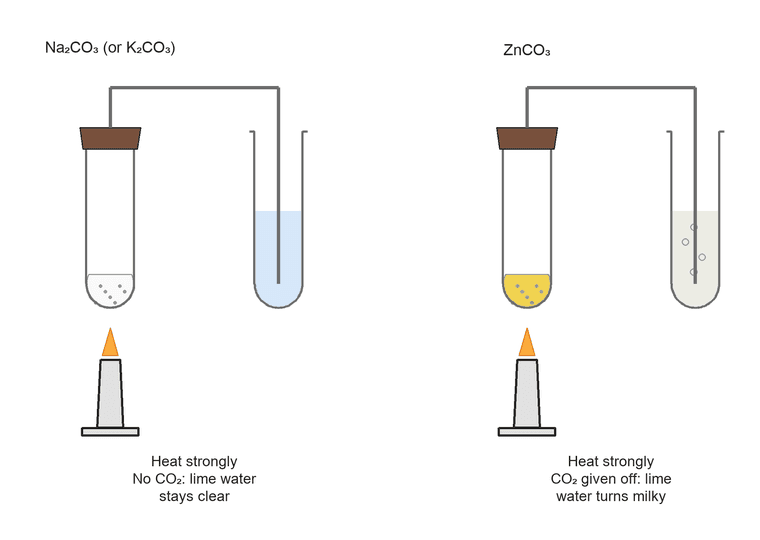
Step 1 — (a) Carbonates that give no CO₂ on heating.
Sodium carbonate and potassium carbonate do not decompose on heating with a burner. In contrast, a carbonate such as zinc carbonate breaks up:
Step 2 — (b) A colourless gas which bleaches.
Sulphur dioxide is colourless, and it bleaches moist coloured matter by reduction.
Step 3 — (c) Gases with a sour taste.
Acidic gases such as carbon dioxide and sulphur dioxide (and hydrogen chloride) dissolve in water to form acids, and acids taste sour.
Step 4 — (d) A greenish yellow gas which also bleaches.
Chlorine is greenish yellow, and it bleaches moist coloured matter by oxidation.
Step 5 — (e) The gas with a rotten egg smell.
Hydrogen sulphide, , smells of rotten eggs. It is confirmed by turning moist lead acetate paper black.
Watch out: Never taste or deeply sniff a gas in the laboratory; 'sour taste' is a property quoted from the book, and a gas is smelled only by wafting a little towards the nose.
Therefore, (a) sodium carbonate and potassium carbonate; (b) sulphur dioxide; (c) carbon dioxide and sulphur dioxide; (d) chlorine; (e) hydrogen sulphide.
- 41 mark
Question 4
Carbon dioxide and sulphur dioxide gas can be distinguished by using.
Solve with AIAnswer
(A) moist blue litmus paper
(B) lime water
- Correct
(C) acidified potassium dichromate paper
(D) none of the above.
Answer: (C) acidified potassium dichromate paper
Concept: To tell two gases apart we need a test that only one of them passes. Sulphur dioxide is a reducing agent; carbon dioxide is not.
Step 1 — Test sulphur dioxide.
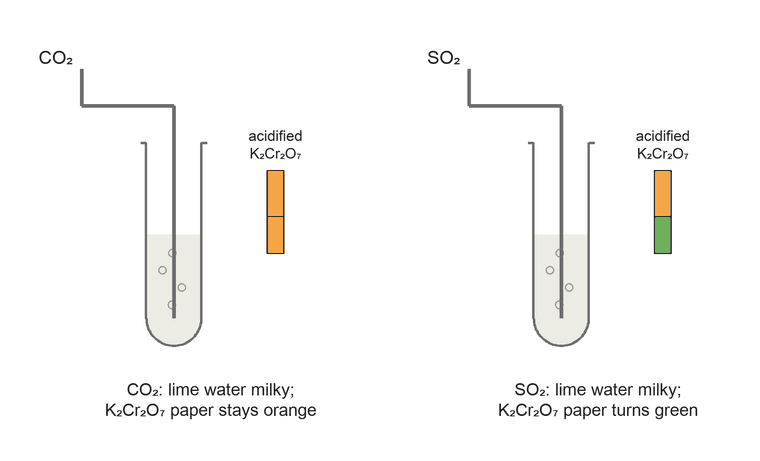
Sulphur dioxide reduces orange acidified potassium dichromate () to green chromium (III) sulphate, so the paper turns orange to green:
Step 2 — Test carbon dioxide.
Carbon dioxide cannot reduce the dichromate, so the paper stays orange. The two gases give different results, so this paper distinguishes them.
Watch out: Lime water is the usual test for carbon dioxide, but it cannot tell CO₂ from SO₂ because both turn it milky.
Why the other options are wrong:
- (A) moist blue litmus paper: both gases are acidic, so both turn moist blue litmus red; the results are the same.
- (B) lime water: both gases turn lime water milky (calcium carbonate and calcium sulphite), so the results are the same.
- (D) none of the above: a suitable reagent does exist (acidified potassium dichromate paper), so 'none of the above' is wrong.
Therefore, CO₂ and SO₂ are distinguished by acidified potassium dichromate paper, option (C).
- 51 mark
Question 5
The salt which in solution gives a pale green precipitate with sodium hydroxide solution and a white precipitate with barium chloride solution is :
Solve with AIAnswer
(A) Iron (III) sulphate
- Correct
(B) Iron (II) sulphate
(C) Iron (II) chloride
(D) Iron (III) chloride
Answer: (B) Iron (II) sulphate
Concept: Read the two clues separately: the precipitate with sodium hydroxide identifies the cation (metal ion), and the precipitate with barium chloride identifies the anion.
Step 1 — Use the sodium hydroxide clue.
A pale (dirty) green precipitate with NaOH is iron (II) hydroxide, so the salt contains :
Step 2 — Use the barium chloride clue.
A white precipitate with barium chloride is barium sulphate, so the salt contains :

Step 3 — Put the clues together.
The salt contains iron (II) ions and sulphate ions, so it is iron (II) sulphate.
Watch out: Iron (II) gives a dirty green precipitate and iron (III) a reddish brown one; the oxidation state decides the colour.
Why the other options are wrong:
- (A) Iron (III) sulphate: iron (III) sulphate gives a reddish brown precipitate of iron (III) hydroxide with NaOH, not a green one.
- (C) Iron (II) chloride: iron (II) chloride gives the green precipitate but no precipitate with barium chloride, as it has no sulphate ion.
- (D) Iron (III) chloride: iron (III) chloride gives a reddish brown precipitate with NaOH and none with barium chloride.
Therefore, the salt is iron (II) sulphate, option (B).
- 61 mark
Question 6
A compound P is heated in a test tube with sodium hydroxide solution. A red litmus paper held at the mouth of the test tube turns blue. Which of the following could compound P be ?
Solve with AIAnswer
(A) Zinc sulphate
(B) Copper sulphate
(C) Ferrous sulphate
- Correct
(D) Ammonium sulphate
Answer: (D) Ammonium sulphate
Concept: An ammonium salt warmed with an alkali gives ammonia, the only common gas that turns moist red litmus blue. This is the test for the ammonium ion, .
Step 1 — Find the gas.
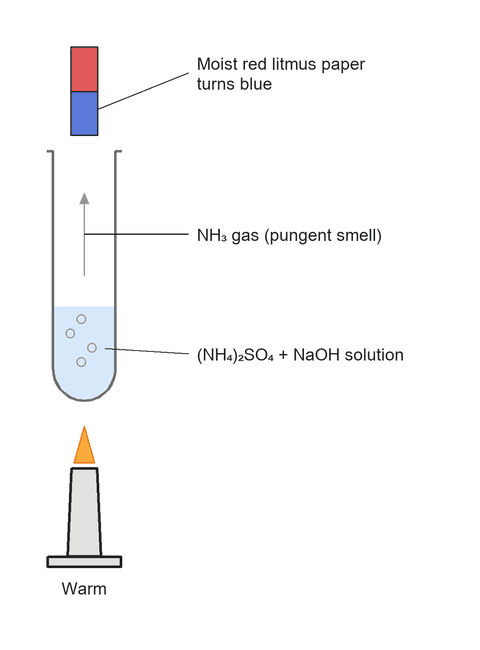
The red litmus at the mouth of the tube turns blue, so the gas given off is basic: it is ammonia.
Step 2 — Find the compound that gives ammonia.
Only an ammonium salt sets ammonia free when warmed with sodium hydroxide solution:
Ammonia dissolves in the water on the litmus paper to form ammonium hydroxide, an alkali, so the paper turns blue.
Watch out: A precipitate with NaOH is not a gas; only the ammonium salt gives off a gas here.
Why the other options are wrong:
- (A) Zinc sulphate: zinc sulphate gives only a white precipitate of zinc hydroxide; no gas is given off.
- (B) Copper sulphate: copper sulphate gives only a pale blue precipitate of copper (II) hydroxide; no gas is given off.
- (C) Ferrous sulphate: ferrous sulphate gives only a dirty green precipitate of iron (II) hydroxide; no gas is given off.
Therefore, compound P could be ammonium sulphate, option (D).
- 71 mark
Question 7
Aqueous lead (II) nitrate can be distinguished from aqueous zinc nitrate by adding any of the following solution in excess, except :
Solve with AIAnswer
(A) aqueous potassium chloride
(B) aqueous sodium sulphate
(C) dilute sulphuric acid
- Correct
(D) sodium hydroxide solution
Answer: (D) sodium hydroxide solution
Concept: A reagent distinguishes two solutions only if it gives a different result with each. The question asks for the one reagent that does not distinguish them.
Step 1 — Add a little sodium hydroxide.
Both solutions give a white precipitate, because lead hydroxide and zinc hydroxide are both white:
Step 2 — Add sodium hydroxide in excess.
Both hydroxides are amphoteric, so both precipitates dissolve and both tubes become clear and colourless:
The two tubes look the same at every stage, so sodium hydroxide cannot distinguish them.
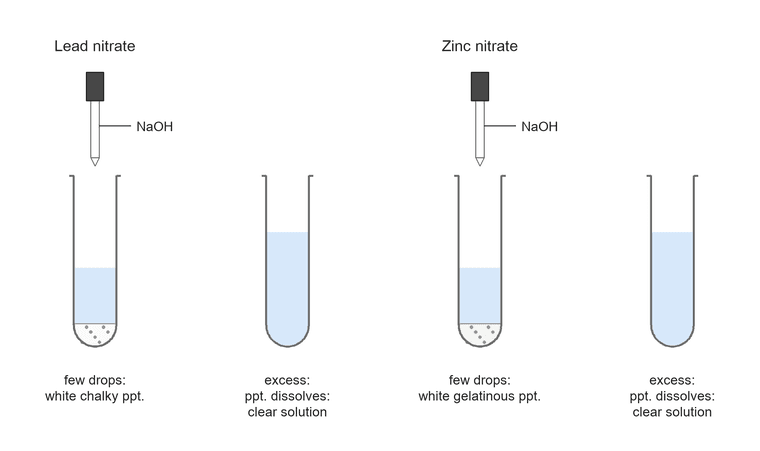
Step 3 — Check the other reagents.
Chloride and sulphate ions give white precipitates with lead ions (, ) but not with zinc ions, because zinc chloride and zinc sulphate are soluble. So each of the other three reagents does distinguish the solutions.
Watch out: 'except' asks for the reagent that FAILS; do not pick a reagent just because it gives a precipitate with lead.
Note: the book's printed key is (C), but dilute sulphuric acid does distinguish the two solutions (white lead sulphate forms with lead nitrate only). Only excess sodium hydroxide gives the same result with both, so (D) is the correct answer.
Why the other options are wrong:
- (A) aqueous potassium chloride: potassium chloride gives a white precipitate of lead chloride with lead nitrate only, so it does distinguish them.
- (B) aqueous sodium sulphate: sodium sulphate gives a white precipitate of lead sulphate with lead nitrate only, so it does distinguish them.
- (C) dilute sulphuric acid: dilute sulphuric acid gives white lead sulphate with lead nitrate only (), while zinc sulphate stays dissolved, so it does distinguish them.
Therefore, the reagent that cannot distinguish them is sodium hydroxide solution, option (D).
- 81 mark
Question 8
A student takes Cu, Al, Fe and Zn strips, separately in four test tubes labelled as I, II, III and IV respectively. He adds 10 ml of freshly prepared ferrous sulphate solution to each test tube and observes the colour of the metal residue in each case.
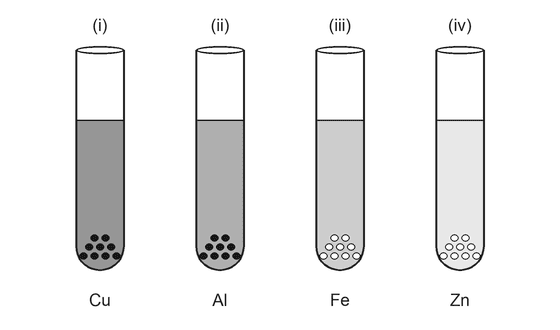
He would observe a black residue in the test tubes :
Solve with AIAnswer
(A) (I) and (II)
(B) (I) and (III)
(C) (II) and (III)
- Correct
(D) (II) and (IV)
Answer: (D) (II) and (IV)
Concept: A more reactive metal displaces a less reactive metal from a solution of its salt. Iron displaced from ferrous sulphate settles as a finely divided black (greyish black) deposit.
Step 1 — Place each metal in the activity series.
The order of reactivity of the four metals is Al > Zn > Fe > Cu. Only a metal above iron can push iron out of ferrous sulphate.
Step 2 — Tubes II and IV (aluminium and zinc).
Aluminium and zinc are above iron, so they displace it, and black iron collects on the strip and at the bottom:
The pale green colour of the solution also fades, because iron (II) ions are used up.
Step 3 — Tubes I and III (copper and iron).
Copper is below iron, so it cannot displace it; iron cannot displace itself from its own salt. These tubes show no change.
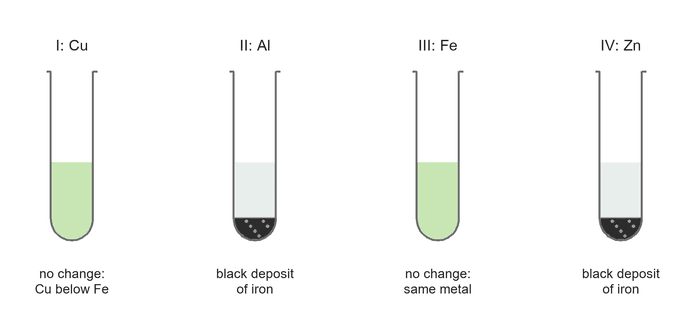
Watch out: In the laboratory the thin oxide layer on aluminium can make its reaction slow to start, but by the activity series aluminium still displaces iron.
Note: the figure printed with the question shades the grains dark in the first two tubes (I and II); the chemistry puts the black iron in tubes II (aluminium) and IV (zinc), which is also the book's key.
Why the other options are wrong:
- (A) (I) and (II): tube I holds copper, which is less reactive than iron and does not react.
- (B) (I) and (III): neither tube I (copper) nor tube III (iron) displaces iron, so neither shows a black residue.
- (C) (II) and (III): tube III holds iron, which does not react with its own salt.
Therefore, the black residue appears in test tubes (II) and (IV), option (D).
- 91 mark
Question 9
A nitrate which forms a precipitate with ammonium hydroxide and is also soluble in excess of it :
Solve with AIAnswer
(A) ferrous nitrate
(B) ferric nitrate
(C) lead nitrate
- Correct
(D) copper nitrate
Answer: (D) copper nitrate
Concept: Ammonium hydroxide precipitates most metal hydroxides. Of the cations in this chapter, only the copper (II) and zinc hydroxides dissolve in excess ammonium hydroxide; copper gives a deep (inky) blue solution.
Step 1 — Add a little ammonium hydroxide to copper nitrate.
A pale blue precipitate of copper (II) hydroxide forms:
Step 2 — Add excess ammonium hydroxide.
The precipitate dissolves and a deep blue solution of tetraamminecopper (II) nitrate forms:
So copper nitrate both forms a precipitate and dissolves in excess, as the question asks.
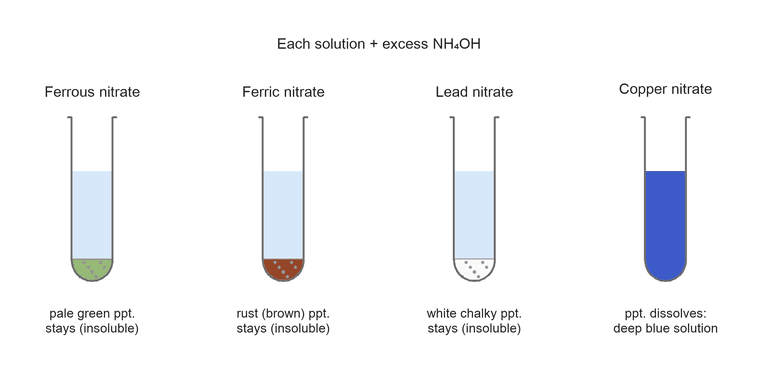
Watch out: 'soluble in excess' is a two-part test: a precipitate must form first and then dissolve.
Why the other options are wrong:
- (A) ferrous nitrate: ferrous nitrate gives a dirty green precipitate of iron (II) hydroxide, insoluble in excess.
- (B) ferric nitrate: ferric nitrate gives a reddish brown precipitate of iron (III) hydroxide, insoluble in excess.
- (C) lead nitrate: lead nitrate gives a white chalky precipitate of lead hydroxide, insoluble in excess ammonium hydroxide.
Therefore, the nitrate is copper nitrate, option (D).
- 101 mark
Question 10
Dilute sulphuric acid is added to sodium sulphite. The following observations are noticed :
P A gas with a suffocating smell is evolved which turns lime water milky.
Q A foul smelling gas is evolved which turns lead acetate solution black.
R A gas is evolved which decolourises pink .
Which of the following is true ?
Solve with AIAnswer
(A) Only P
(B) Only Q
(C) Only R
- Correct
(D) Both P and R
Answer: (D) Both P and R
Concept: A sulphite with a dilute acid gives sulphur dioxide; a sulphide would give hydrogen sulphide. So we judge each statement against the properties of sulphur dioxide.
Step 1 — Find the gas.
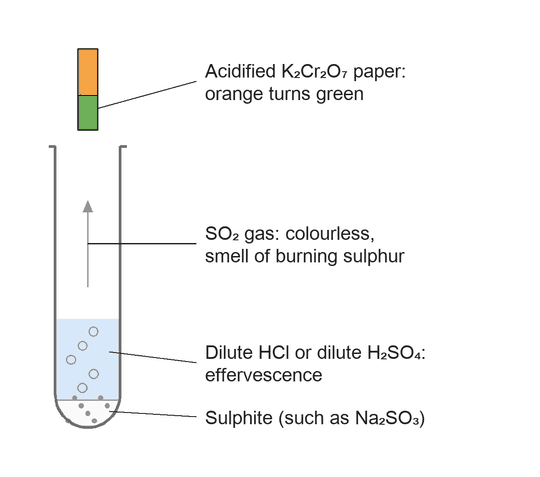
Sodium sulphite reacts with dilute sulphuric acid to give sulphur dioxide:
Step 2 — Judge statement P.
Sulphur dioxide has the suffocating smell of burning sulphur and turns lime water milky. Statement P is true.
Step 3 — Judge statement R.
Sulphur dioxide is a reducing agent, so it decolourises pink (acidified) potassium permanganate. Statement R is true:
Step 4 — Judge statement Q.
A foul smell and blackening of lead acetate belong to hydrogen sulphide, which comes from a sulphide, not a sulphite. Statement Q is false.
Watch out: Sulphite and sulphide differ by one letter but give different gases: sulphite → SO₂, sulphide → H₂S.
Why the other options are wrong:
- (A) Only P: 'only P' leaves out statement R, which is also true.
- (B) Only Q: statement Q is false: it describes hydrogen sulphide, which a sulphite does not give.
- (C) Only R: 'only R' leaves out statement P, which is also true.
Therefore, both P and R are true, option (D).
- 111 mark
Question 11
A compound X consists of molecules. Which of the following properties will be shown by X ?
P The boiling point of X is low.
Q The compound X is soluble in water.
R The aqueous solution of X does not conduct electricity.
Solve with AIAnswer
(A) Only P
(B) Only Q
(C) Only R
- Correct
(D) Both P and R
Answer: (D) Both P and R
Concept: A compound made of molecules is a covalent (molecular) compound. Its molecules are held to each other by weak forces, and it contains no ions.
Step 1 — Judge statement P.
The weak forces between molecules are easily overcome, so the boiling point is low. Statement P is true.
Step 2 — Judge statement R.
A typical molecular compound gives no ions, so its solution has nothing to carry charge and does not conduct electricity. Statement R is true.
Step 3 — Judge statement Q.
Covalent compounds are generally insoluble in water and soluble in organic solvents, so solubility in water is not a general property of X. Statement Q is not shown.
Watch out: A few polar covalent compounds, such as hydrogen chloride, react with water to form ions, and their solutions do conduct; the book's statement R is the general rule for molecular compounds such as sugar or alcohol.
Why the other options are wrong:
- (A) Only P: 'only P' leaves out statement R, which is also true.
- (B) Only Q: statement Q is not a general property: most molecular compounds do not dissolve in water.
- (C) Only R: 'only R' leaves out statement P, which is also true.
Therefore, X shows properties P and R, option (D).
- 121 mark
Question 12
The following questions are Assertion-Reason based questions. Choose the answer based on the codes given below.
Assertion (A) : HCl can be tested by solution.
Reason (R) : White precipitate of AgCl is formed when is added to HCl.
Solve with AIAnswer
- Correct
(A) (1) Both A and R are true and R is the correct explanation of A.
(B) (2) Both A and R are true but R is not the correct explanation of A.
(C) (3) A is true but R is false.
(D) (4) A is false but R is true.
Answer: (A) (1) Both A and R are true and R is the correct explanation of A.
Concept: In an assertion–reason item, judge the Assertion and the Reason separately as true or false; only when both are true do we ask whether the Reason correctly explains the Assertion. Here, hydrogen chloride is identified because it gives a curdy white precipitate of silver chloride with silver nitrate solution.
Step 1 — Judge the Assertion.
Silver nitrate solution is the standard test for hydrogen chloride. The Assertion is true.
Step 2 — Judge the Reason.
The chloride ions from HCl combine with silver ions to form insoluble white silver chloride. The Reason is true:
The precipitate does not dissolve in dilute nitric acid but dissolves in ammonium hydroxide, which confirms that it is silver chloride.
Step 3 — Does the Reason explain the Assertion?
Yes. The white precipitate is exactly what we see in the test, so the Reason is the correct explanation.
Why the other options are wrong:
- (B) (2) Both A and R are true but R is not the correct explanation of A: the Reason is the very observation the test relies on, so it does explain the Assertion.
- (C) (3) A is true but R is false: the Reason is true: silver chloride is a white precipitate.
- (D) (4) A is false but R is true: the Assertion is true: silver nitrate solution is used to test for HCl.
Therefore, both statements are true and the Reason explains the Assertion, option (A).
- 131 mark
Question 13
The following questions are Assertion-Reason based questions. Choose the answer based on the codes given below.
Assertion (A) : and can be distinguished by lime water.
Reason (R) : Both turn lime water milky.
Solve with AIAnswer
(A) (1) Both A and R are true and R is the correct explanation of A.
(B) (2) Both A and R are true but R is not the correct explanation of A.
(C) (3) A is true but R is false.
- Correct
(D) (4) A is false but R is true.
Answer: (D) (4) A is false but R is true.
Concept: In an assertion–reason item, judge the Assertion and the Reason separately as true or false; only when both are true do we ask whether the Reason correctly explains the Assertion. A test can distinguish two gases only if they behave differently in it.
Step 1 — Judge the Reason.
Both gases turn lime water milky, forming insoluble calcium carbonate and calcium sulphite. The Reason is true:
Step 2 — Judge the Assertion.
Since both gases give the same result, lime water cannot tell them apart. The Assertion is false. Acidified potassium dichromate is used instead: only sulphur dioxide turns it green.
Watch out: The Reason here actually shows why the Assertion is false.
Why the other options are wrong:
- (A) (1) Both A and R are true and R is the correct explanation of A: code (1) needs the Assertion to be true, but lime water cannot distinguish the gases.
- (B) (2) Both A and R are true but R is not the correct explanation of A: code (2) also needs the Assertion to be true.
- (C) (3) A is true but R is false: code (3) says the Reason is false, but both gases do turn lime water milky.
Therefore, the Assertion is false but the Reason is true, option (D).
- 141 mark
Question 14
The following questions are Assertion-Reason based questions. Choose the answer based on the codes given below.
Assertion (A) : On passing through lead nitrate solution, a black precipitate is formed.
Reason (R) : Lead nitrate reacts with to form a black precipitate of PbS.
Solve with AIAnswer
- Correct
(A) (1) Both A and R are true and R is the correct explanation of A.
(B) (2) Both A and R are true but R is not the correct explanation of A.
(C) (3) A is true but R is false.
(D) (4) A is false but R is true.
Answer: (A) (1) Both A and R are true and R is the correct explanation of A.
Concept: In an assertion–reason item, judge the Assertion and the Reason separately as true or false; only when both are true do we ask whether the Reason correctly explains the Assertion. Hydrogen sulphide gives black lead sulphide with lead salts; this is also why moist lead acetate paper turns black in hydrogen sulphide.
Step 1 — Judge the Assertion.
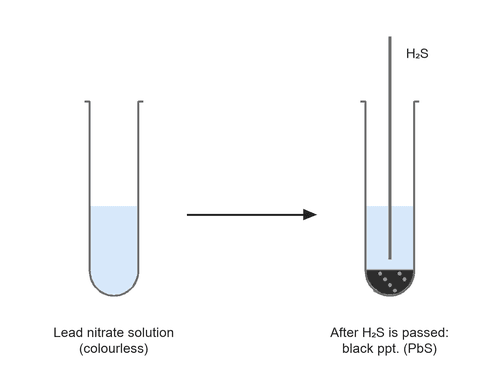
When hydrogen sulphide is passed through lead nitrate solution, a black precipitate forms. The Assertion is true.
Step 2 — Judge the Reason.
The black precipitate is lead sulphide, PbS. The Reason is true:
Step 3 — Does the Reason explain the Assertion?
Yes. The Reason names the reaction that produces the black precipitate, so it correctly explains the Assertion.
Why the other options are wrong:
- (B) (2) Both A and R are true but R is not the correct explanation of A: the Reason gives the reaction behind the black precipitate, so it is the correct explanation.
- (C) (3) A is true but R is false: the Reason is true: lead sulphide is black.
- (D) (4) A is false but R is true: the Assertion is true: a black precipitate does form.
Therefore, both statements are true and the Reason explains the Assertion, option (A).
- 151 mark
Question 15
The following questions are Assertion-Reason based questions. Choose the answer based on the codes given below.
Assertion (A) : Chloride can be tested by adding concentrated sulphuric acid to it. A colourless gas with a pungent odour is evolved.
Reason (R) : The gas formed is chlorine.
Solve with AIAnswer
(A) (1) Both A and R are true and R is the correct explanation of A.
(B) (2) Both A and R are true but R is not the correct explanation of A.
- Correct
(C) (3) A is true but R is false.
(D) (4) A is false but R is true.
Answer: (C) (3) A is true but R is false.
Concept: In an assertion–reason item, judge the Assertion and the Reason separately as true or false; only when both are true do we ask whether the Reason correctly explains the Assertion. A chloride warmed with concentrated sulphuric acid gives hydrogen chloride, a colourless gas with a pungent (choking) smell, not chlorine.
Step 1 — Judge the Assertion.
Warming a chloride with concentrated sulphuric acid gives a colourless, pungent gas, which shows that a chloride may be present. The Assertion is true:
Step 2 — Judge the Reason.
The gas is hydrogen chloride, not chlorine. Chlorine is greenish yellow, not colourless, and concentrated sulphuric acid alone does not oxidise a chloride to chlorine (manganese dioxide must be added for that). The Reason is false.
Watch out: HCl gas (colourless, fumes in moist air) and Cl₂ gas (greenish yellow) are easily confused by name.
Why the other options are wrong:
- (A) (1) Both A and R are true and R is the correct explanation of A: code (1) needs the Reason to be true, but the gas is HCl, not chlorine.
- (B) (2) Both A and R are true but R is not the correct explanation of A: code (2) also needs the Reason to be true.
- (D) (4) A is false but R is true: code (4) says the Assertion is false, but the colourless pungent gas is a valid sign of a chloride.
Therefore, the Assertion is true but the Reason is false, option (C).
- 161 mark
Question 16
The following questions are Assertion-Reason based questions. Choose the answer based on the codes given below.
Assertion (A) : If barium nitrate solution is added to sodium sulphate solution, a white precipitate is formed.
Reason (R) : Sodium sulphate solution is white in colour.
Solve with AIAnswer
(A) (1) Both A and R are true and R is the correct explanation of A.
(B) (2) Both A and R are true but R is not the correct explanation of A.
- Correct
(C) (3) A is true but R is false.
(D) (4) A is false but R is true.
Answer: (C) (3) A is true but R is false.
Concept: In an assertion–reason item, judge the Assertion and the Reason separately as true or false; only when both are true do we ask whether the Reason correctly explains the Assertion. Barium ions and sulphate ions combine to form insoluble barium sulphate, which is the white precipitate.
Step 1 — Judge the Assertion.
Mixing barium nitrate and sodium sulphate solutions gives a white precipitate. The Assertion is true:

Step 2 — Judge the Reason.
Sodium sulphate solution is colourless, because sodium ions and sulphate ions are both colourless. The white colour belongs to the precipitate, not to the solution. The Reason is false.
Watch out: 'white' describes a solid; a clear solution with no colour is called colourless.
Why the other options are wrong:
- (A) (1) Both A and R are true and R is the correct explanation of A: code (1) needs the Reason to be true, but sodium sulphate solution is colourless.
- (B) (2) Both A and R are true but R is not the correct explanation of A: code (2) also needs the Reason to be true.
- (D) (4) A is false but R is true: code (4) says the Assertion is false, but the white barium sulphate precipitate does form.
Therefore, the Assertion is true but the Reason is false, option (C).
- 174 marks
Question 17
Match the gases in column I to the identification of the gases mentioned in column II.
Column I Column II (a) Hydrogen sulphide A. Turns acidified potassium dichromate solution green (b) Nitric oxide B. Turns lime water milky (c) Carbon dioxide C. Turns reddish brown when it reacts with oxygen (d) Sulphur dioxide D. Turns moist lead acetate paper silvery black Solve with AIWritten solution
Solution:
Concept: Each gas is matched to the test that is special to it: a colour change of a test paper or solution, or a change in the gas itself when it meets air.
Step 1 — (a) Hydrogen sulphide.
Hydrogen sulphide turns moist lead acetate paper silvery black, because black lead sulphide forms on the paper. So (a) matches D:
Step 2 — (b) Nitric oxide.
Colourless nitric oxide combines with the oxygen of the air to form reddish brown nitrogen dioxide. So (b) matches C:
Step 3 — (c) Carbon dioxide.
Carbon dioxide turns lime water milky, because white calcium carbonate forms. So (c) matches B:
Step 4 — (d) Sulphur dioxide.
Sulphur dioxide is a reducing agent: it turns orange acidified potassium dichromate () solution green (chromium (III) sulphate). So (d) matches A:

Watch out: Sulphur dioxide also turns lime water milky, but in this list B is needed for carbon dioxide, which has no other matching test; A belongs only to sulphur dioxide.
Therefore, (a) – D, (b) – C, (c) – B, (d) – A.
- 183 marks
Question 18
Identify the following substances :
(a) An alkaline gas which gives dense white fumes with hydrogen chloride.
(b) The Gas having an offensive smell like rotten eggs.
(c) A colourless gas which can be used as a bleaching agent.
Solve with AIWritten solution
Solution:
Concept: Each description points to one common laboratory gas through its nature (alkaline or acidic), its smell, or what it does.
Step 1 — (a) The alkaline gas.
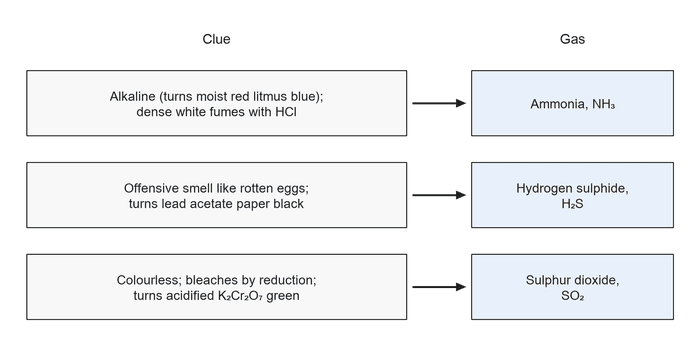
Ammonia, , is the only common alkaline gas, and it combines with hydrogen chloride to form dense white fumes of ammonium chloride:
Step 2 — (b) The gas that smells like rotten eggs.
Hydrogen sulphide, , has this offensive smell. It is confirmed by turning moist lead acetate paper black.
Step 3 — (c) The colourless bleaching gas.
Sulphur dioxide, , is colourless and bleaches moist coloured matter by reduction. Chlorine also bleaches, but chlorine is greenish yellow, so it does not fit.
Therefore, (a) ammonia, (b) hydrogen sulphide, (c) sulphur dioxide.
- 192 marks
Question 19
Name :
(a) The gas which turns acidified potassium dichromate solution green.
(b) A gas which turns moist lead acetate paper silvery black.
Solve with AIWritten solution
Solution:
Concept: These are the standard confirmatory tests for sulphur dioxide (a reducing gas) and hydrogen sulphide (which forms a black sulphide with lead salts).
Step 1 — (a) The gas that turns acidified K₂Cr₂O₇ green.
Sulphur dioxide reduces orange acidified potassium dichromate () to green chromium (III) sulphate:
Step 2 — (b) The gas that turns moist lead acetate paper silvery black.
Hydrogen sulphide reacts with lead acetate on the paper to form black lead sulphide:

Therefore, (a) sulphur dioxide, (b) hydrogen sulphide.
- 201 mark
Question 20
From the following list of substances choose those which meet the description given below. Ammonium chloride, ammonium nitrate, chlorine, dilute hydrochloric acid, iron, lead nitrate, manganese (IV) oxide, silver nitrate, sodium nitrate, sodium nitrite and sulphur.
Two compounds whose aqueous solutions give white precipitates with dilute hydrochloric acid.
Solve with AIWritten solution
Solution:
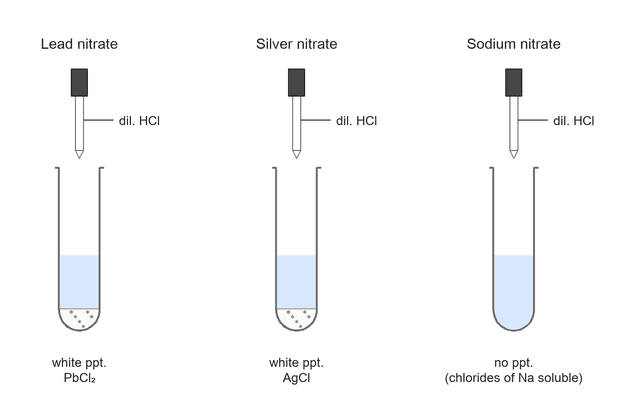
Concept: Silver chloride and lead chloride are the common chlorides that are insoluble in cold water. So only a silver salt or a lead salt gives a white precipitate when chloride ions (from dilute HCl) are added.
Step 1 — Pick out the compounds that give chloride precipitates.
From the list, the two compounds that contain silver or lead are lead nitrate and silver nitrate.
Step 2 — Lead nitrate.
Dilute hydrochloric acid gives a white precipitate of lead chloride:
Step 3 — Silver nitrate.
Dilute hydrochloric acid gives a curdy white precipitate of silver chloride:
The other compounds in the list, such as sodium nitrate or ammonium nitrate, form soluble chlorides, so no precipitate appears.
Watch out: Lead chloride dissolves in hot water, so the test is done with cold solutions.
Therefore, the two compounds are lead nitrate and silver nitrate.
- 215 marks
Question 21
Use the information given in (a) to (h) to identify the substances P to W selecting your answers from the given list.
List :
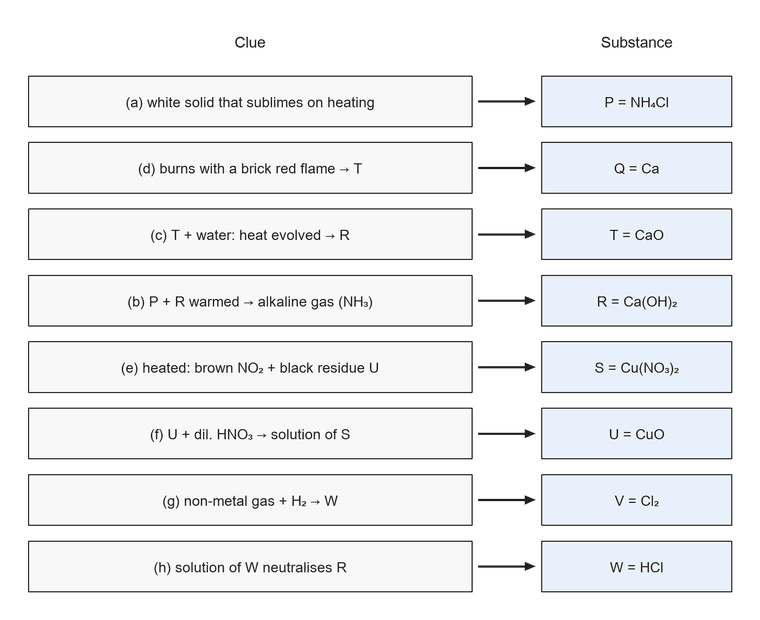
Calcium Oxygen Copper (II) oxide Carbon Calcium hydroxide Copper (II) nitrate Lead (II) oxide Hydrogen chloride Chlorine Lead (II) nitrate Calcium oxide Ammonium chloride (a) P is a white solid. When heated produces white fumes (sublime).
(b) P and R on warming produce an alkaline gas.
(c) On adding water to T, heat is evolved and R is formed.
(d) Q burns with brick red flame in air to form T.
(e) When S is heated, it gives off brown fumes and leaves a black residue of U.
(f) A solution of S is formed by warming U with dilute nitric acid.
(g) V is a gaseous non metallic element that reacts with hydrogen to form W.
(h) A solution of W will neutralise the solution of R.
Solve with AIWritten solution
Solution:
Concept: Start with the clue that fixes a substance on its own (a sublimate, a brick red flame, brown fumes with a black residue), then follow the chain of letters through the other clues.
Step 1 — Clue (a): identify P.
A white solid that gives white fumes and sublimes on heating is P = ammonium chloride.
Step 2 — Clue (d): identify Q and T.
A metal that burns with a brick red flame is calcium, so Q = calcium, and the oxide it forms is T = calcium oxide:
Step 3 — Clue (c): identify R.
Water added to calcium oxide (quicklime) gives out heat and forms slaked lime, so R = calcium hydroxide:
Step 4 — Check clue (b).
Ammonium chloride (P) warmed with calcium hydroxide (R) gives the alkaline gas ammonia, which fits clue (b):
Step 5 — Clues (e) and (f): identify S and U.
A nitrate that gives brown fumes of nitrogen dioxide and leaves a black residue is copper (II) nitrate, so S = copper (II) nitrate and U = copper (II) oxide. (Lead nitrate would leave a yellow residue.)
Warming U with dilute nitric acid gives back a solution of S, which fits clue (f):
Step 6 — Clues (g) and (h): identify V and W.
The gaseous non-metal in the list is chlorine, so V = chlorine; with hydrogen it forms W = hydrogen chloride:
A solution of W (hydrochloric acid) neutralises a solution of R (calcium hydroxide), which fits clue (h):
Watch out: Oxygen is also a gaseous non-metal in the list, but with hydrogen it forms water, which does not neutralise calcium hydroxide; chlorine is the only choice that fits both (g) and (h).
Therefore, P = ammonium chloride, Q = calcium, R = calcium hydroxide, S = copper (II) nitrate, T = calcium oxide, U = copper (II) oxide, V = chlorine, W = hydrogen chloride.
- 223 marks
Question 22
Copy and complete the following table which refers to the action of heat on some carbonates :
Carbonate Colour of residue on cooling Zinc carbonate Lead carbonate Copper carbonate Solve with AIWritten solution
Solution:
Concept: On heating, each of these carbonates gives off carbon dioxide and leaves its metal oxide. The colour of the oxide when hot and when cold identifies the metal.
Step 1 — Write the decomposition of each carbonate.
Each carbonate breaks up into its oxide and carbon dioxide; the colourless gas turns lime water milky:
Step 2 — Note the colour of each residue on cooling.
We read off the colour of each oxide once it has cooled:
Carbonate Colour of residue on cooling Zinc carbonate White (zinc oxide; yellow when hot) Lead carbonate Yellow (lead monoxide; reddish brown when hot) Copper carbonate Black (copper (II) oxide) 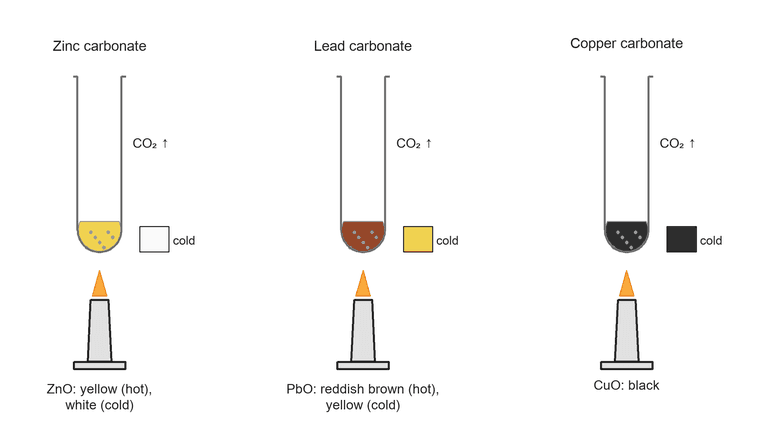
Step 3 — See why the colours help.
Zinc oxide is the common residue that is yellow when hot and white when cold; lead monoxide is reddish brown when hot and yellow when cold (and it fuses into the glass); copper (II) oxide is black both hot and cold.
Watch out: The table asks for the colour on cooling: zinc oxide is white then, even though it looks yellow while hot.
Therefore, the residues on cooling are: zinc carbonate – white (ZnO); lead carbonate – yellow (PbO); copper carbonate – black (CuO).
- 235 marks
Question 23
Sodium hydroxide solution is added first in a small quantity, then in excess to the aqueous salt solutions of copper (II) sulphate, zinc nitrate, lead nitrate, calcium chloride and iron (III) sulphate. Copy the following table and write the colour of the precipitate in (i) to (v) and the nature of the precipitate (soluble or insoluble) in (vi) to (x).
Aqueous salt solution Colour of precipitate when NaOH is added in a small quantity Nature of precipitate (soluble or insoluble) when NaOH is added in excess Copper (II) sulphate (i) (vi) Zinc nitrate (ii) (vii) Lead nitrate (iii) (viii) Calcium chloride (iv) (ix) Iron (III) sulphate (v) (x) Solve with AIWritten solution
Solution:
Concept: Sodium hydroxide precipitates the metal hydroxide from each salt solution. Zinc and lead hydroxides are amphoteric, so they dissolve in excess NaOH; the hydroxides of copper, calcium and iron do not.
Step 1 — Add a small quantity of NaOH.
Each metal ion forms its hydroxide, whose colour we note. For example:
Step 2 — Add NaOH in excess.
Zinc hydroxide forms sodium zincate and lead hydroxide forms sodium plumbite; both are soluble and colourless:
Step 3 — Fill in the table.
Putting the two observations together gives:
Aqueous salt solution Colour of precipitate (small quantity of NaOH) Nature of precipitate (excess NaOH) Copper (II) sulphate (i) Pale blue (vi) Insoluble Zinc nitrate (ii) White, gelatinous (vii) Soluble Lead nitrate (iii) White, chalky (viii) Soluble Calcium chloride (iv) White (slight) (ix) Insoluble Iron (III) sulphate (v) Reddish brown (x) Insoluble 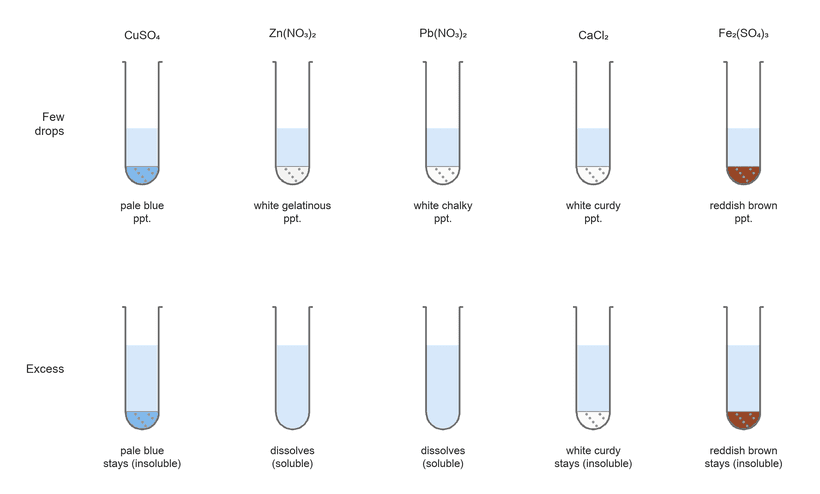
Watch out: Calcium hydroxide is only slightly soluble, so calcium chloride gives only a slight white precipitate, and it does not dissolve in excess NaOH (calcium hydroxide is not amphoteric).
Therefore, (i) pale blue, (ii) white gelatinous, (iii) white chalky, (iv) white, (v) reddish brown; (vi) insoluble, (vii) soluble, (viii) soluble, (ix) insoluble, (x) insoluble.
- 243 marks
Question 24
Mention the colour changes observed when the following indicators are added :
Solution Acids Alkalies (a) Alkaline phenolphthalein solution, (b) Methyl orange solution, (c) Neutral litmus solution. Solve with AIWritten solution
Solution:
Concept: An indicator has one colour in acid and another in alkali. We start from the colour the indicator already has and see whether the added solution changes it.
Step 1 — (a) Alkaline phenolphthalein.
Phenolphthalein is colourless in neutral and acidic solutions and pink in alkaline ones. 'Alkaline' phenolphthalein is already pink, so an acid turns it colourless, while an alkali leaves it pink.
Step 2 — (b) Methyl orange.
Methyl orange is orange in neutral solution, pink (red) in acid and yellow in alkali.
Step 3 — (c) Neutral litmus.
Neutral litmus solution is purple; it turns red in acid and blue in alkali.
Step 4 — Fill in the table.
Putting the three results together:
Solution Acids Alkalies (a) Alkaline phenolphthalein solution Pink turns colourless Remains pink (b) Methyl orange solution Orange turns pink (red) Orange turns yellow (c) Neutral litmus solution Purple turns red Purple turns blue 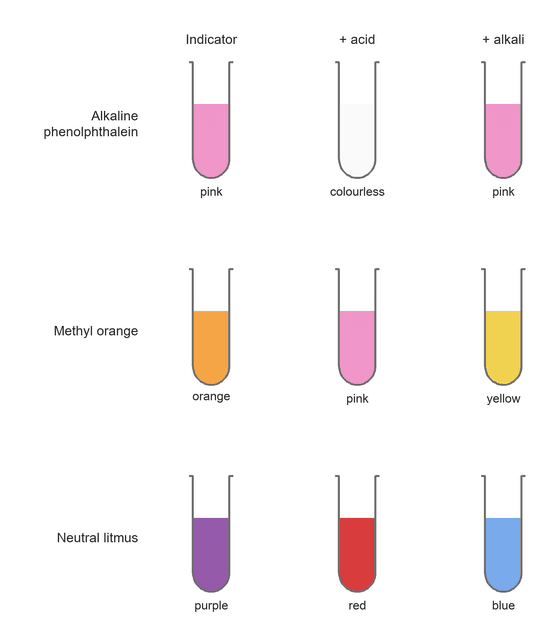
Watch out: Phenolphthalein never turns pink with an acid; with alkaline phenolphthalein the change is pink → colourless.
Therefore, (a) acid: pink → colourless, alkali: stays pink; (b) acid: orange → pink (red), alkali: orange → yellow; (c) acid: purple → red, alkali: purple → blue.
- 252 marks
Question 25
Select the correct answer from A, B, C and D.
A. Nitroso iron (II) sulphate B. Iron (III) chloride C. Chromium sulphate D. Lead (II) chloride.
(a) The compound which is responsible for the green colour formed when is bubbled through acidified potassium dichromate solution.
(b) Compound responsible for brown ring.
Solve with AIWritten solution
Solution:
Concept: Sulphur dioxide reduces orange dichromate to green chromium (III) sulphate; in the nitrate test, the brown ring is nitroso iron (II) sulphate.
Step 1 — (a) The green colour with sulphur dioxide.
The orange colour of dichromate changes to the green colour of the chromium (III) sulphate formed, so the answer is C. Chromium sulphate:
Step 2 — (b) The brown ring.
In the brown ring test, iron (II) sulphate reduces the nitrate to nitric oxide, and nitric oxide joins more iron (II) sulphate to form the brown compound A. Nitroso iron (II) sulphate, , at the junction of the two layers.
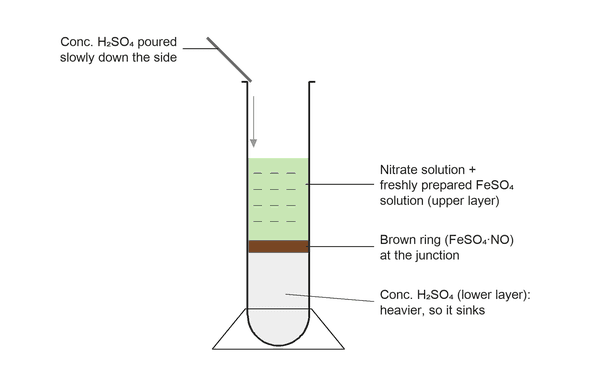
Watch out: Iron (III) chloride is also brown in colour, but it plays no part in the brown ring test.
Therefore, (a) C – chromium sulphate, (b) A – nitroso iron (II) sulphate.
- 261 mark
Question 26
Choose from the list of substances – Acetylene gas, aqua fortis, coke, brass, barium chloride, bronze, platinum.
An aqueous salt solution used for testing sulphate radical.
Solve with AIWritten solution
Solution:
Concept: A sulphate gives a white precipitate of barium sulphate with barium chloride solution, and this precipitate does not dissolve in mineral acids such as dilute HCl or dilute .
Step 1 — Pick the salt solution from the list.
Of the substances listed, only barium chloride is a salt used in solution to test for a sulphate.
Step 2 — Show the test.
Barium chloride gives white barium sulphate with any sulphate, for example:
Dilute HCl is then added: carbonates and sulphites also give white precipitates with barium chloride, but theirs dissolve in the acid, while barium sulphate stays.

Therefore, the salt solution is barium chloride.
- 272 marks
Question 27
Identify :
(a) The flame test with a salt P gave a brick red flame. What is the cation in P ?
(b) pH of liquid R is 10. What kind of substance is R?
Solve with AIWritten solution
Solution:
Concept: In the flame test each metal ion gives its own flame colour. On the pH scale, 7 is neutral, below 7 is acidic and above 7 is alkaline.
Step 1 — (a) The cation in P.
A brick red flame is given by calcium salts, so P contains the calcium ion, . (Sodium gives golden yellow, potassium lilac and copper bluish green.)
Step 2 — (b) The kind of substance R.
A pH of 10 is more than 7, so R is alkaline (basic), an alkali solution. It would turn red litmus blue and phenolphthalein pink.

Watch out: The flame test names only the metal ion (the cation); it says nothing about the anion of the salt.
Therefore, (a) the cation is Ca²⁺; (b) R is an alkaline (basic) substance.
- 282 marks
Question 28
A student was asked to perform two experiments in the laboratory based on the instructions given :
Observe the picture given below and state one observation for each of the Experiments 1 and 2 that you would notice on mixing the given solutions.
(a) Experiment 1 (b) Experiment 2
 Solve with AI
Written solution
Solution:
Concept: Experiment 1 is the sulphate test with barium chloride; Experiment 2 is the action of excess ammonium hydroxide on copper (II) hydroxide.
Step 1 — (a) Experiment 1.
Zinc sulphate solution is poured into barium chloride solution. A white precipitate of barium sulphate forms:
Step 2 — (b) Experiment 2.
Ammonium hydroxide solution is poured onto the pale blue precipitate of copper (II) hydroxide. In excess, the precipitate dissolves to give a deep (inky) blue solution of tetraamminecopper (II) sulphate:
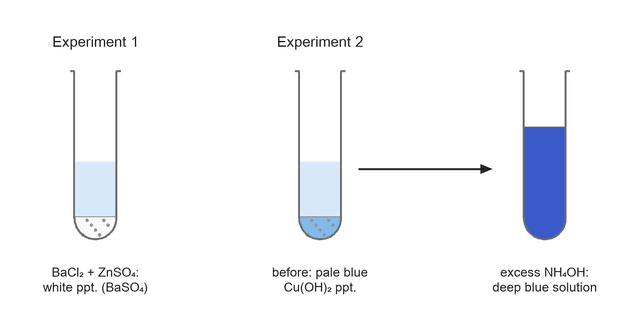
Watch out: The deep blue colour appears only when enough ammonium hydroxide is added; a few drops leave the pale blue precipitate.
Therefore, (a) a white precipitate (BaSO₄) forms; (b) the pale blue precipitate dissolves, giving a deep (inky) blue solution.
- 295 marks
Question 29
Name the anion present in each of the following compounds :
(a) Compound A when warmed with concentrated sulphuric acid gives a gas which fumes in moist air and which gives dense white fumes with ammonia.
(b) When barium chloride solution is added to a solution of compound B, a white precipitate insoluble in dilute hydrochloric acid is formed.
(c) The action of heat on the insoluble compound C produces a gas which turns lime water turbid.
(d) Compound D when warmed with dilute sulphuric acid gives a gas which turns acidified dichromate solution green.
Solve with AIWritten solution
Solution:
Concept: To name an anion, first identify the gas or precipitate in the test, then name the anion that gives it.
Step 1 — (a) Compound A.
A gas that fumes in moist air and gives dense white fumes (ammonium chloride) with ammonia is hydrogen chloride. Concentrated sulphuric acid sets it free from a chloride, so the anion is chloride, :
Step 2 — (b) Compound B.
A white precipitate with barium chloride that does not dissolve in dilute HCl is barium sulphate, so the anion is sulphate, . (A carbonate or sulphite would also give a white precipitate, but it would dissolve in the acid.)
Step 3 — (c) Compound C.
A gas that turns lime water turbid is carbon dioxide, given off when an insoluble carbonate is heated, so the anion is carbonate, :
Step 4 — (d) Compound D.
A gas that turns acidified potassium dichromate () green is sulphur dioxide, which a sulphite gives with dilute sulphuric acid, so the anion is sulphite, :

Watch out: In (b) the acid test matters: barium carbonate and barium sulphite are white too, but only barium sulphate stays undissolved in dilute HCl.
Therefore, (a) chloride, Cl⁻; (b) sulphate, SO₄²⁻; (c) carbonate, CO₃²⁻; (d) sulphite, SO₃²⁻.
- 305 marks
Question 30
A given white crystalline salt was tested as follows :
(a) It dissolved in water and the resulting solution of the salt turned blue litmus red.
(b) Addition of barium chloride solution into this solution gave a white precipitate.
(c) A flame test on the salt gave a persistent golden-yellow colourisation.
What conclusions can be drawn for each observation?
Solve with AIWritten solution
Solution:
Concept: Each test gives one clue: litmus tells us whether the solution is acidic, barium chloride tells us the anion, and the flame test tells us the metal. Together they name the salt.
Step 1 — (a) Blue litmus turns red.
The solution is acidic. A salt whose solution is acidic here is an acid salt. It still contains replaceable hydrogen, and this hydrogen goes into the water as ions.
Step 2 — (b) White precipitate with barium chloride.
The white precipitate is barium sulphate, so the salt contains the sulphate ion, .
Step 3 — (c) Persistent golden-yellow flame.
A persistent golden-yellow flame is given by the sodium ion, .
Step 4 — Put the three clues together.
An acid salt of sodium that contains sulphate is sodium hydrogen sulphate, . With barium chloride it reacts as:
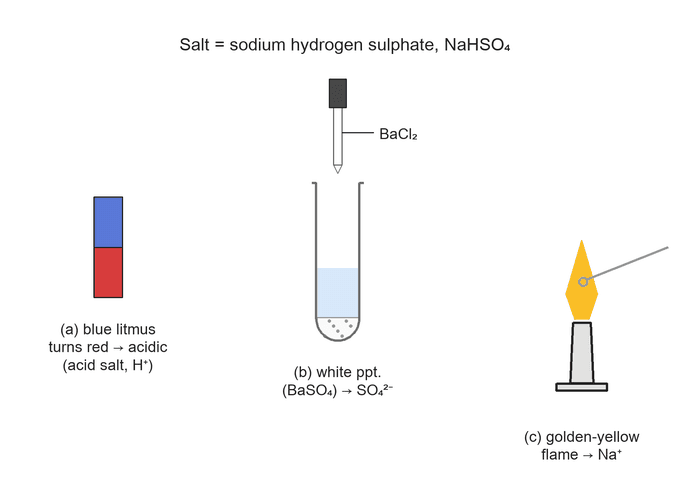
Watch out: A salt solution that turns blue litmus red is not always an acid salt in general (some normal salts hydrolyse), but with these three clues together the salt is sodium hydrogen sulphate.
Therefore, (a) the salt is an acid salt (gives H⁺ ions); (b) it contains the sulphate ion; (c) it contains the sodium ion; the salt is sodium hydrogen sulphate, NaHSO₄.
- 314 marks
Question 31
(a) Sodium hydroxide solution is added to solution A. A white precipitate is formed which is insoluble in excess sodium hydroxide solution. Name the metal ion present in solution A.
(b) When ammonium hydroxide is added to solution B, a pale blue precipitate is formed. This pale blue precipitate dissolves in excess ammonium hydroxide giving an inky blue solution. Name the cation present in solution B.
Solve with AIWritten solution
Solution:
Concept: Calcium, zinc and lead ions all give white precipitates with NaOH, but only calcium's stays in excess (zinc and lead hydroxides are amphoteric). Only copper gives an inky blue solution with excess ammonium hydroxide.
Step 1 — (a) The metal ion in solution A.
The white precipitate does not dissolve in excess sodium hydroxide, so it is not zinc or lead hydroxide. It is calcium hydroxide, and the metal ion is the calcium ion, :
Step 2 — (b) The cation in solution B: the pale blue precipitate.
A pale blue precipitate with ammonium hydroxide is copper (II) hydroxide:
Step 3 — (b) The inky blue solution.
In excess ammonium hydroxide the precipitate dissolves to form inky blue tetraamminecopper (II) sulphate, which confirms the copper (II) ion, :
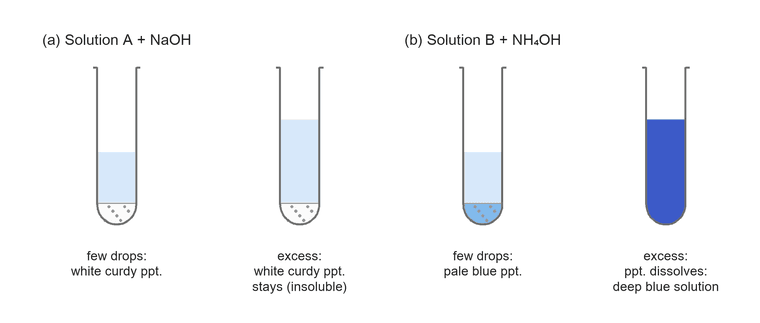
Watch out: Excess NaOH is the step that separates calcium from zinc and lead; a white precipitate alone could be any of the three.
Therefore, (a) the metal ion in A is calcium, Ca²⁺; (b) the cation in B is copper (II), Cu²⁺.
- 325 marks
Question 32
The questions (i) to (v) refer to the following salt solutions listed A to F.
A. Copper nitrate B. Iron (II) sulphate C. Iron (III) chloride D. Lead nitrate E. Magnesium sulphate F. Zinc chloride
(i) Which two solutions will give a white precipitate when treated with dilute hydrochloric acid followed by barium chloride solution?
(ii) Which two solutions will give a white precipitate when treated with dilute nitric acid followed by silver nitrate solution?
(iii) Which solution will give a white precipitate, when either dilute hydrochloric acid or dilute sulphuric acid is added to it?
(iv) Which solution becomes a deep/inky blue colour when excess of ammonium hydroxide is added to it?
(v) Which solution gives a white precipitate with excess ammonium hydroxide solution?
Solve with AIWritten solution
Solution:
Concept: Barium chloride tests for sulphate and silver nitrate for chloride; lead is the metal whose chloride and sulphate are both insoluble; copper is the metal whose hydroxide dissolves in excess ammonium hydroxide to give an inky blue solution.
Step 1 — (i) White precipitate with dilute HCl, then barium chloride.
The sulphates, B (iron (II) sulphate) and E (magnesium sulphate), give white barium sulphate. The dilute HCl first removes any carbonate or sulphite, so the precipitate can only be barium sulphate:
Step 2 — (ii) White precipitate with dilute HNO₃, then silver nitrate.
The chlorides, C (iron (III) chloride) and F (zinc chloride), give white silver chloride:
Step 3 — (iii) White precipitate with dilute HCl or with dilute H₂SO₄.
Only D (lead nitrate) does this: lead chloride and lead sulphate are both white and insoluble:
Step 4 — (iv) Deep (inky) blue with excess ammonium hydroxide.
A (copper nitrate) gives pale blue copper (II) hydroxide, which dissolves in excess ammonium hydroxide to give an inky blue solution.
Step 5 — (v) White precipitate with excess ammonium hydroxide.
D (lead nitrate) gives white lead hydroxide, which does not dissolve in excess ammonium hydroxide:
Zinc chloride's white precipitate dissolves in excess, and the iron and copper precipitates are coloured.

Watch out: In (iii) both acids must give a precipitate; a silver salt would give one with HCl only.
Note: magnesium sulphate (E) also gives a white precipitate of magnesium hydroxide with ammonium hydroxide, so it fits (v) as well; the expected answer is lead nitrate (D), the usual example of a white hydroxide that stays undissolved in excess ammonium hydroxide.
Therefore, (i) B and E; (ii) C and F; (iii) D; (iv) A; (v) D.
- 335 marks
Question 33
Salts A, B, C, D and E undergo reactions (i) to (v) respectively. Identify the anion present in these salts on the basis of these reactions.
(a) When silver nitrate solution is added to a solution of A, a white precipitate, insoluble in dilute nitric acid, is formed.
(b) Addition of dilute hydrochloric acid to B produces a gas which turns lead acetate paper black.
(c) When a freshly prepared solution of ferrous sulphate is added to a solution of C and concentrated sulphuric acid is gently poured from the side of the test-tube, a brown ring is formed.
(d) When dilute sulphuric acid is added to D, a gas is produced which turns acidified potassium dichromate solution from orange to green.
(e) Addition of dilute hydrochloric acid to E produces an effervescence. The gas produced turns limewater milky but does not affect acidified potassium dichromate solution.
Solve with AIWritten solution
Solution:
Concept: Each observation is the standard test for one anion: name the gas or precipitate first, then the anion it comes from.
Step 1 — (a) Salt A.
A white precipitate with silver nitrate that does not dissolve in dilute nitric acid is silver chloride, so the anion is chloride, :
Step 2 — (b) Salt B.
A gas that turns lead acetate paper black is hydrogen sulphide, which a sulphide gives with dilute acid, so the anion is sulphide, :
Step 3 — (c) Salt C.
A brown ring at the junction of the two layers is nitroso iron (II) sulphate, , which forms only with a nitrate, so the anion is nitrate, .
Step 4 — (d) Salt D.
A gas that turns acidified potassium dichromate from orange to green is sulphur dioxide, which a sulphite gives with dilute acid, so the anion is sulphite, :
Step 5 — (e) Salt E.
Effervescence of a gas that turns lime water milky but leaves acidified dichromate orange is carbon dioxide, so the anion is carbonate, :

Watch out: Lime water alone cannot tell a carbonate from a sulphite; the 'no effect on dichromate' part of (e) rules out sulphur dioxide.
Therefore, A – chloride, B – sulphide, C – nitrate, D – sulphite, E – carbonate.
- 345 marks
Question 34
State your observations when :
(a) lead nitrate solution and sodium chloride solution are mixed.
(b) zinc chloride solution, zinc nitrate solution and zinc sulphate solutions are added individually to
(i) barium chloride solution,
(ii) lead nitrate solution.
(c) Decomposition of bicarbonates by dil.
(d) Zinc carbonate is heated strongly.
(e) a piece of moist blue litmus paper is introduced in a jar of chlorine.
(f) paper soaked in potassium permanganate solution – is introduced in each case into a jar of sulphur dioxide.
(g) When moist starch iodide paper is introduced into chlorine gas.
Solve with AIWritten solution
Solution:
Concept: An observation is what is seen: a colour change, a precipitate, a gas, a smell. Each part below names the observation and then the reaction behind it.
Step 1 — (a) Lead nitrate and sodium chloride.
A white precipitate of lead chloride forms, because lead chloride is insoluble in cold water:
Step 2 — (b) (i) The three zinc salts with barium chloride.
Only zinc sulphate gives a white precipitate of barium sulphate; zinc chloride and zinc nitrate show no change, because barium chloride and barium nitrate are soluble:
Step 3 — (b) (ii) The three zinc salts with lead nitrate.
Zinc chloride gives a white precipitate of lead chloride and zinc sulphate a white precipitate of lead sulphate; zinc nitrate shows no change, since all nitrates are soluble:

Step 4 — (c) Bicarbonates with dilute sulphuric acid.
There is brisk effervescence of a colourless, odourless gas that turns lime water milky: the gas is carbon dioxide, as in the equations given in the question.
Step 5 — (d) Zinc carbonate heated strongly.
The white solid turns yellow while hot and becomes white again on cooling (zinc oxide), and a colourless gas that turns lime water milky is given off:
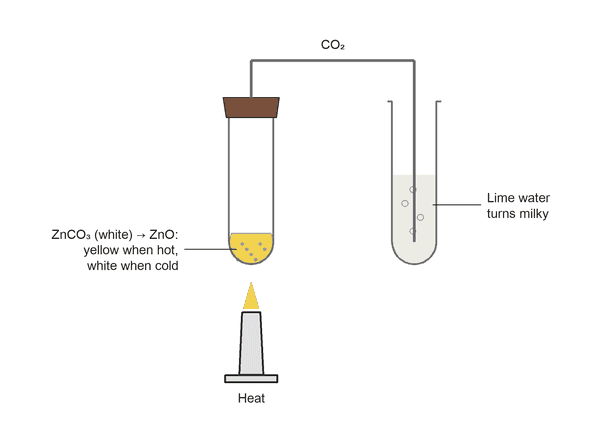
Step 6 — (e) Moist blue litmus in chlorine.
The paper first turns red, because chlorine forms acids with water, and is then bleached white by oxidation:
Step 7 — (f) Potassium permanganate paper in sulphur dioxide.
The pink (purple) paper is decolourised, because sulphur dioxide is a reducing agent and reduces the permanganate.

Step 8 — (g) Moist starch iodide paper in chlorine.
The paper turns blue-black: chlorine sets free iodine from the iodide, and iodine turns starch blue-black:
Watch out: In (e) the red colour lasts only a moment; the final observation is a bleached (white) paper.
Therefore, (a) white ppt (PbCl₂); (b) (i) white ppt only with ZnSO₄, (ii) white ppt with ZnCl₂ and ZnSO₄, none with Zn(NO₃)₂; (c) brisk effervescence of CO₂, lime water milky; (d) residue yellow when hot, white when cold, CO₂ given off; (e) blue litmus turns red, then is bleached; (f) pink permanganate paper is decolourised; (g) starch iodide paper turns blue-black.
- 355 marks
Question 35
Complete the following table and write your observations.
Hydrogen sulphide Ammonia Sulphur dioxide Hydrogen chloride Shake the gas with red litmus solution Shake the gas with blue litmus solution Apply a burning splint to the gas Solve with AIWritten solution
Solution:
Concept: Ammonia is the only basic gas of the four; the other three are acidic. An acidic gas turns blue litmus red, a basic gas turns red litmus blue, and litmus already of a gas's own colour stays unchanged. Of the four, only hydrogen sulphide burns in air.
Step 1 — Shake each gas with red and blue litmus.
Ammonia dissolves in water to form the alkali ammonium hydroxide, so it turns red litmus blue:
Hydrogen sulphide (a weak acid), sulphur dioxide and hydrogen chloride dissolve to form acids, so they turn blue litmus red.
Step 2 — Apply a burning splint.
Hydrogen sulphide burns in air with a pale blue flame, forming sulphur dioxide and water:
Ammonia, sulphur dioxide and hydrogen chloride neither burn in air nor support burning, so the splint goes out.
Step 3 — Complete the table.
Putting the observations together:
Hydrogen sulphide Ammonia Sulphur dioxide Hydrogen chloride Shake the gas with red litmus solution No change Turns blue No change No change Shake the gas with blue litmus solution Turns red (weakly acidic) No change Turns red Turns red Apply a burning splint to the gas Gas burns with a pale blue flame Splint is extinguished; gas does not burn in air Splint is extinguished Splint is extinguished Watch out: Ammonia does burn in pure oxygen, but not in air, so with a burning splint in air the splint simply goes out.
Therefore, red litmus turns blue only with ammonia; blue litmus turns red with hydrogen sulphide, sulphur dioxide and hydrogen chloride; a burning splint makes hydrogen sulphide burn (pale blue flame) and is put out by the other three gases.
- 365 marks
Question 36
Identify the anion present in the following compounds :
(a) Compound X on heating with copper turnings and conc. sulphuric acid liberates a reddish brown gas.
(b) When a solution of compound Y is treated with silver nitrate solution a white precipitate is obtained which is soluble in excess of ammonium hydroxide solution.
(c) Compound Z which on reacting with dilute sulphuric acid liberates a gas which turns lime water milky, but the gas has no effect on acidified potassium dichromate solution.
(d) Compound L on reacting with barium chloride solution gives a white precipitate insoluble in dilute hydrochloric acid or dilute nitric acid.
Solve with AIWritten solution
Solution:
Concept: Brown nitrogen dioxide with copper means nitrate; a white precipitate that dissolves in ammonium hydroxide means chloride; carbon dioxide means carbonate; white barium sulphate insoluble in acids means sulphate.
Step 1 — (a) Compound X.
Concentrated sulphuric acid sets free nitric acid from a nitrate:
The nitric acid then oxidises copper and gives reddish brown nitrogen dioxide, so the anion is nitrate, :
Step 2 — (b) Compound Y.
The white precipitate with silver nitrate that dissolves in excess ammonium hydroxide is silver chloride, so the anion is chloride, :
Step 3 — (c) Compound Z.
The gas turns lime water milky but has no effect on acidified potassium dichromate, so it is carbon dioxide, not sulphur dioxide. The anion is carbonate, :
Step 4 — (d) Compound L.
A white precipitate with barium chloride that does not dissolve in dilute HCl or dilute nitric acid is barium sulphate, so the anion is sulphate, :
Watch out: In (a) the copper turnings are needed: they react with the nitric acid to give the brown gas that shows a nitrate is present.
Therefore, X – nitrate, NO₃⁻; Y – chloride, Cl⁻; Z – carbonate, CO₃²⁻; L – sulphate, SO₄²⁻.
- 374 marks
Question 37
State giving reasons if :
(a) zinc and aluminium can be distinguished by heating the metal powder with concentrated sodium hydroxide solution.
(b) calcium nitrate and lead nitrate can be distinguished by adding ammonium hydroxide solution to the salt solution.
Solve with AIWritten solution
Solution:
Concept: A test distinguishes two substances only if they behave differently in it.
Step 1 — (a) Zinc and aluminium with hot conc. NaOH.
No, they cannot be distinguished. Both metals dissolve in hot concentrated sodium hydroxide to give a colourless solution, and both give off hydrogen. The observations are the same:
Step 2 — (b) Calcium nitrate and lead nitrate with ammonium hydroxide.
Yes, they can be distinguished. Lead nitrate gives a white chalky precipitate of lead hydroxide, insoluble in excess ammonium hydroxide:
Calcium nitrate gives no precipitate, because ammonium hydroxide is a weak alkali and does not supply enough hydroxide ions to precipitate calcium hydroxide.
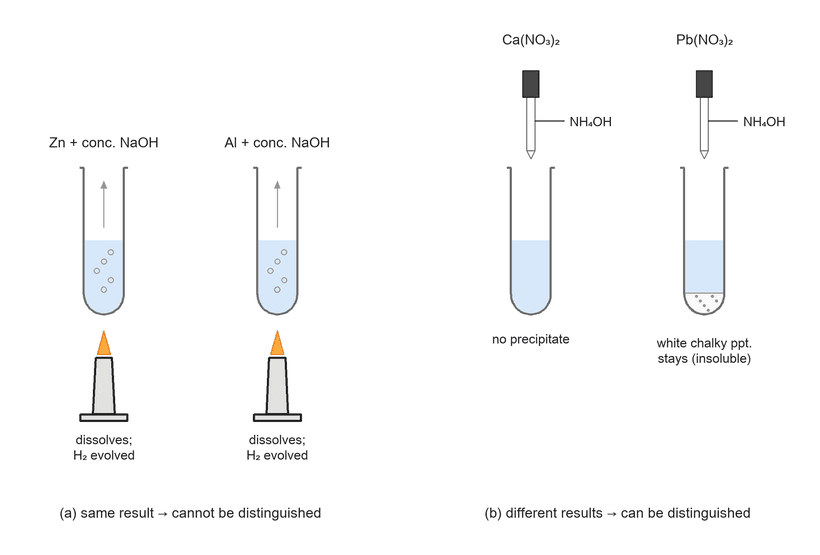
Watch out: With sodium hydroxide (a strong alkali) calcium nitrate does give a white precipitate; the difference in (b) comes from using ammonium hydroxide.
Therefore, (a) no: zinc and aluminium both dissolve and give hydrogen; (b) yes: lead nitrate gives a white precipitate with ammonium hydroxide, calcium nitrate gives none.
- 382 marks
Question 38
Identify the substance 'R' based on the information given below :
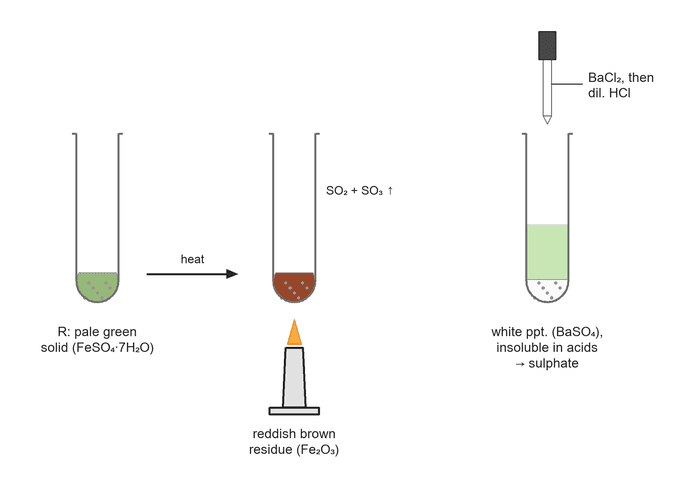
The pale green solid 'R' turns reddish brown on heating. Its aqueous solution gives a white precipitate with barium chloride solution. The precipitate is insoluble in mineral acids.
Solve with AIWritten solution
Solution:
Concept: A pale green salt suggests iron (II); a white precipitate with barium chloride that is insoluble in mineral acids shows a sulphate.
Step 1 — Use the colour and the effect of heat.
Pale green crystals that leave a reddish brown residue on heating are iron (II) sulphate: the crystals lose water, and then the salt decomposes to reddish brown iron (III) oxide:
Step 2 — Use the barium chloride test.
A white precipitate of barium sulphate forms, which does not dissolve in mineral acids, so the anion is sulphate:
Step 3 — Put the clues together.
The salt contains iron (II) ions and sulphate ions, so R is iron (II) sulphate crystals, .
Therefore, R is iron (II) sulphate (ferrous sulphate), FeSO₄·7H₂O.
- 392 marks
Question 39
Write the equation for the reaction of magnesium sulphate solution with barium chloride solution.
Solve with AIWritten solution
Solution:
Concept: Barium ions and sulphate ions combine to give insoluble barium sulphate; this is the test for a sulphate.
Step 1 — Write the reaction.
Magnesium sulphate and barium chloride exchange ions; barium sulphate is insoluble and falls out as a precipitate, while magnesium chloride stays in solution:
Step 2 — State what is seen.
A white precipitate of barium sulphate forms. It does not dissolve in dilute HCl or dilute .
Therefore, MgSO₄ + BaCl₂ → BaSO₄↓ (white) + MgCl₂.
- 403 marks
Question 40
When an ammonium salt is warmed with sodium hydroxide solution, ammonia gas is evolved. State three ways in which you could identify this gas.
Solve with AIWritten solution
Solution:
Concept: Ammonia is the only common alkaline gas, and it has a characteristic smell. Warming any ammonium salt with an alkali sets it free.
Step 1 — See where the ammonia comes from.
Warming an ammonium salt with sodium hydroxide solution gives ammonia gas, for example:
Step 2 — Way 1: smell.
The gas has a characteristic sharp, pungent smell (smelled by wafting, never sniffed directly).
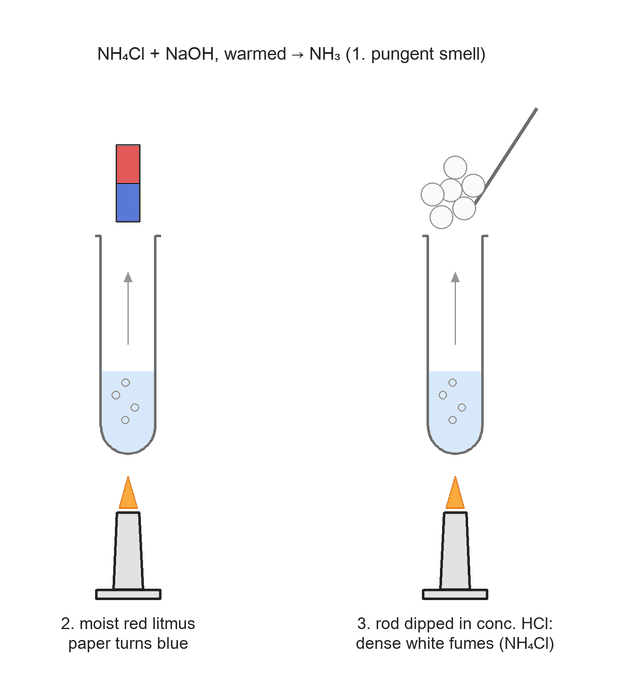
Step 3 — Way 2: moist red litmus.
The gas turns moist red litmus paper blue, because it dissolves in the water on the paper to form the alkali ammonium hydroxide:
Step 4 — Way 3: conc. hydrochloric acid.
A glass rod dipped in concentrated hydrochloric acid and held near the gas gives dense white fumes of ammonium chloride:
Ammonia also turns Nessler's reagent brown, a fourth possible test.
Watch out: The litmus paper must be moist; dry ammonia cannot form ammonium hydroxide on dry paper.
Therefore, ammonia is identified by (1) its pungent smell, (2) turning moist red litmus blue, and (3) dense white fumes with a rod dipped in conc. HCl.
- 415 marks
Question 41
Give a chemical test to distinguish between :
(a) Sodium chloride solution and sodium nitrate solution
(b) Hydrogen chloride gas and hydrogen sulphide gas.
(c) Calcium nitrate solution and zinc nitrate solution
(d) Carbon dioxide gas and sulphur dioxide gas.
(e) Sodium carbonate and sodium sulphite.
(f) Ferrous nitrate and lead nitrate.
(g) Manganese dioxide and copper (II) oxide.
(h) Sodium nitrate and sodium sulphite [using dilute sulphuric acid].
(i) Sodium chloride and sodium sulphide
(j) Sodium hydroxide solution and ammonium hydroxide solution.
(k) Ammonium sulphate crystals and sodium sulphate crystals .
(l) Sulphuric acid from nitric acid and hydrochloric acid.
(m) Magnesium chloride and magnesium nitrate solutions
(n) Zinc sulphate solution and zinc chloride solution
(o) Iron (II) chloride solution and iron (III) chloride solution
(p) Calcium nitrate solution and calcium chloride solution
Solve with AIWritten solution
Solution:
Concept: To distinguish two substances, pick one reagent that gives a clear result with one of them and no result (or a different one) with the other, and state both observations.
Step 1 — (a) Sodium chloride and sodium nitrate solutions.
We add silver nitrate solution. Sodium chloride gives a white precipitate of silver chloride; sodium nitrate gives no precipitate:
Step 2 — (b) Hydrogen chloride and hydrogen sulphide gases.
We hold moist lead acetate paper in each gas. Hydrogen sulphide turns it silvery black; hydrogen chloride has no effect on it:
Step 3 — (c) Calcium nitrate and zinc nitrate solutions.
We add sodium hydroxide solution, first a little and then in excess. Both give a white precipitate at first, but zinc hydroxide dissolves in excess (it is amphoteric) and calcium hydroxide does not:
Step 4 — (d) Carbon dioxide and sulphur dioxide gases.
We pass each gas through acidified potassium dichromate () solution. Sulphur dioxide turns it from orange to green; carbon dioxide has no effect. (Lime water cannot be used: both gases turn it milky.)

Step 5 — (e) Sodium carbonate and sodium sulphite.
We add dilute sulphuric acid and test the gas. Both effervesce, but the gas from sodium sulphite has a suffocating smell of burning sulphur and turns acidified green; the gas from sodium carbonate is odourless and leaves the dichromate orange (it only turns lime water milky):
Step 6 — (f) Ferrous nitrate and lead nitrate.
We add sodium hydroxide solution. Ferrous nitrate gives a dirty green precipitate, insoluble in excess; lead nitrate gives a white precipitate, soluble in excess:
Step 7 — (g) Manganese dioxide and copper (II) oxide.
We warm each with concentrated hydrochloric acid. Manganese dioxide oxidises the acid and gives greenish yellow chlorine gas; copper (II) oxide only acts as a base, gives no gas, and forms a bluish green solution of copper (II) chloride:

Step 8 — (h) Sodium nitrate and sodium sulphite with dilute sulphuric acid.
We add dilute sulphuric acid. Sodium sulphite gives sulphur dioxide, with a suffocating smell, which turns acidified green; sodium nitrate shows no reaction with the dilute acid:
Step 9 — (i) Sodium chloride and sodium sulphide.
We add dilute hydrochloric acid. Sodium sulphide gives hydrogen sulphide, which smells of rotten eggs and turns lead acetate paper black; sodium chloride shows no change:
Step 10 — (j) Sodium hydroxide and ammonium hydroxide solutions.
We add each, a little and then in excess, to copper (II) sulphate solution. Both give a pale blue precipitate. With ammonium hydroxide it dissolves in excess to an inky blue solution; with sodium hydroxide it stays insoluble:

Step 11 — (k) Ammonium sulphate and sodium sulphate crystals.
We warm each with sodium hydroxide solution. Ammonium sulphate gives ammonia (pungent smell, turns moist red litmus blue); sodium sulphate gives no gas:
Step 12 — (l) Sulphuric acid from nitric acid and hydrochloric acid.
We add barium chloride solution. Sulphuric acid gives a white precipitate of barium sulphate, insoluble in mineral acids; nitric acid and hydrochloric acid give no precipitate:
Step 13 — (m) Magnesium chloride and magnesium nitrate solutions.
We add silver nitrate solution. Magnesium chloride gives a white precipitate of silver chloride; magnesium nitrate gives none:
Step 14 — (n) Zinc sulphate and zinc chloride solutions.
We add barium chloride solution. Zinc sulphate gives a white precipitate of barium sulphate; zinc chloride gives none:
Step 15 — (o) Iron (II) chloride and iron (III) chloride solutions.
We add sodium hydroxide solution. Iron (II) chloride gives a dirty green precipitate; iron (III) chloride gives a reddish brown precipitate:
Step 16 — (p) Calcium nitrate and calcium chloride solutions.
We add silver nitrate solution. Calcium chloride gives a white precipitate of silver chloride; calcium nitrate gives none:

Watch out: A distinguishing test must state what happens with BOTH substances; 'gives a white precipitate' alone is half an answer.
Therefore, (a) AgNO₃; (b) moist lead acetate paper; (c) excess NaOH; (d) acidified K₂Cr₂O₇; (e) dil. H₂SO₄ and test the gas; (f) NaOH; (g) warm with conc. HCl; (h) dil. H₂SO₄; (i) dil. HCl; (j) CuSO₄ solution with excess of each alkali; (k) warm with NaOH; (l) BaCl₂; (m) AgNO₃; (n) BaCl₂; (o) NaOH; (p) AgNO₃ — each with the observations above.
What Class 10 Chemistry Ch 13 covers
The sections of the chapter, in the order the book takes them. Every question above comes from one of these.
- 01Recognition and Identification of Gases
- 02Action of Heat
- 03Recognition of Substances by Colour, Odour and State
- 04Identification of Ions
- 05Distinction Between Dilute Acids and Alkalis
- 06Distinguishing Black Copper Oxide and Manganese Dioxide
- 07Flame Test
More ways to study this chapter
The same chapter asked three other ways. Practise it, revise it, and see what the board has set on Ch 13 before.
- Competency-Based Questions (CBQ)Case study questions: a situation, and the part of the chapter that answers it.40questionsOpen
- Previous Year QuestionsQuestions that have actually appeared in board papers, each tagged with its year.28questionsOpen
- Practice QuestionsExtra questions per chapter, for when one attempt at a method is not enough.42questionsOpen
Ch 13 in past ICSE papers
The same chapter as the board has actually asked it. These are worded differently from the textbook exercise, which is the point of reading them.
- 12 marks
Board paper question 1
Identify the gas evolved and give the chemical test in each of the following cases:
(i) Dilute hydrochloric acid reacts with sodium sulphite.
(ii) Dilute hydrochloric acid reacts with iron (II) sulphide.
Solve with AIWritten solution
Solution:
Concept: A dilute acid decomposes the salt of a weaker or more volatile acid and sets that acid's gas free: a carbonate gives carbon dioxide, a sulphite gives sulphur dioxide and a sulphide gives hydrogen sulphide. Each gas is then confirmed by its own test.
Step 1 — (i) Find the gas from sodium sulphite.
Sodium sulphite is the salt of sulphurous acid, a weak and unstable acid. Dilute hydrochloric acid sets that acid free, and it breaks up at once into water and sulphur dioxide, a colourless gas with the suffocating smell of burning sulphur.
Step 2 — (i) Test for sulphur dioxide.
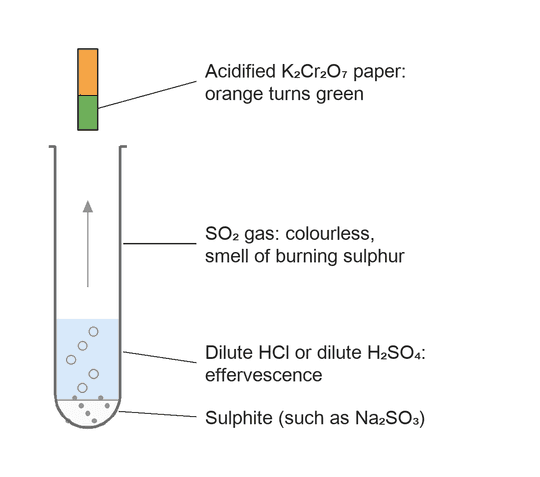
Hold a filter paper moistened with acidified potassium dichromate solution in the gas. Sulphur dioxide is a reducing agent: it reduces the orange dichromate to green chromium (III) sulphate, so the paper turns from orange to green.
Sulphur dioxide also decolourises pink acidified potassium permanganate solution.
Step 3 — (ii) Find the gas from iron (II) sulphide.
Iron (II) sulphide is the salt of hydrogen sulphide, a weak and volatile acid. Dilute hydrochloric acid sets free hydrogen sulphide, a colourless gas with the smell of rotten eggs.
Step 4 — (ii) Test for hydrogen sulphide.
Hold a moist lead acetate paper in the gas. Hydrogen sulphide reacts with the lead acetate to form black lead sulphide, so the paper turns silvery black.
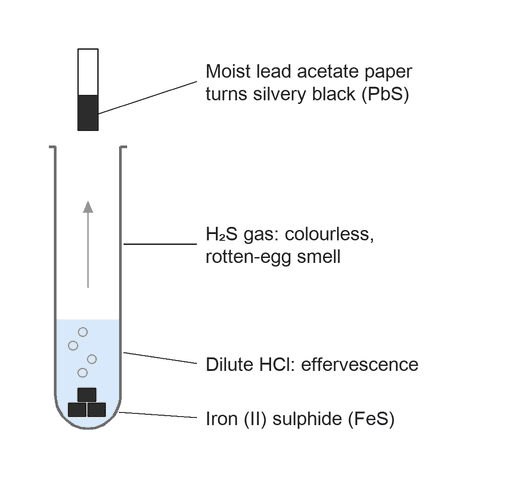
Watch out: Carbon dioxide also comes off with effervescence and turns lime water milky, but it does not change acidified dichromate. Use the dichromate paper (not lime water) to prove the gas is sulphur dioxide.
Therefore, (i) the gas is sulphur dioxide (SO₂), which turns acidified potassium dichromate paper from orange to green; (ii) the gas is hydrogen sulphide (H₂S), which turns moist lead acetate paper silvery black.
- 22 marks
Board paper question 2
Identify the salts P and Q from the observations given below:
(i) On performing the flame test salt P produces a lilac coloured flame and its solution gives a white precipitate with silver nitrate solution, which is soluble in Ammonium hydroxide solution.
(ii) When dilute HCl is added to a salt Q, a brisk effervescence is produced and the gas turns lime water milky. When solution is added to the above mixture (after adding dilute HCl), it produces a white precipitate which is soluble in excess solution.
Solve with AIWritten solution
Solution:
Concept: The cation of a salt is found from its flame colour and from the colour of the hydroxide precipitate it gives with sodium hydroxide or ammonium hydroxide (and whether that precipitate dissolves in excess). The anion is found from the gas a dilute acid gives, or from the precipitate silver nitrate gives.
Step 1 — (i) Cation of P from the flame test.
A lilac flame is the flame colour of potassium, so salt P contains potassium ions, .
Step 2 — (i) Anion of P from silver nitrate.
A white precipitate with silver nitrate that dissolves in ammonium hydroxide is silver chloride, so the anion is chloride, . The silver chloride dissolves because it forms a soluble complex with ammonia.
Putting the two ions together, P is potassium chloride, .
Step 3 — (ii) Anion of Q from dilute HCl.
Brisk effervescence of a gas that turns lime water milky shows carbon dioxide, so the anion is carbonate, .
Step 4 — (ii) Cation of Q from ammonium hydroxide.
The solution now holds the chloride of Q's metal. Ammonium hydroxide gives a white precipitate that dissolves in excess: that is zinc hydroxide, so the cation is zinc, .
Lead hydroxide is also white but does not dissolve in excess ammonium hydroxide, and calcium gives no precipitate with it. So Q is zinc carbonate, .

Watch out: The precipitate that dissolves in excess AMMONIUM hydroxide is zinc hydroxide; lead hydroxide dissolves in excess SODIUM hydroxide but not in excess ammonium hydroxide.
Therefore, P is potassium chloride (KCl) and Q is zinc carbonate (ZnCO₃).
- 31 mark
Board paper question 3
State one observation for each of the following:
Lead nitrate is heated strongly in a test tube.
Solve with AIWritten solution
Solution:
Concept: Most metal nitrates (other than those of sodium and potassium) break down on strong heating into the metal oxide, reddish brown nitrogen dioxide and oxygen. The colour of the oxide left behind tells the metal: zinc oxide is yellow when hot and white when cold, copper (II) oxide is black, and lead monoxide is reddish brown when hot and yellow when cold.
Step 1 — Write the change.
Lead nitrate is a heavy-metal nitrate, so on strong heating it breaks down into lead monoxide, nitrogen dioxide and oxygen.
Step 2 — Pick an observation.
The crystals hold a little trapped water, which turns to steam and bursts them, so they crackle (decrepitate). Reddish brown fumes of nitrogen dioxide fill the tube, and the residue of lead monoxide is reddish brown when hot and yellow when cold.
Any one of these observations earns the mark. A glowing splint held in the tube also relights, because oxygen comes off with the nitrogen dioxide.
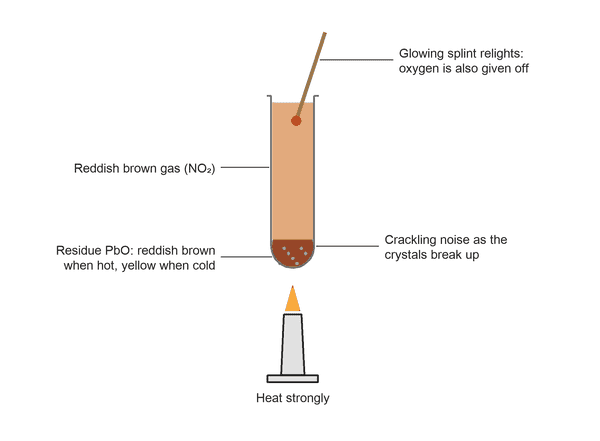
Watch out: The brown colour of the gas is nitrogen dioxide, not the oxygen; oxygen is colourless.
Therefore, on strong heating lead nitrate crackles and gives off reddish brown fumes of nitrogen dioxide, leaving a residue that is reddish brown when hot and yellow when cold.
- 41 mark
Board paper question 4
State one relevant observation for each of the following reactions:
(iv) Zinc carbonate is heated strongly.
Solve with AIWritten solution
Solution:
Concept: Most metal carbonates (other than those of sodium and potassium) break down on heating into the metal oxide and carbon dioxide; the colour change of the solid and the lime-water test show what happened.
Step 1 — Write the change.
Zinc carbonate breaks down on strong heating into zinc oxide and carbon dioxide.
Step 2 — Pick an observation.
The white zinc carbonate leaves a residue of zinc oxide that is yellow while hot and turns white on cooling. This colour change is the sign of zinc oxide. A colourless, odourless gas (carbon dioxide) also comes off and turns lime water milky.
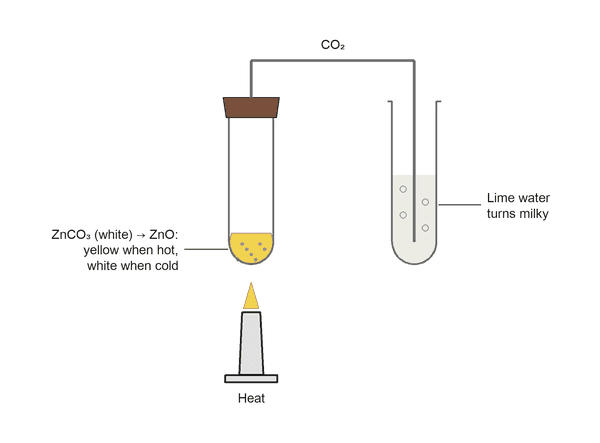
Watch out: Zinc oxide is yellow only while hot; a residue that stays yellow when cold would be lead monoxide.
Therefore, the white solid leaves a residue that is yellow when hot and white when cold, and a colourless gas that turns lime water milky is given off.
- 54 marks
Board paper question 5
Match the gases given in column I to the identification of the gases mentioned in column II:
Column I Column II (i) Hydrogen sulphide A. Turns acidified potassium dichromate solution green. (ii) Nitric oxide B. Turns lime water milky. (iii) Carbon dioxide C. Turns reddish brown when it reacts with oxygen. (iv) Sulphur dioxide D. Turns moist lead acetate paper silvery black. Solve with AIWritten solution
Solution:
Concept: Each gas has one characteristic test. Carbon dioxide and sulphur dioxide both turn lime water milky. Only sulphur dioxide, a reducing agent, turns acidified potassium dichromate from orange to green and decolourises pink acidified potassium permanganate; carbon dioxide has no effect on either.
Step 1 — (i) Hydrogen sulphide.
Hydrogen sulphide forms black lead sulphide on moist lead acetate paper, so the paper turns silvery black. It matches D.
Step 2 — (ii) Nitric oxide.
Nitric oxide is colourless, but it combines at once with the oxygen of the air to form reddish brown nitrogen dioxide. It matches C.
Step 3 — (iii) Carbon dioxide.
Carbon dioxide turns lime water milky, because insoluble calcium carbonate forms. It matches B.
Step 4 — (iv) Sulphur dioxide.
Sulphur dioxide is a reducing agent and turns acidified potassium dichromate from orange to green. It matches A.
Sulphur dioxide also turns lime water milky, but carbon dioxide has no effect on dichromate. So A must go to sulphur dioxide and B to carbon dioxide.
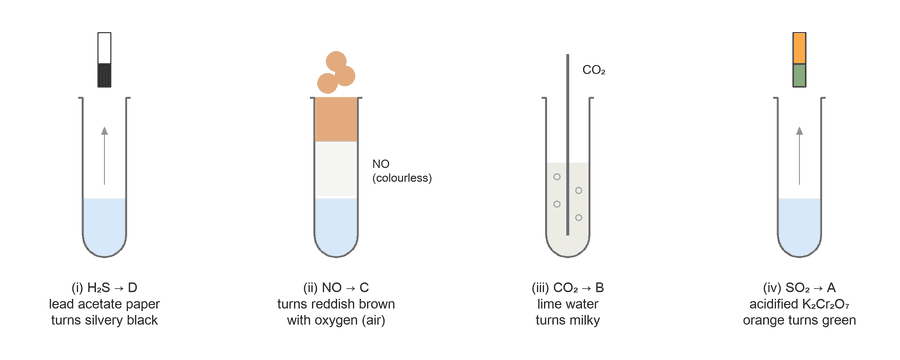
Watch out: Do not match sulphur dioxide to B just because it also turns lime water milky; each letter is used once.
Therefore, (i) – D, (ii) – C, (iii) – B, (iv) – A.
- 63 marks
Board paper question 6
Identify the salts P, Q, R from the following observations:
(i) Salt P has light bluish green colour. On heating, it produces a black coloured residue. Salt P produces brisk effervescence with dil. HCl and the gas evolved turns lime water milky, but no action with acidified potassium dichromate solution.
(ii) Salt Q is white in colour. On strong heating, it produces buff yellow residue and liberates reddish brown gas. Solution of salt Q produces chalky white insoluble precipitate with excess of ammonium hydroxide.
(iii) Salt R is black in colour. On reacting with concentrated HCl, it liberates a pungent greenish yellow gas which turns moist starch iodide paper blue black.
Solve with AIWritten solution
Solution:
Concept: Combine the colour of the salt, the colour of the residue left on heating, and the gas or precipitate it gives; each clue narrows the choice to one substance.
Step 1 — (i) Read the clues for P.
A light bluish green colour points to a copper (II) compound. Brisk effervescence with dilute HCl of a gas that turns lime water milky but has no action on acidified is carbon dioxide (sulphur dioxide would turn it green), so P is a carbonate. The black residue on heating is copper (II) oxide.
So P is copper carbonate, . (The green solid sold as copper carbonate is really basic copper carbonate, ; it gives the same results.)
Step 2 — (ii) Read the clues for Q.
A white salt that gives a reddish brown gas (nitrogen dioxide) on strong heating is a heavy-metal nitrate. The buff yellow residue is lead monoxide, and a chalky white precipitate with ammonium hydroxide that does not dissolve in excess is lead hydroxide (zinc hydroxide would dissolve in excess).
So Q is lead nitrate, .
Step 3 — (iii) Read the clues for R.
A black solid that gives pungent greenish yellow chlorine with concentrated HCl must be an oxidising agent, and the black one is manganese dioxide. Black copper (II) oxide gives no chlorine with concentrated HCl.
Chlorine turns moist starch iodide paper blue-black because it sets iodine free, and iodine turns starch blue-black.
So R is manganese dioxide, .

Watch out: A gas that turns lime water milky is not always carbon dioxide; the 'no action on acidified dichromate' clue is what rules out sulphur dioxide.
Note: Manganese dioxide is strictly an oxide, not a salt, although the question calls R a salt; it is the black solid that gives chlorine with concentrated HCl.
Therefore, P is copper carbonate (CuCO₃), Q is lead nitrate (Pb(NO₃)₂) and R is manganese dioxide (MnO₂).
All 28 board paper questions for this chapter, solved the same way.
Class 10 Chemistry Ch 13 questions students ask
How many questions are there in Class 10 Chemistry Ch 13?
41 questions. Every one is solved step by step on this page.
Are these Class 10 Chemistry solutions free?
Yes. Every question and its full working is free to read, with no account needed.
Can I download the Class 10 Chemistry Ch 13 solutions as a PDF?
There is no PDF to download. Every solution is on this page instead, which means it is searchable, always the current syllabus, and readable on a phone. Use your browser's print option if you want it on paper.