Solution:
Concept: A test distinguishes two substances only if they behave differently in it.
Step 1 — (a) Zinc and aluminium with hot conc. NaOH.
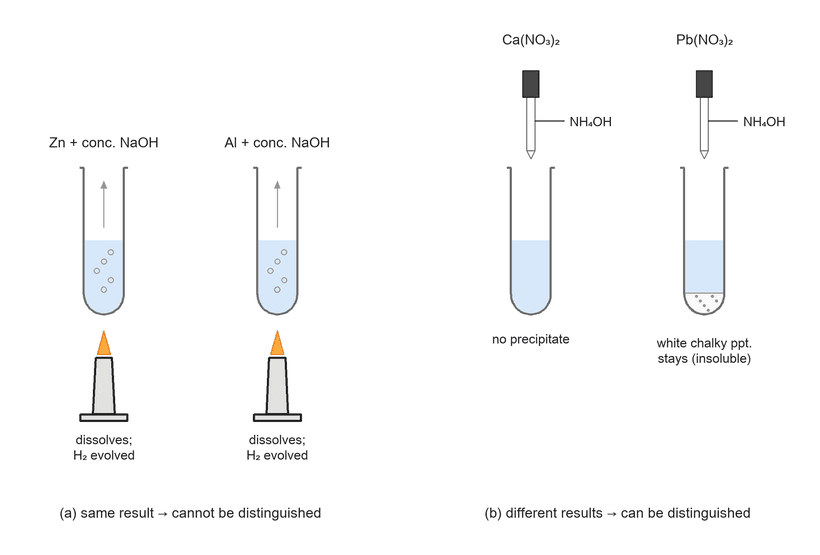
No, they cannot be distinguished. Both metals dissolve in hot concentrated sodium hydroxide to give a colourless solution, and both give off hydrogen. The observations are the same:
Zn+2NaOH→Na2ZnO2+H2↑
2Al+2NaOH+2H2O→2NaAlO2+3H2↑
Step 2 — (b) Calcium nitrate and lead nitrate with ammonium hydroxide.
Yes, they can be distinguished. Lead nitrate gives a white chalky precipitate of lead hydroxide, insoluble in excess ammonium hydroxide:
Pb(NO3)2+2NH4OH→Pb(OH)2↓+2NH4NO3
Calcium nitrate gives no precipitate, because ammonium hydroxide is a weak alkali and does not supply enough hydroxide ions to precipitate calcium hydroxide.
Watch out: With sodium hydroxide (a strong alkali) calcium nitrate does give a white precipitate; the difference in (b) comes from using ammonium hydroxide.
Therefore, (a) no: zinc and aluminium both dissolve and give hydrogen; (b) yes: lead nitrate gives a white precipitate with ammonium hydroxide, calcium nitrate gives none.
