
Question 91 markMCQEasy
A nitrate which forms a precipitate with ammonium hydroxide and is also soluble in excess of it :
Confirming your payment
Sign up now and get 250 free tokens.
Practical Work · Question 9 of 41
A nitrate which forms a precipitate with ammonium hydroxide and is also soluble in excess of it :
(A) ferrous nitrate
(B) ferric nitrate
(C) lead nitrate
(D) copper nitrate
Answer: (D) copper nitrate
Concept: Ammonium hydroxide precipitates most metal hydroxides. Of the cations in this chapter, only the copper (II) and zinc hydroxides dissolve in excess ammonium hydroxide; copper gives a deep (inky) blue solution.
Step 1 — Add a little ammonium hydroxide to copper nitrate.
A pale blue precipitate of copper (II) hydroxide forms:
Step 2 — Add excess ammonium hydroxide.
The precipitate dissolves and a deep blue solution of tetraamminecopper (II) nitrate forms:
So copper nitrate both forms a precipitate and dissolves in excess, as the question asks.
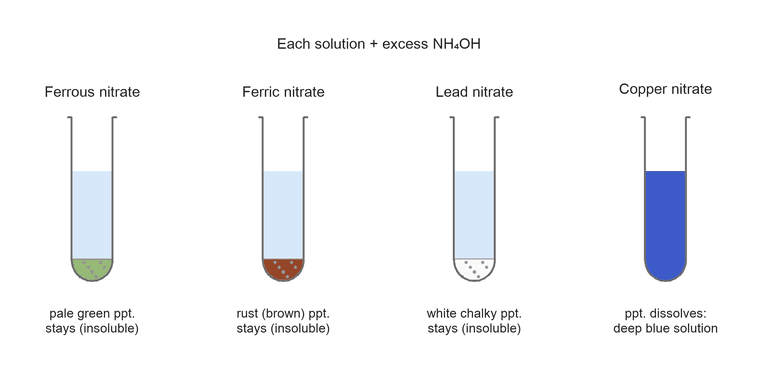
Watch out: 'soluble in excess' is a two-part test: a precipitate must form first and then dissolve.
Why the other options are wrong:
Therefore, the nitrate is copper nitrate, option (D).