Answer: (D) Both P and R
Concept: A sulphite with a dilute acid gives sulphur dioxide; a sulphide would give hydrogen sulphide. So we judge each statement against the properties of sulphur dioxide.
Step 1 — Find the gas.
Sodium sulphite reacts with dilute sulphuric acid to give sulphur dioxide:
Na2SO3+H2SO4→Na2SO4+H2O+SO2↑
Step 2 — Judge statement P.
Sulphur dioxide has the suffocating smell of burning sulphur and turns lime water milky. Statement P is true.
Step 3 — Judge statement R.
Sulphur dioxide is a reducing agent, so it decolourises pink (acidified) potassium permanganate. Statement R is true:
2KMnO4+2H2O+5SO2→K2SO4+2MnSO4+2H2SO4
Step 4 — Judge statement Q.
A foul smell and blackening of lead acetate belong to hydrogen sulphide, which comes from a sulphide, not a sulphite. Statement Q is false.
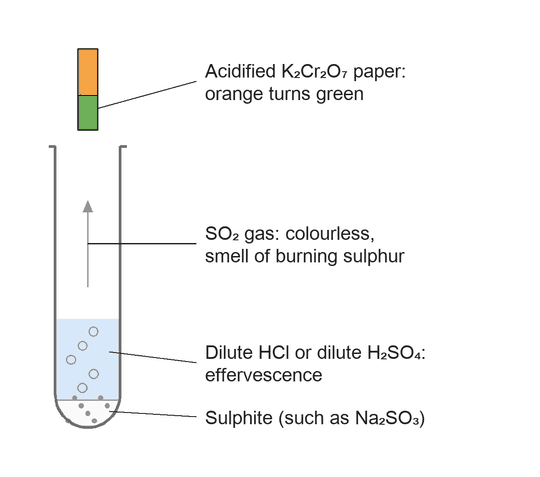
Watch out: Sulphite and sulphide differ by one letter but give different gases: sulphite → SO₂, sulphide → H₂S.
Why the other options are wrong:
- (A) Only P: 'only P' leaves out statement R, which is also true.
- (B) Only Q: statement Q is false: it describes hydrogen sulphide, which a sulphite does not give.
- (C) Only R: 'only R' leaves out statement P, which is also true.
Therefore, both P and R are true, option (D).
