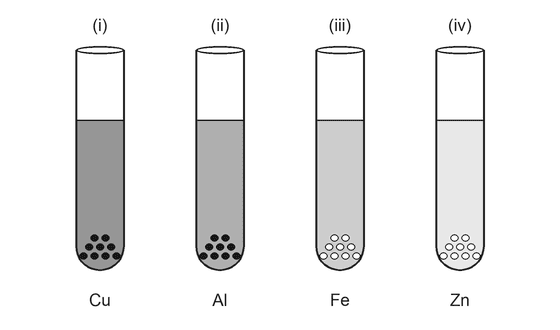
Answer: (D) (II) and (IV)
Concept: A more reactive metal displaces a less reactive metal from a solution of its salt. Iron displaced from ferrous sulphate settles as a finely divided black (greyish black) deposit.
Step 1 — Place each metal in the activity series.
The order of reactivity of the four metals is Al > Zn > Fe > Cu. Only a metal above iron can push iron out of ferrous sulphate.
Step 2 — Tubes II and IV (aluminium and zinc).
Aluminium and zinc are above iron, so they displace it, and black iron collects on the strip and at the bottom:
2Al+3FeSO4→Al2(SO4)3+3Fe
Zn+FeSO4→ZnSO4+Fe
The pale green colour of the solution also fades, because iron (II) ions are used up.
Step 3 — Tubes I and III (copper and iron).
Copper is below iron, so it cannot displace it; iron cannot displace itself from its own salt. These tubes show no change.
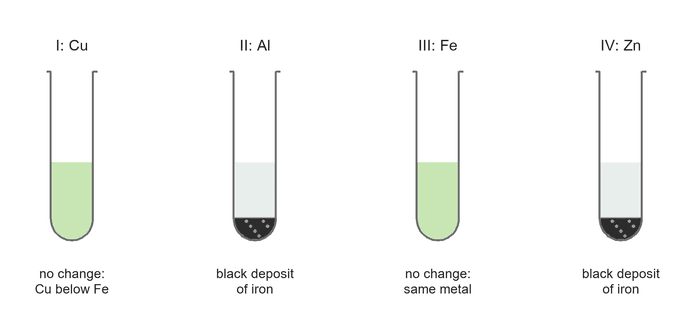
Watch out: In the laboratory the thin oxide layer on aluminium can make its reaction slow to start, but by the activity series aluminium still displaces iron.
Note: the figure printed with the question shades the grains dark in the first two tubes (I and II); the chemistry puts the black iron in tubes II (aluminium) and IV (zinc), which is also the book's key.
Why the other options are wrong:
- (A) (I) and (II): tube I holds copper, which is less reactive than iron and does not react.
- (B) (I) and (III): neither tube I (copper) nor tube III (iron) displaces iron, so neither shows a black residue.
- (C) (II) and (III): tube III holds iron, which does not react with its own salt.
Therefore, the black residue appears in test tubes (II) and (IV), option (D).