
Question 71 markMCQMedium
Aqueous lead (II) nitrate can be distinguished from aqueous zinc nitrate by adding any of the following solution in excess, except :
Confirming your payment
Sign up now and get 250 free tokens.
Practical Work · Question 7 of 41
Aqueous lead (II) nitrate can be distinguished from aqueous zinc nitrate by adding any of the following solution in excess, except :
(A) aqueous potassium chloride
(B) aqueous sodium sulphate
(C) dilute sulphuric acid
(D) sodium hydroxide solution
Answer: (D) sodium hydroxide solution
Concept: A reagent distinguishes two solutions only if it gives a different result with each. The question asks for the one reagent that does not distinguish them.
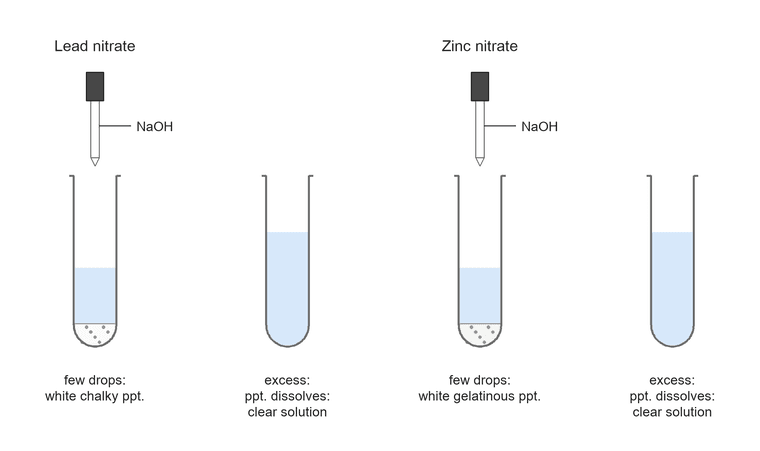
Step 1 — Add a little sodium hydroxide.
Both solutions give a white precipitate, because lead hydroxide and zinc hydroxide are both white:
Step 2 — Add sodium hydroxide in excess.
Both hydroxides are amphoteric, so both precipitates dissolve and both tubes become clear and colourless:
The two tubes look the same at every stage, so sodium hydroxide cannot distinguish them.
Step 3 — Check the other reagents.
Chloride and sulphate ions give white precipitates with lead ions (, ) but not with zinc ions, because zinc chloride and zinc sulphate are soluble. So each of the other three reagents does distinguish the solutions.
Watch out: 'except' asks for the reagent that FAILS; do not pick a reagent just because it gives a precipitate with lead.
Note: the book's printed key is (C), but dilute sulphuric acid does distinguish the two solutions (white lead sulphate forms with lead nitrate only). Only excess sodium hydroxide gives the same result with both, so (D) is the correct answer.
Why the other options are wrong:
Therefore, the reagent that cannot distinguish them is sodium hydroxide solution, option (D).