
Question 61 markMCQEasy
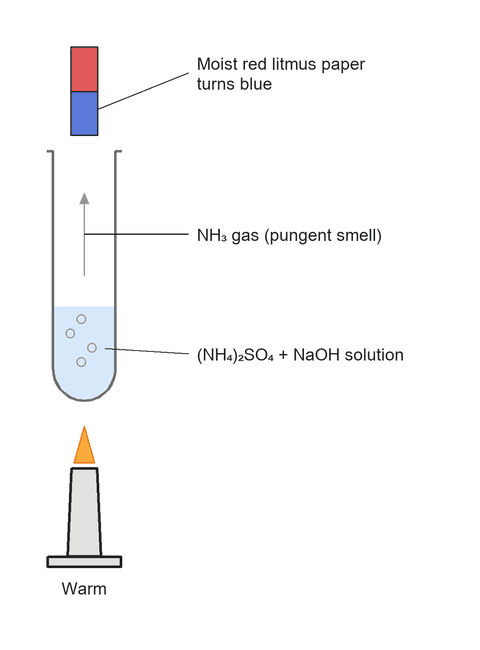
A compound P is heated in a test tube with sodium hydroxide solution. A red litmus paper held at the mouth of the test tube turns blue. Which of the following could compound P be ?
Confirming your payment
Sign up now and get 250 free tokens.
Practical Work · Question 6 of 41
A compound P is heated in a test tube with sodium hydroxide solution. A red litmus paper held at the mouth of the test tube turns blue. Which of the following could compound P be ?
(A) Zinc sulphate
(B) Copper sulphate
(C) Ferrous sulphate
(D) Ammonium sulphate
Answer: (D) Ammonium sulphate
Concept: An ammonium salt warmed with an alkali gives ammonia, the only common gas that turns moist red litmus blue. This is the test for the ammonium ion, .
Step 1 — Find the gas.
The red litmus at the mouth of the tube turns blue, so the gas given off is basic: it is ammonia.
Step 2 — Find the compound that gives ammonia.
Only an ammonium salt sets ammonia free when warmed with sodium hydroxide solution:
Ammonia dissolves in the water on the litmus paper to form ammonium hydroxide, an alkali, so the paper turns blue.
Watch out: A precipitate with NaOH is not a gas; only the ammonium salt gives off a gas here.
Why the other options are wrong:
Therefore, compound P could be ammonium sulphate, option (D).