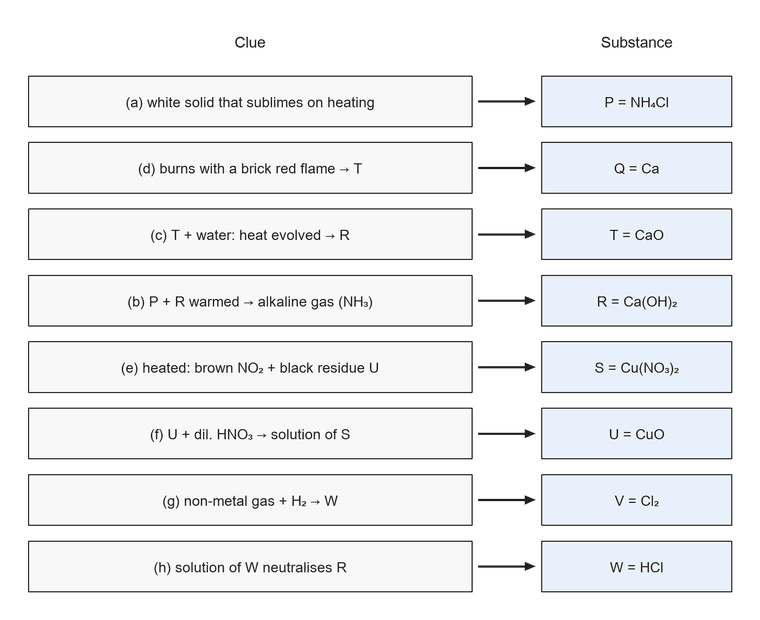
Use the information given in (a) to (h) to identify the substances P to W selecting your answers from the given list.
List :
Calcium
Oxygen
Copper (II) oxide
Carbon
Calcium hydroxide
Copper (II) nitrate
Lead (II) oxide
Hydrogen chloride
Chlorine
Lead (II) nitrate
Calcium oxide
Ammonium chloride
(a) P is a white solid. When heated produces white fumes (sublime).
(b) P and R on warming produce an alkaline gas.
(c) On adding water to T, heat is evolved and R is formed.
(d) Q burns with brick red flame in air to form T.
(e) When S is heated, it gives off brown fumes and leaves a black residue of U.
(f) A solution of S is formed by warming U with dilute nitric acid.
(g) V is a gaseous non metallic element that reacts with hydrogen to form W.
(h) A solution of W will neutralise the solution of R.
Solution:
Concept: Start with the clue that fixes a substance on its own (a sublimate, a brick red flame, brown fumes with a black residue), then follow the chain of letters through the other clues.
Step 1 — Clue (a): identify P.
A white solid that gives white fumes and sublimes on heating is P = ammonium chloride.
Step 2 — Clue (d): identify Q and T.
A metal that burns with a brick red flame is calcium, so Q = calcium, and the oxide it forms is T = calcium oxide:
2Ca+O2→2CaO
Step 3 — Clue (c): identify R.
Water added to calcium oxide (quicklime) gives out heat and forms slaked lime, so R = calcium hydroxide:
CaO+H2O→Ca(OH)2
Step 4 — Check clue (b).
Ammonium chloride (P) warmed with calcium hydroxide (R) gives the alkaline gas ammonia, which fits clue (b):
2NH4Cl+Ca(OH)2ΔCaCl2+2H2O+2NH3↑
Step 5 — Clues (e) and (f): identify S and U.
A nitrate that gives brown fumes of nitrogen dioxide and leaves a black residue is copper (II) nitrate, so S = copper (II) nitrate and U = copper (II) oxide. (Lead nitrate would leave a yellow residue.)
2Cu(NO3)2Δ2CuO+4NO2↑+O2↑
Warming U with dilute nitric acid gives back a solution of S, which fits clue (f):
CuO+2HNO3→Cu(NO3)2+H2O
Step 6 — Clues (g) and (h): identify V and W.
The gaseous non-metal in the list is chlorine, so V = chlorine; with hydrogen it forms W = hydrogen chloride:
H2+Cl2→2HCl
A solution of W (hydrochloric acid) neutralises a solution of R (calcium hydroxide), which fits clue (h):
Ca(OH)2+2HCl→CaCl2+2H2O
Watch out: Oxygen is also a gaseous non-metal in the list, but with hydrogen it forms water, which does not neutralise calcium hydroxide; chlorine is the only choice that fits both (g) and (h).
Therefore, P = ammonium chloride, Q = calcium, R = calcium hydroxide, S = copper (II) nitrate, T = calcium oxide, U = copper (II) oxide, V = chlorine, W = hydrogen chloride.