
Question 223 marksEasy
Copy and complete the following table which refers to the action of heat on some carbonates :
| Carbonate | Colour of residue on cooling |
|---|---|
| Zinc carbonate | |
| Lead carbonate | |
| Copper carbonate |
Confirming your payment
Sign up now and get 250 free tokens.
Practical Work · Question 22 of 41
Copy and complete the following table which refers to the action of heat on some carbonates :
| Carbonate | Colour of residue on cooling |
|---|---|
| Zinc carbonate | |
| Lead carbonate | |
| Copper carbonate |
Solution:
Concept: On heating, each of these carbonates gives off carbon dioxide and leaves its metal oxide. The colour of the oxide when hot and when cold identifies the metal.
Step 1 — Write the decomposition of each carbonate.
Each carbonate breaks up into its oxide and carbon dioxide; the colourless gas turns lime water milky:
Step 2 — Note the colour of each residue on cooling.
We read off the colour of each oxide once it has cooled:
| Carbonate | Colour of residue on cooling |
|---|---|
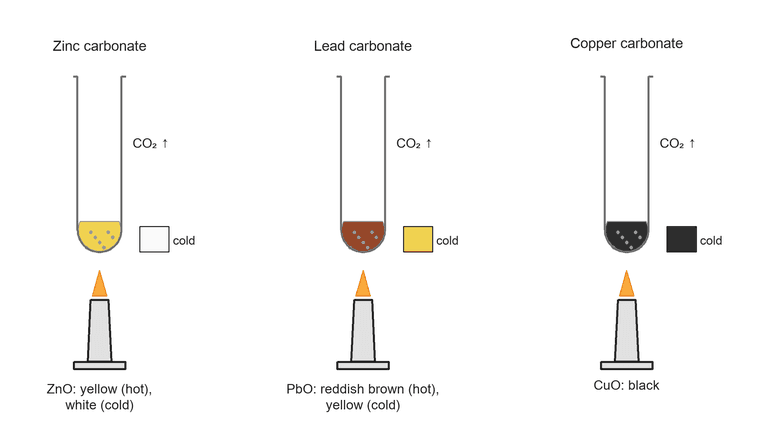
| Zinc carbonate | White (zinc oxide; yellow when hot) |
| Lead carbonate | Yellow (lead monoxide; reddish brown when hot) |
| Copper carbonate | Black (copper (II) oxide) |
Step 3 — See why the colours help.
Zinc oxide is the common residue that is yellow when hot and white when cold; lead monoxide is reddish brown when hot and yellow when cold (and it fuses into the glass); copper (II) oxide is black both hot and cold.
Watch out: The table asks for the colour on cooling: zinc oxide is white then, even though it looks yellow while hot.
Therefore, the residues on cooling are: zinc carbonate – white (ZnO); lead carbonate – yellow (PbO); copper carbonate – black (CuO).