Solution:
Concept: Sodium hydroxide precipitates the metal hydroxide from each salt solution. Zinc and lead hydroxides are amphoteric, so they dissolve in excess NaOH; the hydroxides of copper, calcium and iron do not.
Step 1 — Add a small quantity of NaOH.
Each metal ion forms its hydroxide, whose colour we note. For example:
CuSO4+2NaOH→Cu(OH)2↓+Na2SO4
Fe2(SO4)3+6NaOH→2Fe(OH)3↓+3Na2SO4
Step 2 — Add NaOH in excess.
Zinc hydroxide forms sodium zincate and lead hydroxide forms sodium plumbite; both are soluble and colourless:
Zn(OH)2+2NaOH→Na2ZnO2+2H2O
Pb(OH)2+2NaOH→Na2PbO2+2H2O
Step 3 — Fill in the table.
Putting the two observations together gives:
| Aqueous salt solution | Colour of precipitate (small quantity of NaOH) | Nature of precipitate (excess NaOH) |
|---|
| Copper (II) sulphate | (i) Pale blue | (vi) Insoluble |
| Zinc nitrate | (ii) White, gelatinous | (vii) Soluble |
| Lead nitrate | (iii) White, chalky | (viii) Soluble |
| Calcium chloride | (iv) White (slight) | (ix) Insoluble |
| Iron (III) sulphate | (v) Reddish brown | (x) Insoluble |
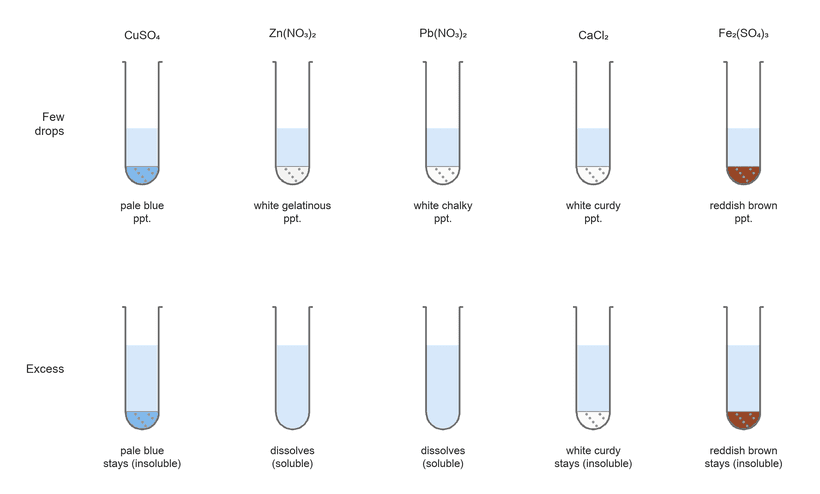
Watch out: Calcium hydroxide is only slightly soluble, so calcium chloride gives only a slight white precipitate, and it does not dissolve in excess NaOH (calcium hydroxide is not amphoteric).
Therefore, (i) pale blue, (ii) white gelatinous, (iii) white chalky, (iv) white, (v) reddish brown; (vi) insoluble, (vii) soluble, (viii) soluble, (ix) insoluble, (x) insoluble.
