
Question 243 marksEasy
Mention the colour changes observed when the following indicators are added :
| Solution | Acids | Alkalies |
|---|---|---|
| (a) Alkaline phenolphthalein solution, | ||
| (b) Methyl orange solution, | ||
| (c) Neutral litmus solution. |
Confirming your payment
Sign up now and get 250 free tokens.
Practical Work · Question 24 of 41
Mention the colour changes observed when the following indicators are added :
| Solution | Acids | Alkalies |
|---|---|---|
| (a) Alkaline phenolphthalein solution, | ||
| (b) Methyl orange solution, | ||
| (c) Neutral litmus solution. |
Solution:
Concept: An indicator has one colour in acid and another in alkali. We start from the colour the indicator already has and see whether the added solution changes it.
Step 1 — (a) Alkaline phenolphthalein.
Phenolphthalein is colourless in neutral and acidic solutions and pink in alkaline ones. 'Alkaline' phenolphthalein is already pink, so an acid turns it colourless, while an alkali leaves it pink.
Step 2 — (b) Methyl orange.
Methyl orange is orange in neutral solution, pink (red) in acid and yellow in alkali.
Step 3 — (c) Neutral litmus.
Neutral litmus solution is purple; it turns red in acid and blue in alkali.
Step 4 — Fill in the table.
Putting the three results together:
| Solution | Acids | Alkalies |
|---|---|---|
| (a) Alkaline phenolphthalein solution | Pink turns colourless | Remains pink |
| (b) Methyl orange solution | Orange turns pink (red) | Orange turns yellow |
| (c) Neutral litmus solution | Purple turns red | Purple turns blue |
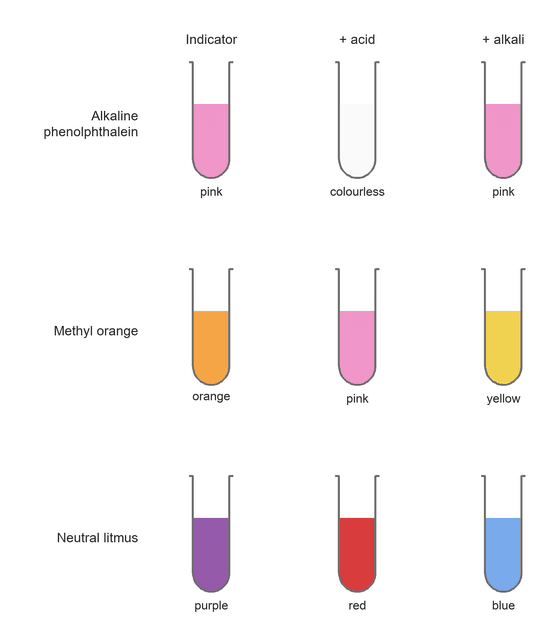
Watch out: Phenolphthalein never turns pink with an acid; with alkaline phenolphthalein the change is pink → colourless.
Therefore, (a) acid: pink → colourless, alkali: stays pink; (b) acid: orange → pink (red), alkali: orange → yellow; (c) acid: purple → red, alkali: purple → blue.