
Question 403 marksEasy
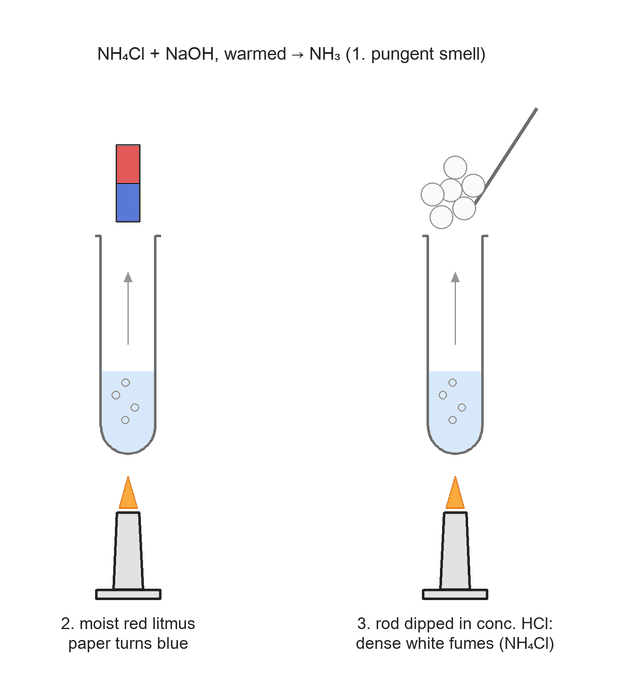
When an ammonium salt is warmed with sodium hydroxide solution, ammonia gas is evolved. State three ways in which you could identify this gas.
Confirming your payment
Sign up now and get 250 free tokens.
Practical Work · Question 40 of 41
When an ammonium salt is warmed with sodium hydroxide solution, ammonia gas is evolved. State three ways in which you could identify this gas.
Solution:
Concept: Ammonia is the only common alkaline gas, and it has a characteristic smell. Warming any ammonium salt with an alkali sets it free.
Step 1 — See where the ammonia comes from.
Warming an ammonium salt with sodium hydroxide solution gives ammonia gas, for example:
Step 2 — Way 1: smell.
The gas has a characteristic sharp, pungent smell (smelled by wafting, never sniffed directly).
Step 3 — Way 2: moist red litmus.
The gas turns moist red litmus paper blue, because it dissolves in the water on the paper to form the alkali ammonium hydroxide:
Step 4 — Way 3: conc. hydrochloric acid.
A glass rod dipped in concentrated hydrochloric acid and held near the gas gives dense white fumes of ammonium chloride:
Ammonia also turns Nessler's reagent brown, a fourth possible test.
Watch out: The litmus paper must be moist; dry ammonia cannot form ammonium hydroxide on dry paper.
Therefore, ammonia is identified by (1) its pungent smell, (2) turning moist red litmus blue, and (3) dense white fumes with a rod dipped in conc. HCl.