Answer: (A) (1) Both A and R are true and R is the correct explanation of A.
Concept: In an assertion–reason item, judge the Assertion and the Reason separately as true or false; only when both are true do we ask whether the Reason correctly explains the Assertion. Hydrogen sulphide gives black lead sulphide with lead salts; this is also why moist lead acetate paper turns black in hydrogen sulphide.
Step 1 — Judge the Assertion.
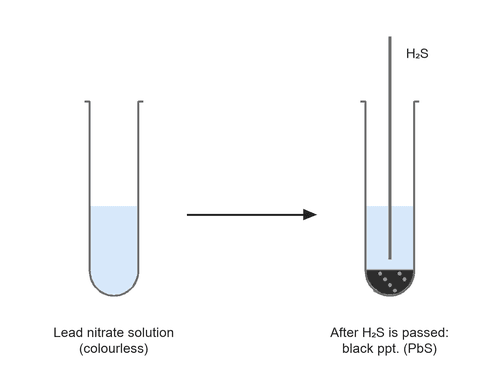
When hydrogen sulphide is passed through lead nitrate solution, a black precipitate forms. The Assertion is true.
Step 2 — Judge the Reason.
The black precipitate is lead sulphide, PbS. The Reason is true:
Pb(NO3)2+H2S→PbS↓+2HNO3
Step 3 — Does the Reason explain the Assertion?
Yes. The Reason names the reaction that produces the black precipitate, so it correctly explains the Assertion.
Why the other options are wrong:
- (B) (2) Both A and R are true but R is not the correct explanation of A: the Reason gives the reaction behind the black precipitate, so it is the correct explanation.
- (C) (3) A is true but R is false: the Reason is true: lead sulphide is black.
- (D) (4) A is false but R is true: the Assertion is true: a black precipitate does form.
Therefore, both statements are true and the Reason explains the Assertion, option (A).
