
Question 131 markMCQEasy
The following questions are Assertion-Reason based questions. Choose the answer based on the codes given below.
Assertion (A) : and can be distinguished by lime water.
Reason (R) : Both turn lime water milky.
Confirming your payment
Sign up now and get 250 free tokens.
Practical Work · Question 13 of 41
The following questions are Assertion-Reason based questions. Choose the answer based on the codes given below.
Assertion (A) : and can be distinguished by lime water.
Reason (R) : Both turn lime water milky.
(A) (1) Both A and R are true and R is the correct explanation of A.
(B) (2) Both A and R are true but R is not the correct explanation of A.
(C) (3) A is true but R is false.
(D) (4) A is false but R is true.
Answer: (D) (4) A is false but R is true.
Concept: In an assertion–reason item, judge the Assertion and the Reason separately as true or false; only when both are true do we ask whether the Reason correctly explains the Assertion. A test can distinguish two gases only if they behave differently in it.
Step 1 — Judge the Reason.
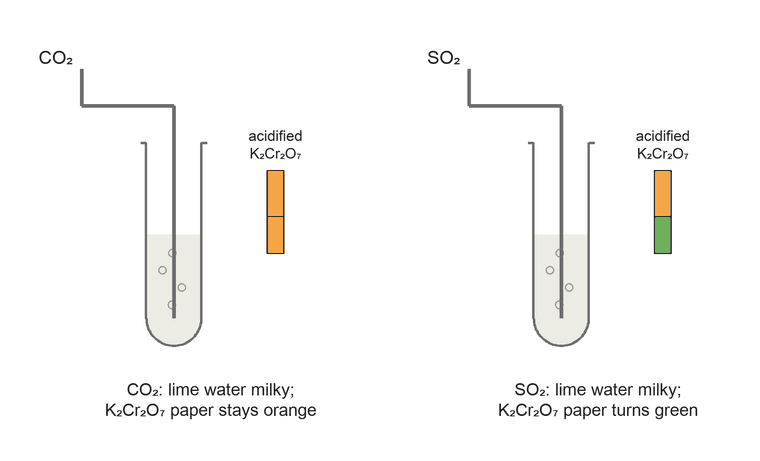
Both gases turn lime water milky, forming insoluble calcium carbonate and calcium sulphite. The Reason is true:
Step 2 — Judge the Assertion.
Since both gases give the same result, lime water cannot tell them apart. The Assertion is false. Acidified potassium dichromate is used instead: only sulphur dioxide turns it green.
Watch out: The Reason here actually shows why the Assertion is false.
Why the other options are wrong:
Therefore, the Assertion is false but the Reason is true, option (D).