Answer: (A) (1) Both A and R are true and R is the correct explanation of A.
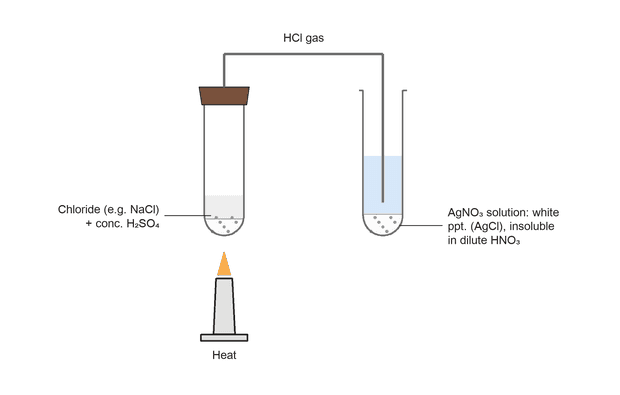
Concept: In an assertion–reason item, judge the Assertion and the Reason separately as true or false; only when both are true do we ask whether the Reason correctly explains the Assertion. Here, hydrogen chloride is identified because it gives a curdy white precipitate of silver chloride with silver nitrate solution.
Step 1 — Judge the Assertion.
Silver nitrate solution is the standard test for hydrogen chloride. The Assertion is true.
Step 2 — Judge the Reason.
The chloride ions from HCl combine with silver ions to form insoluble white silver chloride. The Reason is true:
HCl+AgNO3→AgCl↓+HNO3
The precipitate does not dissolve in dilute nitric acid but dissolves in ammonium hydroxide, which confirms that it is silver chloride.
Step 3 — Does the Reason explain the Assertion?
Yes. The white precipitate is exactly what we see in the test, so the Reason is the correct explanation.
Why the other options are wrong:
- (B) (2) Both A and R are true but R is not the correct explanation of A: the Reason is the very observation the test relies on, so it does explain the Assertion.
- (C) (3) A is true but R is false: the Reason is true: silver chloride is a white precipitate.
- (D) (4) A is false but R is true: the Assertion is true: silver nitrate solution is used to test for HCl.
Therefore, both statements are true and the Reason explains the Assertion, option (A).
