The following questions are Assertion-Reason based questions.
Question 151 markMCQEasy
The following questions are Assertion-Reason based questions. Choose the answer based on the codes given below.
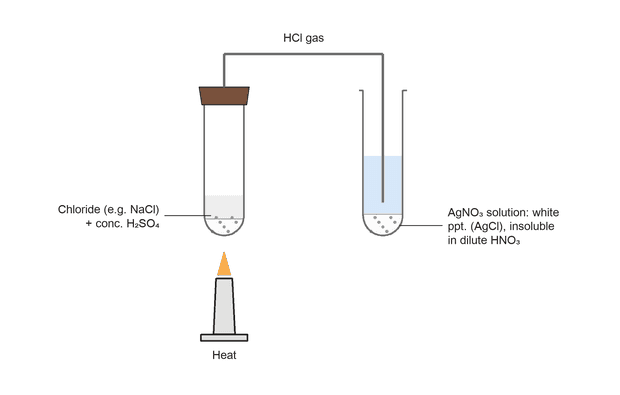
Assertion (A) : Chloride can be tested by adding concentrated sulphuric acid to it. A colourless gas with a pungent odour is evolved.
Reason (R) : The gas formed is chlorine.
Select your answer
(A) (1) Both A and R are true and R is the correct explanation of A.
(B) (2) Both A and R are true but R is not the correct explanation of A.
(C) (3) A is true but R is false.
Correct answer
(D) (4) A is false but R is true.
Answer: (C) (3) A is true but R is false.
Concept: In an assertion–reason item, judge the Assertion and the Reason separately as true or false; only when both are true do we ask whether the Reason correctly explains the Assertion. A chloride warmed with concentrated sulphuric acid gives hydrogen chloride, a colourless gas with a pungent (choking) smell, not chlorine.
Step 1 — Judge the Assertion.
Warming a chloride with concentrated sulphuric acid gives a colourless, pungent gas, which shows that a chloride may be present. The Assertion is true:
NaCl+H2SO4ΔNaHSO4+HCl↑
Step 2 — Judge the Reason.
The gas is hydrogen chloride, not chlorine. Chlorine is greenish yellow, not colourless, and concentrated sulphuric acid alone does not oxidise a chloride to chlorine (manganese dioxide must be added for that). The Reason is false.
Watch out: HCl gas (colourless, fumes in moist air) and Cl₂ gas (greenish yellow) are easily confused by name.
Why the other options are wrong:
(A) (1) Both A and R are true and R is the correct explanation of A: code (1) needs the Reason to be true, but the gas is HCl, not chlorine.
(B) (2) Both A and R are true but R is not the correct explanation of A: code (2) also needs the Reason to be true.
(D) (4) A is false but R is true: code (4) says the Assertion is false, but the colourless pungent gas is a valid sign of a chloride.
Therefore, the Assertion is true but the Reason is false, option (C).