
Question 12 marksAsked 2016Medium
Identify the gas evolved and give the chemical test in each of the following cases:
(i) Dilute hydrochloric acid reacts with sodium sulphite.
(ii) Dilute hydrochloric acid reacts with iron (II) sulphide.
Confirming your payment
Sign up now and get 250 free tokens.
Previous Year Questions · Question 1 of 28
Identify the gas evolved and give the chemical test in each of the following cases:
(i) Dilute hydrochloric acid reacts with sodium sulphite.
(ii) Dilute hydrochloric acid reacts with iron (II) sulphide.
Solution:
Concept: A dilute acid decomposes the salt of a weaker or more volatile acid and sets that acid's gas free: a carbonate gives carbon dioxide, a sulphite gives sulphur dioxide and a sulphide gives hydrogen sulphide. Each gas is then confirmed by its own test.
Step 1 — (i) Find the gas from sodium sulphite.
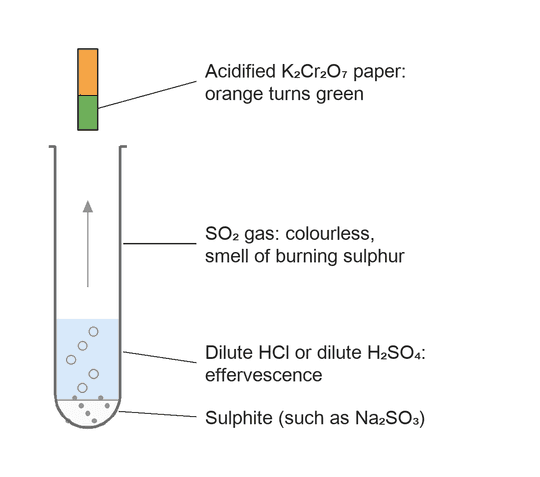
Sodium sulphite is the salt of sulphurous acid, a weak and unstable acid. Dilute hydrochloric acid sets that acid free, and it breaks up at once into water and sulphur dioxide, a colourless gas with the suffocating smell of burning sulphur.
Step 2 — (i) Test for sulphur dioxide.
Hold a filter paper moistened with acidified potassium dichromate solution in the gas. Sulphur dioxide is a reducing agent: it reduces the orange dichromate to green chromium (III) sulphate, so the paper turns from orange to green.
Sulphur dioxide also decolourises pink acidified potassium permanganate solution.
Step 3 — (ii) Find the gas from iron (II) sulphide.
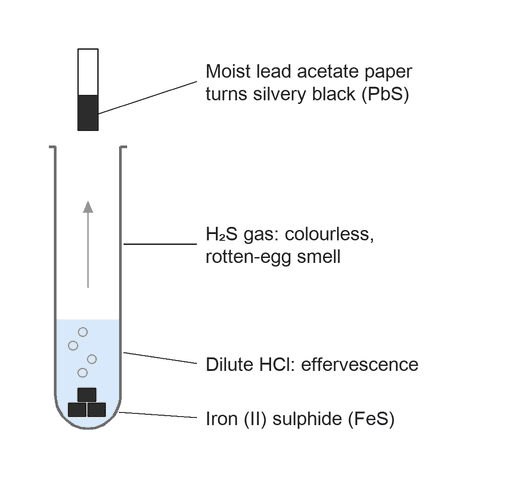
Iron (II) sulphide is the salt of hydrogen sulphide, a weak and volatile acid. Dilute hydrochloric acid sets free hydrogen sulphide, a colourless gas with the smell of rotten eggs.
Step 4 — (ii) Test for hydrogen sulphide.
Hold a moist lead acetate paper in the gas. Hydrogen sulphide reacts with the lead acetate to form black lead sulphide, so the paper turns silvery black.
Watch out: Carbon dioxide also comes off with effervescence and turns lime water milky, but it does not change acidified dichromate. Use the dichromate paper (not lime water) to prove the gas is sulphur dioxide.
Therefore, (i) the gas is sulphur dioxide (SO₂), which turns acidified potassium dichromate paper from orange to green; (ii) the gas is hydrogen sulphide (H₂S), which turns moist lead acetate paper silvery black.