
Opening your dashboard
Class 10 Chemistry Chapter 13 Practical Work: Previous Year Questions
28 questions on Chapter 13, each solved step by step. Class 10 Chemistry, ICSE 2026-27.
28 questions with solutions
1–4 marks · Mixed difficulty
- 12 marks
Question 1
Identify the gas evolved and give the chemical test in each of the following cases:
(i) Dilute hydrochloric acid reacts with sodium sulphite.
(ii) Dilute hydrochloric acid reacts with iron (II) sulphide.
Solve with AIWritten solution
Solution:
Concept: A dilute acid decomposes the salt of a weaker or more volatile acid and sets that acid's gas free: a carbonate gives carbon dioxide, a sulphite gives sulphur dioxide and a sulphide gives hydrogen sulphide. Each gas is then confirmed by its own test.
Step 1 — (i) Find the gas from sodium sulphite.
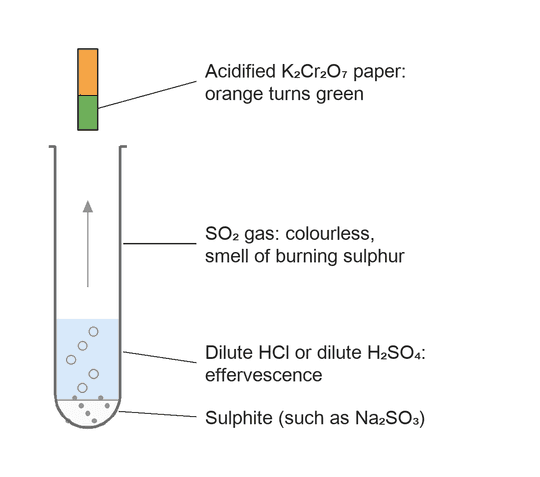
Sodium sulphite is the salt of sulphurous acid, a weak and unstable acid. Dilute hydrochloric acid sets that acid free, and it breaks up at once into water and sulphur dioxide, a colourless gas with the suffocating smell of burning sulphur.
Step 2 — (i) Test for sulphur dioxide.
Hold a filter paper moistened with acidified potassium dichromate solution in the gas. Sulphur dioxide is a reducing agent: it reduces the orange dichromate to green chromium (III) sulphate, so the paper turns from orange to green.
Sulphur dioxide also decolourises pink acidified potassium permanganate solution.
Step 3 — (ii) Find the gas from iron (II) sulphide.
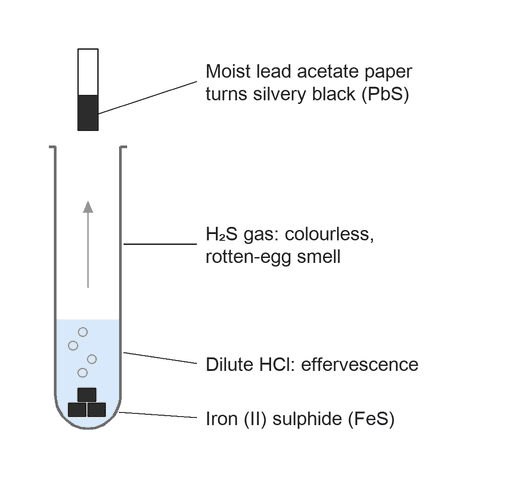
Iron (II) sulphide is the salt of hydrogen sulphide, a weak and volatile acid. Dilute hydrochloric acid sets free hydrogen sulphide, a colourless gas with the smell of rotten eggs.
Step 4 — (ii) Test for hydrogen sulphide.
Hold a moist lead acetate paper in the gas. Hydrogen sulphide reacts with the lead acetate to form black lead sulphide, so the paper turns silvery black.
Watch out: Carbon dioxide also comes off with effervescence and turns lime water milky, but it does not change acidified dichromate. Use the dichromate paper (not lime water) to prove the gas is sulphur dioxide.
Therefore, (i) the gas is sulphur dioxide (SO₂), which turns acidified potassium dichromate paper from orange to green; (ii) the gas is hydrogen sulphide (H₂S), which turns moist lead acetate paper silvery black.
- 22 marks
Question 2
Identify the salts P and Q from the observations given below:
(i) On performing the flame test salt P produces a lilac coloured flame and its solution gives a white precipitate with silver nitrate solution, which is soluble in Ammonium hydroxide solution.
(ii) When dilute HCl is added to a salt Q, a brisk effervescence is produced and the gas turns lime water milky. When solution is added to the above mixture (after adding dilute HCl), it produces a white precipitate which is soluble in excess solution.
Solve with AIWritten solution
Solution:
Concept: The cation of a salt is found from its flame colour and from the colour of the hydroxide precipitate it gives with sodium hydroxide or ammonium hydroxide (and whether that precipitate dissolves in excess). The anion is found from the gas a dilute acid gives, or from the precipitate silver nitrate gives.
Step 1 — (i) Cation of P from the flame test.
A lilac flame is the flame colour of potassium, so salt P contains potassium ions, .
Step 2 — (i) Anion of P from silver nitrate.
A white precipitate with silver nitrate that dissolves in ammonium hydroxide is silver chloride, so the anion is chloride, . The silver chloride dissolves because it forms a soluble complex with ammonia.
Putting the two ions together, P is potassium chloride, .
Step 3 — (ii) Anion of Q from dilute HCl.
Brisk effervescence of a gas that turns lime water milky shows carbon dioxide, so the anion is carbonate, .
Step 4 — (ii) Cation of Q from ammonium hydroxide.
The solution now holds the chloride of Q's metal. Ammonium hydroxide gives a white precipitate that dissolves in excess: that is zinc hydroxide, so the cation is zinc, .
Lead hydroxide is also white but does not dissolve in excess ammonium hydroxide, and calcium gives no precipitate with it. So Q is zinc carbonate, .

Watch out: The precipitate that dissolves in excess AMMONIUM hydroxide is zinc hydroxide; lead hydroxide dissolves in excess SODIUM hydroxide but not in excess ammonium hydroxide.
Therefore, P is potassium chloride (KCl) and Q is zinc carbonate (ZnCO₃).
- 31 mark
Question 3
State one observation for each of the following:
Lead nitrate is heated strongly in a test tube.
Solve with AIWritten solution
Solution:
Concept: Most metal nitrates (other than those of sodium and potassium) break down on strong heating into the metal oxide, reddish brown nitrogen dioxide and oxygen. The colour of the oxide left behind tells the metal: zinc oxide is yellow when hot and white when cold, copper (II) oxide is black, and lead monoxide is reddish brown when hot and yellow when cold.
Step 1 — Write the change.
Lead nitrate is a heavy-metal nitrate, so on strong heating it breaks down into lead monoxide, nitrogen dioxide and oxygen.
Step 2 — Pick an observation.
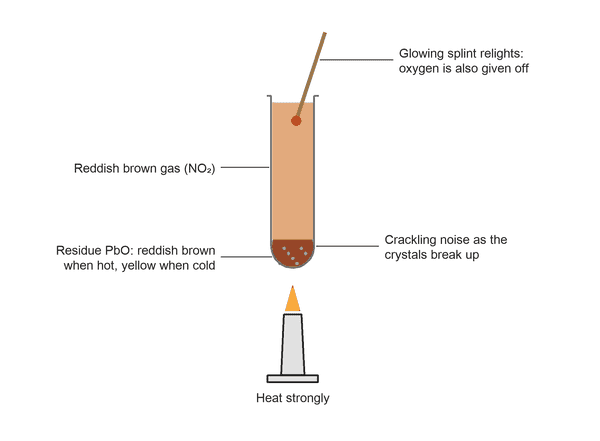
The crystals hold a little trapped water, which turns to steam and bursts them, so they crackle (decrepitate). Reddish brown fumes of nitrogen dioxide fill the tube, and the residue of lead monoxide is reddish brown when hot and yellow when cold.
Any one of these observations earns the mark. A glowing splint held in the tube also relights, because oxygen comes off with the nitrogen dioxide.
Watch out: The brown colour of the gas is nitrogen dioxide, not the oxygen; oxygen is colourless.
Therefore, on strong heating lead nitrate crackles and gives off reddish brown fumes of nitrogen dioxide, leaving a residue that is reddish brown when hot and yellow when cold.
- 41 mark
Question 4
State one relevant observation for each of the following reactions:
(iv) Zinc carbonate is heated strongly.
Solve with AIWritten solution
Solution:
Concept: Most metal carbonates (other than those of sodium and potassium) break down on heating into the metal oxide and carbon dioxide; the colour change of the solid and the lime-water test show what happened.
Step 1 — Write the change.
Zinc carbonate breaks down on strong heating into zinc oxide and carbon dioxide.
Step 2 — Pick an observation.
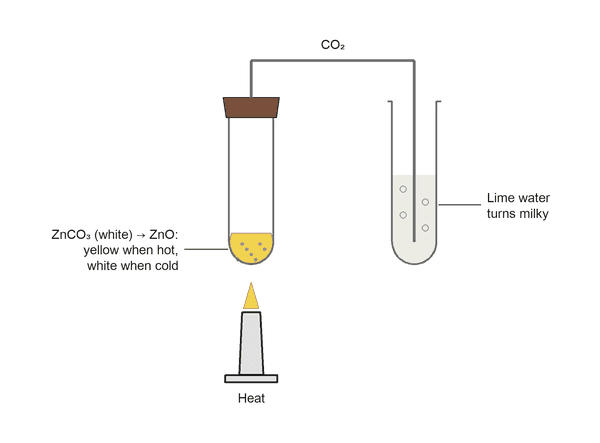
The white zinc carbonate leaves a residue of zinc oxide that is yellow while hot and turns white on cooling. This colour change is the sign of zinc oxide. A colourless, odourless gas (carbon dioxide) also comes off and turns lime water milky.
Watch out: Zinc oxide is yellow only while hot; a residue that stays yellow when cold would be lead monoxide.
Therefore, the white solid leaves a residue that is yellow when hot and white when cold, and a colourless gas that turns lime water milky is given off.
- 54 marks
Question 5
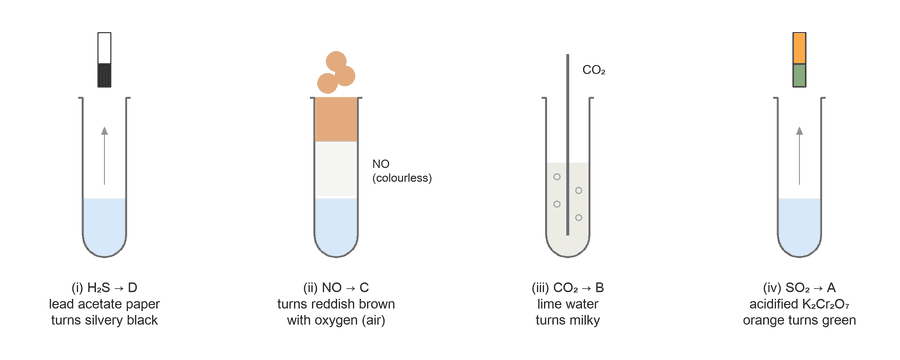
Match the gases given in column I to the identification of the gases mentioned in column II:
Column I Column II (i) Hydrogen sulphide A. Turns acidified potassium dichromate solution green. (ii) Nitric oxide B. Turns lime water milky. (iii) Carbon dioxide C. Turns reddish brown when it reacts with oxygen. (iv) Sulphur dioxide D. Turns moist lead acetate paper silvery black. Solve with AIWritten solution
Solution:
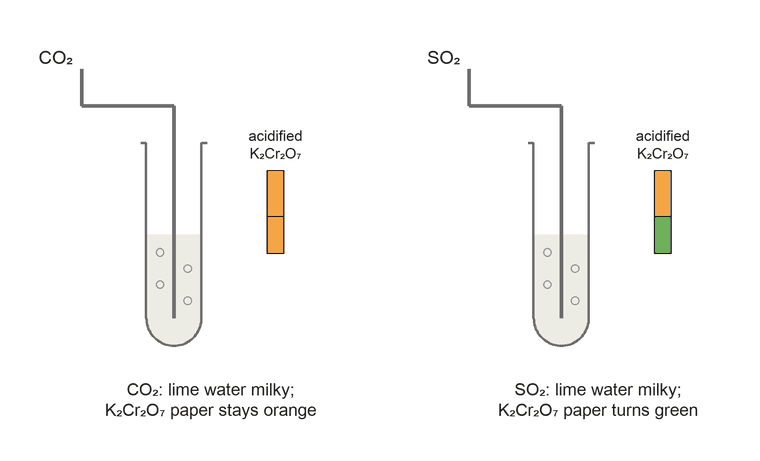
Concept: Each gas has one characteristic test. Carbon dioxide and sulphur dioxide both turn lime water milky. Only sulphur dioxide, a reducing agent, turns acidified potassium dichromate from orange to green and decolourises pink acidified potassium permanganate; carbon dioxide has no effect on either.
Step 1 — (i) Hydrogen sulphide.
Hydrogen sulphide forms black lead sulphide on moist lead acetate paper, so the paper turns silvery black. It matches D.
Step 2 — (ii) Nitric oxide.
Nitric oxide is colourless, but it combines at once with the oxygen of the air to form reddish brown nitrogen dioxide. It matches C.
Step 3 — (iii) Carbon dioxide.
Carbon dioxide turns lime water milky, because insoluble calcium carbonate forms. It matches B.
Step 4 — (iv) Sulphur dioxide.
Sulphur dioxide is a reducing agent and turns acidified potassium dichromate from orange to green. It matches A.
Sulphur dioxide also turns lime water milky, but carbon dioxide has no effect on dichromate. So A must go to sulphur dioxide and B to carbon dioxide.
Watch out: Do not match sulphur dioxide to B just because it also turns lime water milky; each letter is used once.
Therefore, (i) – D, (ii) – C, (iii) – B, (iv) – A.
- 63 marks
Question 6
Identify the salts P, Q, R from the following observations:
(i) Salt P has light bluish green colour. On heating, it produces a black coloured residue. Salt P produces brisk effervescence with dil. HCl and the gas evolved turns lime water milky, but no action with acidified potassium dichromate solution.
(ii) Salt Q is white in colour. On strong heating, it produces buff yellow residue and liberates reddish brown gas. Solution of salt Q produces chalky white insoluble precipitate with excess of ammonium hydroxide.
(iii) Salt R is black in colour. On reacting with concentrated HCl, it liberates a pungent greenish yellow gas which turns moist starch iodide paper blue black.
Solve with AIWritten solution
Solution:
Concept: Combine the colour of the salt, the colour of the residue left on heating, and the gas or precipitate it gives; each clue narrows the choice to one substance.
Step 1 — (i) Read the clues for P.
A light bluish green colour points to a copper (II) compound. Brisk effervescence with dilute HCl of a gas that turns lime water milky but has no action on acidified is carbon dioxide (sulphur dioxide would turn it green), so P is a carbonate. The black residue on heating is copper (II) oxide.
So P is copper carbonate, . (The green solid sold as copper carbonate is really basic copper carbonate, ; it gives the same results.)
Step 2 — (ii) Read the clues for Q.
A white salt that gives a reddish brown gas (nitrogen dioxide) on strong heating is a heavy-metal nitrate. The buff yellow residue is lead monoxide, and a chalky white precipitate with ammonium hydroxide that does not dissolve in excess is lead hydroxide (zinc hydroxide would dissolve in excess).
So Q is lead nitrate, .
Step 3 — (iii) Read the clues for R.
A black solid that gives pungent greenish yellow chlorine with concentrated HCl must be an oxidising agent, and the black one is manganese dioxide. Black copper (II) oxide gives no chlorine with concentrated HCl.
Chlorine turns moist starch iodide paper blue-black because it sets iodine free, and iodine turns starch blue-black.
So R is manganese dioxide, .

Watch out: A gas that turns lime water milky is not always carbon dioxide; the 'no action on acidified dichromate' clue is what rules out sulphur dioxide.
Note: Manganese dioxide is strictly an oxide, not a salt, although the question calls R a salt; it is the black solid that gives chlorine with concentrated HCl.
Therefore, P is copper carbonate (CuCO₃), Q is lead nitrate (Pb(NO₃)₂) and R is manganese dioxide (MnO₂).
- 71 mark
Question 7
The gas formed, when calcium bisulphite reacts with dilute :
Solve with AIAnswer
(A) Sulphur trioxide
(B) Hydrogen
- Correct
(C) Sulphur dioxide
(D) Hydrogen sulphide
Answer: (C) Sulphur dioxide
Concept: A dilute acid decomposes a sulphite or a bisulphite (hydrogen sulphite) and sets sulphur dioxide free.
Step 1 — Write the reaction.
Calcium bisulphite is calcium hydrogen sulphite. The dilute acid sets free sulphurous acid, which breaks up into water and sulphur dioxide.
Step 2 — Identify the gas.
The gas is colourless, smells of burning sulphur and turns acidified potassium dichromate paper from orange to green, so it is sulphur dioxide.
Note: In the laboratory this test is normally done with dilute HCl or dilute sulphuric acid, because nitric acid is an oxidising agent and can oxidise some of the sulphur dioxide to sulphate. The gas the reaction gives is still sulphur dioxide, as keyed.
Why the other options are wrong:
- (A) Sulphur trioxide: it is made by the catalytic oxidation of sulphur dioxide (contact process); a dilute acid does not set it free from a bisulphite.
- (B) Hydrogen: it comes from a dilute acid acting on an active metal such as zinc, not on a salt like a bisulphite.
- (D) Hydrogen sulphide: it comes from a sulphide with a dilute acid, not from a bisulphite.
Therefore, the gas formed is sulphur dioxide, option (C).
- 82 marks
Question 8
Identify the gas P and Q in the reactions given below:
(a) A compound reacts with an acid to form gas P which has no effect on acidified solution but turns lime water milky.
(b) A metallic nitrate reacts on heating gives oxygen gas along with a coloured gas Q.
Solve with AIWritten solution
Solution:
Concept: Carbon dioxide and sulphur dioxide both turn lime water milky. Only sulphur dioxide, a reducing agent, turns acidified potassium dichromate from orange to green and decolourises pink acidified potassium permanganate; carbon dioxide has no effect on either. Heavy-metal nitrates give oxygen together with a coloured gas on heating.
Step 1 — (a) Narrow down gas P.
Gas P turns lime water milky, so it is carbon dioxide or sulphur dioxide.
Step 2 — (a) Decide with the dichromate test.
Sulphur dioxide would turn acidified green, but gas P has no effect on it. So P is carbon dioxide. The compound is a carbonate or a hydrogen carbonate, which an acid decomposes.
Step 3 — (b) Identify gas Q.
A heavy-metal nitrate such as copper nitrate breaks down on heating into the metal oxide, oxygen and reddish brown nitrogen dioxide. Oxygen is colourless, so the coloured gas Q is nitrogen dioxide.
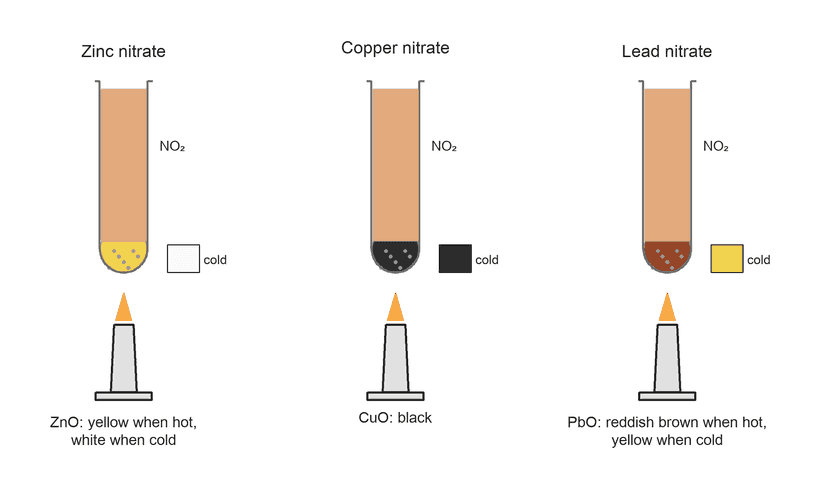
Watch out: The coloured gas is nitrogen dioxide, not nitric oxide; nitric oxide (NO) is colourless.
Therefore, gas P is carbon dioxide (CO₂) and gas Q is nitrogen dioxide (NO₂).
- 93 marks
Question 9
Study the diagram, which shows the Brown Ring Test and answer the questions given below:
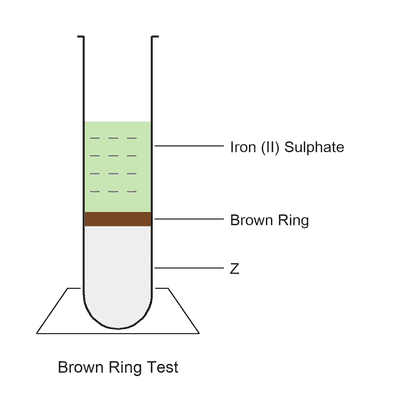
(a) Which ion is determined by Brown Ring Test?
(b) Why is freshly prepared iron[II] sulphate used in the test?
(c) Name the substance Z.
Solve with AIWritten solution
Solution:
Concept: The brown ring test detects a nitrate. Freshly prepared iron (II) sulphate solution is added to the nitrate solution and conc. sulphuric acid is poured slowly down the side; iron (II) ions reduce the nitrate to nitric oxide, which combines with more iron (II) sulphate to form brown nitroso ferrous sulphate where the two layers meet.
Step 1 — (a) The ion tested.
The brown ring test is the confirmatory test for the nitrate ion, .
Step 2 — (b) Why the iron (II) sulphate must be fresh.
On standing, iron (II) sulphate solution is slowly oxidised by the air to iron (III) sulphate. The test needs iron (II) ions, because they do two jobs: they reduce the nitrate (as nitric acid) to nitric oxide, and they then combine with the nitric oxide to form the brown compound.
An old solution has too few iron (II) ions left, so it gives a faint ring or none at all.
Step 3 — (c) Name Z.
Z is concentrated sulphuric acid. It is poured slowly down the side of the tube; being much denser than the aqueous solution, it sinks and forms the lower layer, and the brown ring of nitroso ferrous sulphate, , appears where the two layers meet.
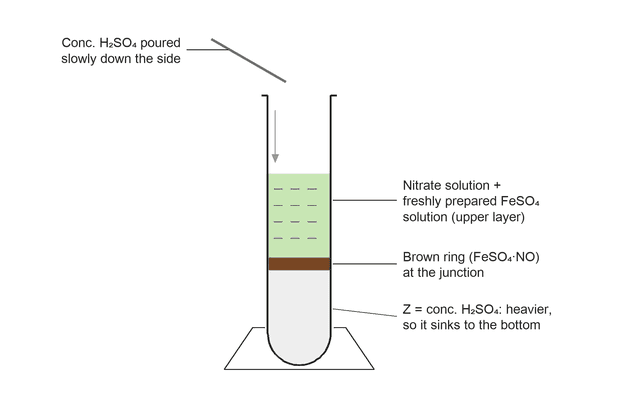
Watch out: The brown ring forms at the JUNCTION of the two layers; if the tube is shaken the layers mix and the ring disappears.
Therefore, (a) the brown ring test detects the nitrate ion (NO₃⁻); (b) fresh iron (II) sulphate is used because on standing it is oxidised by air to iron (III) sulphate, which cannot form the brown ring; (c) Z is concentrated sulphuric acid.
- 101 mark
Question 10
Distinguish between the following as directed:
(a) Sodium sulphite solution and sodium sulphate solution. [using dilute ]
Solve with AIWritten solution
Solution:
Concept: A dilute acid decomposes a sulphite, giving sulphur dioxide gas. A sulphate is the salt of sulphuric acid itself, so dilute sulphuric acid has no gas to set free from it.
Step 1 — Add dilute sulphuric acid to sodium sulphite.
There is effervescence (warm if needed) of a colourless gas with the smell of burning sulphur, which turns acidified potassium dichromate paper from orange to green.
Step 2 — Add dilute sulphuric acid to sodium sulphate.
No gas is given off and there is no visible change, because nothing reacts.
Therefore, sodium sulphite gives effervescence of sulphur dioxide (smell of burning sulphur, turns acidified dichromate green) with dilute H₂SO₄, while sodium sulphate shows no change.
- 111 mark
Question 11
The nitrate which on thermal decomposition leaves behind a residue which is yellow when hot and white when cold:
Solve with AIAnswer
(A) Lead nitrate
(B) Ammonium nitrate
(C) Copper nitrate
- Correct
(D) Zinc nitrate
Answer: (D) Zinc nitrate
Concept: Most metal nitrates (other than those of sodium and potassium) break down on strong heating into the metal oxide, reddish brown nitrogen dioxide and oxygen. The colour of the oxide left behind tells the metal: zinc oxide is yellow when hot and white when cold, copper (II) oxide is black, and lead monoxide is reddish brown when hot and yellow when cold.
Step 1 — Write the reaction for zinc nitrate.
Zinc nitrate breaks down on heating into zinc oxide, nitrogen dioxide and oxygen.
Step 2 — Look at the residue.
The residue is zinc oxide, which is yellow while hot and white when cold, exactly as the question describes.
Watch out: Lead monoxide is also yellow, but it is yellow when COLD (reddish brown when hot); zinc oxide is yellow when HOT.
Why the other options are wrong:
- (A) Lead nitrate: it leaves lead monoxide, which is reddish brown when hot and yellow when cold, the opposite order.
- (B) Ammonium nitrate: it breaks down completely into gases (dinitrogen oxide and steam), so it leaves no residue.
- (C) Copper nitrate: it leaves black copper (II) oxide, black both hot and cold.
Therefore, the nitrate is zinc nitrate, option (D).
- 123 marks
Question 12
Study the following observations and name the anions present in each of the reactions.
(a) When a crystalline solid 'P' is warmed with concentrated and copper turnings a reddish brown gas is released.
(b) When few drops of dilute sulphuric acid is added to Salt 'R' and heated, a colourless gas is released which turns moist lead acetate paper silvery black.
(c) When few drops of barium nitrate solution is added to the salt solution 'Q', a white precipitate is formed which is insoluble in HCl.
Solve with AIWritten solution
Solution:
Concept: Each observation is the standard test for one anion: conc. with copper turnings for a nitrate, a dilute acid giving hydrogen sulphide for a sulphide, and barium nitrate giving an acid-insoluble white precipitate for a sulphate.
Step 1 — (a) Anion in P.
Conc. sulphuric acid turns a nitrate into nitric acid, and the nitric acid oxidises the copper turnings, giving reddish brown nitrogen dioxide. So the anion is the nitrate ion, . Taking potassium nitrate as P:
Step 2 — (b) Anion in R.
A colourless gas that turns moist lead acetate paper silvery black is hydrogen sulphide, which a dilute acid sets free from a sulphide. So the anion is the sulphide ion, . Taking sodium sulphide as R:
Step 3 — (c) Anion in Q.
A white precipitate with barium nitrate that does not dissolve in HCl is barium sulphate, so the anion is the sulphate ion, . Barium sulphite and barium carbonate are also white, but they dissolve in dilute HCl. Taking sodium sulphate as Q:
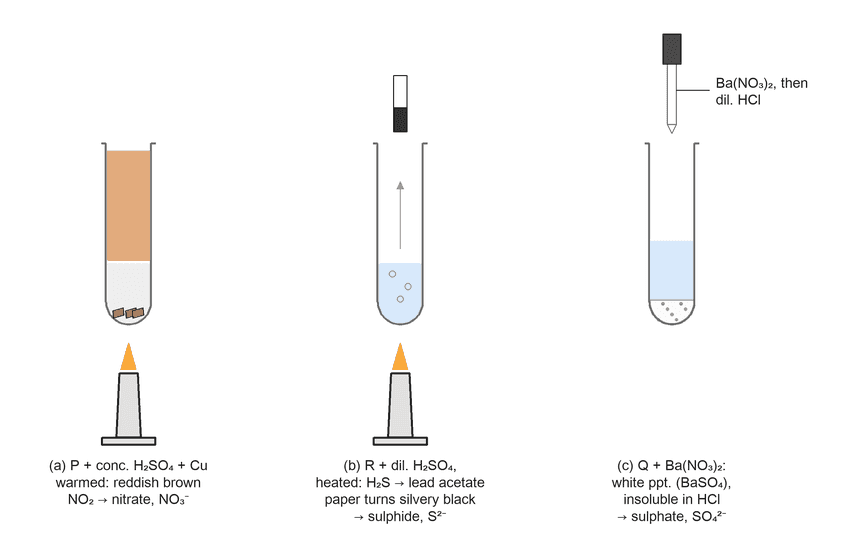
Watch out: The 'insoluble in HCl' part is what proves a sulphate; without it the white precipitate could be a sulphite or a carbonate.
Therefore, the anions are (a) nitrate (NO₃⁻) in P, (b) sulphide (S²⁻) in R and (c) sulphate (SO₄²⁻) in Q.
- 131 mark
Question 13
Choose the substances given in the box below to answer the following questions:
Iron Magnesium sulphite Zinc Sodium sulphide Lead Ferric chloride Copper Ferrous sulphate (b) The compound that will produce sulphur dioxide gas when reacted with dilute HCl.
Solve with AIWritten solution
Solution:
Concept: A sulphite reacts with dilute hydrochloric acid to give sulphur dioxide.
Step 1 — Find the sulphite in the box.
Of the eight substances, only magnesium sulphite, , is a sulphite. Dilute HCl decomposes it and sulphur dioxide comes off.
Step 2 — Rule out the others.
Sodium sulphide gives hydrogen sulphide, not sulphur dioxide. Iron and zinc give hydrogen. Lead and copper give no sulphur dioxide with dilute HCl, and ferric chloride and ferrous sulphate give no gas at all.
Watch out: A sulphite (ending '-ite') gives sulphur dioxide, but a sulphide (ending '-ide') gives hydrogen sulphide, so read the ending of each name carefully.
Therefore, the compound is magnesium sulphite (MgSO₃).
- 141 mark
Question 14
Rotten egg smell is due to the liberation of:
Solve with AIAnswer
(A) HCl gas
- Correct
(B) gas
(C) gas
(D) gas
Answer: (B) gas
Concept: Hydrogen sulphide is the colourless gas with the foul smell of rotten eggs.
Step 1 — Recall where it comes from.
A dilute acid on a metal sulphide gives hydrogen sulphide.
Step 2 — Confirm it.
The gas turns moist lead acetate paper silvery black, because black lead sulphide forms.
Why the other options are wrong:
- (A) HCl gas: it is colourless with a pungent, choking smell, not a rotten-egg smell.
- (C) gas: it is a greenish yellow gas with a sharp, pungent, choking smell.
- (D) gas: it has the suffocating smell of burning sulphur.
Therefore, the rotten egg smell is due to H₂S gas, option (B).
- 151 mark
Question 15
Complete the following sentences by choosing the correct answer from the brackets:
(c) The metal nitrate which on thermal decomposition forms a black residue is ............... . [zinc nitrate / copper nitrate]
Solve with AIWritten solution
Solution:
Concept: Most metal nitrates (other than those of sodium and potassium) break down on strong heating into the metal oxide, reddish brown nitrogen dioxide and oxygen. The colour of the oxide left behind tells the metal: zinc oxide is yellow when hot and white when cold, copper (II) oxide is black, and lead monoxide is reddish brown when hot and yellow when cold.
Step 1 — Compare the two residues.
Zinc nitrate leaves zinc oxide, which is yellow when hot and white when cold, so it never leaves a black residue. Copper nitrate leaves copper (II) oxide, which is black.
Step 2 — Describe what is seen.
The bluish green copper nitrate leaves a black residue of copper (II) oxide, while reddish brown nitrogen dioxide and colourless oxygen are given off.
Therefore, the metal nitrate that forms a black residue is copper nitrate.
- 162 marks
Question 16
Identify only the anion present in the following compound:
(a) The compound on heating produces a colourless, odourless gas which turns lime water milky and has no effect on acidified potassium dichromate solution.
(b) The solution of the compound which on treating with concentrated sulphuric acid and freshly prepared ferrous sulphate solution produces a brown ring.
Solve with AIWritten solution
Solution:
Concept: Lime water turns milky with carbon dioxide and with sulphur dioxide, but only sulphur dioxide turns acidified dichromate green. The brown ring test detects a nitrate. Freshly prepared iron (II) sulphate solution is added to the nitrate solution and conc. sulphuric acid is poured slowly down the side; iron (II) ions reduce the nitrate to nitric oxide, which combines with more iron (II) sulphate to form brown nitroso ferrous sulphate where the two layers meet.
Step 1 — (a) Name the gas.
The gas is colourless and odourless, turns lime water milky and leaves acidified unchanged. Sulphur dioxide has a smell and turns dichromate green, so the gas is carbon dioxide.
Step 2 — (a) Name the anion.
A compound that gives carbon dioxide on heating is a carbonate (other than sodium or potassium carbonate, which do not break down). So the anion is the carbonate ion, . Taking zinc carbonate as the compound:
A hydrogen carbonate also gives carbon dioxide on heating, but the anion expected here is the carbonate.
Step 3 — (b) Name the anion.
A brown ring at the junction of the two layers, with conc. sulphuric acid and freshly prepared ferrous sulphate, is the brown ring test, which confirms the nitrate ion, . The iron (II) ions reduce the nitrate to nitric oxide, which then joins with more iron (II) sulphate:
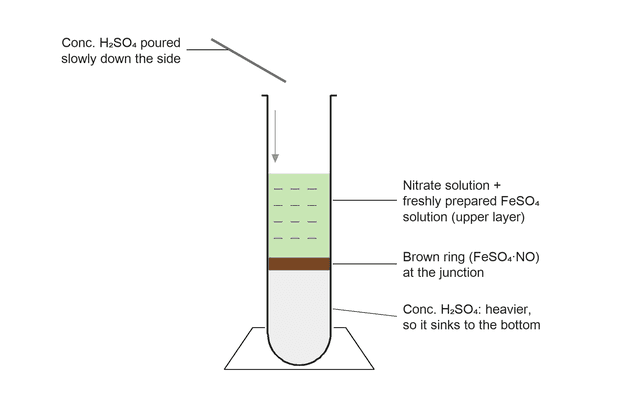
Watch out: The question asks for the ANION only, so name the carbonate and nitrate ions, not whole compounds.
Therefore, the anion is (a) carbonate (CO₃²⁻) and (b) nitrate (NO₃⁻).
- 171 mark
Question 17
Differentiate between the following pairs based on the criteria given:
(a) Sulphuric acid and Nitric acid (using barium chloride solution)
Solve with AIWritten solution
Solution:
Concept: Barium chloride (or barium nitrate) solution is the test for a sulphate: it gives a white precipitate of barium sulphate that does not dissolve in dilute HCl or dilute nitric acid. Barium sulphite and barium carbonate are also white, but they dissolve in dilute HCl. A nitrate gives no precipitate, because barium nitrate is soluble.
Step 1 — Add barium chloride to sulphuric acid.
Sulphuric acid contains sulphate ions, so a white precipitate of barium sulphate forms. It does not dissolve in dilute HCl or dilute nitric acid.
Step 2 — Add barium chloride to nitric acid.
Nitric acid contains nitrate ions, and barium nitrate is soluble, so no precipitate forms and the solution stays clear.

Therefore, with barium chloride solution sulphuric acid gives a white precipitate (BaSO₄), while nitric acid gives no precipitate.
- 181 mark
Question 18
Identify the gas evolved in each of the following reactions:
(b) Copper carbonate is heated.
Solve with AIWritten solution
Solution:
Concept: Most metal carbonates (other than those of sodium and potassium) break down on heating into the metal oxide and carbon dioxide; the colour change of the solid and the lime-water test show what happened.
Step 1 — Write the change.
Copper carbonate breaks down on heating into copper (II) oxide and carbon dioxide.
Step 2 — Identify the gas.
The green copper carbonate turns into black copper (II) oxide, and the colourless gas given off turns lime water milky, so it is carbon dioxide.
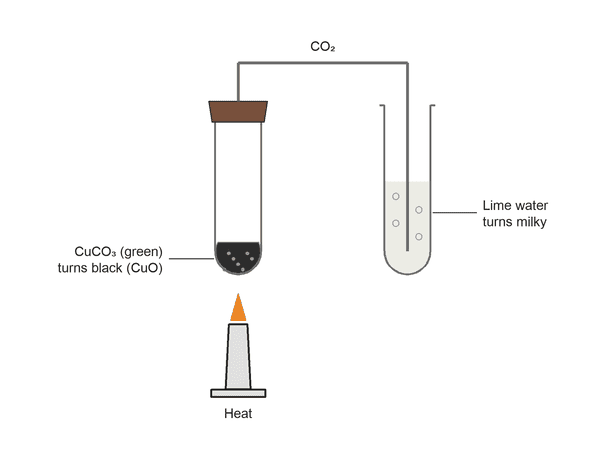
Therefore, the gas evolved is carbon dioxide (CO₂).
- 191 mark
Question 19
Which gas decolourises potassium permanganate () solution?
Solve with AIAnswer
- Correct
(A) Sulphur dioxide
(B) Ammonia
(C) Hydrogen chloride
(D) Carbon dioxide
Answer: (A) Sulphur dioxide
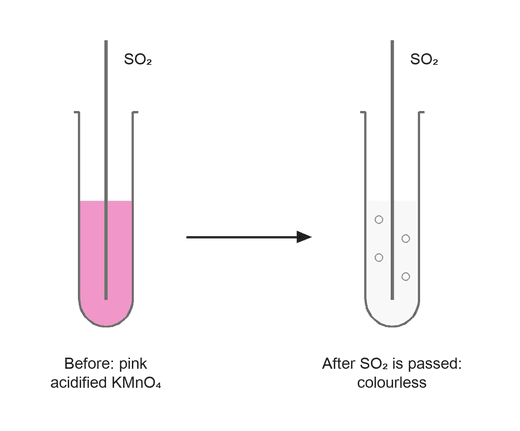
Concept: Sulphur dioxide is a reducing agent. It reduces pink (purple) acidified potassium permanganate to colourless manganese (II) sulphate, so the colour disappears.
Step 1 — Write the reaction.
Sulphur dioxide takes oxygen from the permanganate and is itself oxidised to sulphuric acid.
Step 2 — Use the test.
Carbon dioxide also turns lime water milky but has no effect on potassium permanganate, so this test tells sulphur dioxide apart from carbon dioxide.
Why the other options are wrong:
- (B) Ammonia: it is a basic gas, identified by turning moist red litmus blue and by dense white fumes with a rod dipped in conc. HCl; it does not give this decolourising test.
- (C) Hydrogen chloride: it is identified by dense white fumes with ammonia and a white precipitate with silver nitrate. Only concentrated hydrochloric acid is oxidised by permanganate (a way of making chlorine), so it is not a test for the gas.
- (D) Carbon dioxide: it has no effect on potassium permanganate; that is exactly how it is told apart from sulphur dioxide.
Therefore, the gas that decolourises potassium permanganate solution is sulphur dioxide, option (A).
- 203 marks
Question 20
Give one significant observation when:
(a) a solution of barium chloride is added to zinc sulphate solution.
(b) lead nitrate is heated in a test tube.
(c) chlorine gas is passed over moist starch iodide paper.
Solve with AIWritten solution
Solution:
Concept: Each change is a standard laboratory test: barium chloride for a sulphate, the action of heat on a heavy-metal nitrate, and starch iodide paper for chlorine.
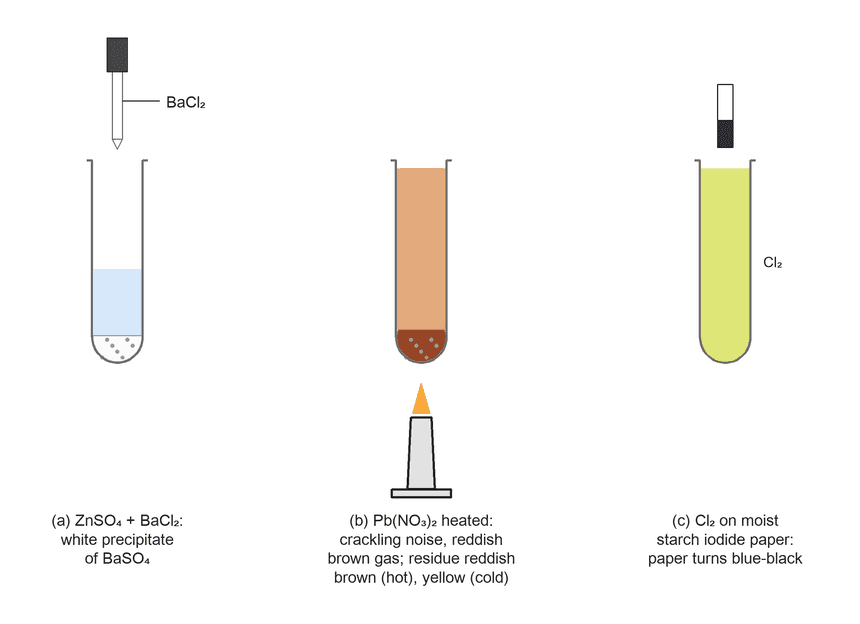
Step 1 — (a) Barium chloride with zinc sulphate.
Zinc sulphate contains sulphate ions, so a white precipitate of barium sulphate forms. It does not dissolve in dilute HCl or dilute nitric acid.
Step 2 — (b) Lead nitrate heated.
The crystals crackle, reddish brown fumes of nitrogen dioxide are given off, and the residue of lead monoxide is reddish brown when hot and yellow when cold.
Step 3 — (c) Chlorine over moist starch iodide paper.
Chlorine is a stronger oxidising agent than iodine, so it sets iodine free from the potassium iodide, and the iodine turns the starch blue-black.
Watch out: In (a) the precipitate is barium SULPHATE; zinc chloride stays in solution.
Therefore, (a) a white precipitate of barium sulphate forms; (b) the crystals crackle, reddish brown fumes of nitrogen dioxide are given off and the residue is reddish brown when hot and yellow when cold; (c) the starch iodide paper turns blue-black.
- 211 mark
Question 21
Name the gas produced during each of the following reactions:
When ferrous sulphide reacts with dilute hydrochloric acid.
Solve with AIWritten solution
Solution:
Concept: A metal sulphide with a dilute acid gives hydrogen sulphide.
Step 1 — Write the reaction.
Ferrous sulphide is iron (II) sulphide. Dilute hydrochloric acid sets hydrogen sulphide free from it.
Step 2 — Recognise the gas.
The gas is colourless, smells of rotten eggs and turns moist lead acetate paper silvery black.
Therefore, the gas produced is hydrogen sulphide (H₂S).
- 223 marks
Question 22
You are provided with some compounds in the box.
Choose the most appropriate compound which fits the descriptions (a) to (c) given below:
(a) A colourless gas which turns acidified from orange to green.
(b) A yellow explosive oily liquid formed when excess chlorine gas reacts with ammonia gas.
(c) A yellow metallic oxide formed on thermal decomposition of .
Solve with AIWritten solution
Solution:
Concept: Match each description to one property: the dichromate test picks out sulphur dioxide, ammonia with excess chlorine gives nitrogen trichloride, and lead carbonate on heating leaves lead monoxide.
Step 1 — (a) The colourless gas.
Carbon dioxide and sulphur dioxide in the box are both colourless, but only sulphur dioxide, a reducing agent, turns acidified potassium dichromate from orange to green. So the answer is .
Step 2 — (b) The yellow explosive oily liquid.
With excess chlorine, every hydrogen atom of ammonia is replaced by chlorine, giving nitrogen trichloride, a yellow, explosive, oily liquid. So the answer is .
Step 3 — (c) The yellow metallic oxide.
Lead carbonate breaks down on heating into lead monoxide and carbon dioxide; lead monoxide is yellow when cold. Lead dioxide, , is dark brown and is not formed. So the answer is .
Watch out: In (b), excess AMMONIA gives nitrogen and ammonium chloride; only excess CHLORINE gives nitrogen trichloride.
Therefore, (a) SO₂, (b) NCl₃ and (c) PbO.
- 231 mark
Question 23
Complete the following sentences by choosing the correct answer from the brackets:
The gas formed when copper carbonate is heated is ............... [ / ]
Solve with AIWritten solution
Solution:
Concept: Most metal carbonates (other than those of sodium and potassium) break down on heating into the metal oxide and carbon dioxide; the colour change of the solid and the lime-water test show what happened. A carbonate gives no oxygen.
Step 1 — Write the change.
Copper carbonate breaks down on heating into copper (II) oxide and carbon dioxide.
Step 2 — Choose from the brackets.
The green copper carbonate leaves black copper (II) oxide, and the gas turns lime water milky. It is carbon dioxide, not oxygen, which would relight a glowing splint instead.
Therefore, the gas formed when copper carbonate is heated is CO₂.
- 243 marks
Question 24
Choose the letters L, M, N, O & P to match the description (a) to (c) given below:
[L – Ammonia, M – Nitrogen, N – Hydrogen sulphide, O – Hydrogen chloride gas, P – Nitrogen dioxide]
(a) When this gas comes in contact with ammonia dense white fumes are seen.
(b) The gas that turns moist lead acetate paper silvery black.
(c) The gas produced on heating lead nitrate.
Solve with AIWritten solution
Solution:
Concept: Use one tell-tale property for each gas: dense white fumes with ammonia for an acidic gas such as HCl, blackening of lead acetate paper for , and the brown gas from heating a heavy-metal nitrate for .
Step 1 — (a) Dense white fumes with ammonia.
Hydrogen chloride meets ammonia and forms tiny solid particles of ammonium chloride, seen as dense white fumes. So the letter is O.
Step 2 — (b) Lead acetate paper turns silvery black.
Hydrogen sulphide forms black lead sulphide on the paper. So the letter is N.
Step 3 — (c) Gas from heating lead nitrate.
Lead nitrate decomposes on heating, giving reddish brown nitrogen dioxide (and oxygen, which is not in the list). So the letter is P.

Watch out: Ammonia (L) is the gas the fumes are tested AGAINST in (a), so it cannot be the answer to (a).
Therefore, (a) O (hydrogen chloride), (b) N (hydrogen sulphide) and (c) P (nitrogen dioxide).
- 252 marks
Question 25
Alex was given a solution of an unknown salt Y for analysis. He performed the following tests and recorded his observations:
-
To a part of the solution Y, he added silver nitrate solution and obtained a white precipitate which was soluble in ammonium hydroxide solution.
-
To the remaining solution he added a few drops of sodium hydroxide solution and obtained a pale blue precipitate.
Based on the observations made by Alex, identify:
(a) the anion and
(b) the cation present in salt Y.
Solve with AIWritten solution
Solution:
Concept: Silver nitrate tests the anion: a white precipitate soluble in ammonium hydroxide is silver chloride. Sodium hydroxide tests the cation, by the colour of the metal hydroxide it precipitates.
Step 1 — (a) Find the anion.
The white precipitate with silver nitrate dissolves in ammonium hydroxide, so it is silver chloride and the anion is chloride, . It dissolves because it forms a soluble complex with ammonia.
Step 2 — (b) Find the cation.
A pale blue precipitate with sodium hydroxide is copper (II) hydroxide, so the cation is copper (II), .
Putting the two ions together, salt Y is copper (II) chloride, .

Watch out: A white precipitate that dissolves in ammonium hydroxide is read as silver chloride; the full test also shows it does not dissolve in dilute nitric acid, which rules out a carbonate or a sulphite.
Therefore, (a) the anion is chloride (Cl⁻) and (b) the cation is copper (II) (Cu²⁺).
-
- 261 mark
Question 26
Select the compound / element from the box given below for each of the following statements:
The colourless gas obtained when a metallic nitrate undergoes thermal decomposition.
Solve with AIWritten solution
Solution:
Concept: A metal nitrate decomposes on heating to give oxygen, together with reddish brown nitrogen dioxide in the case of heavy-metal nitrates.
Step 1 — Write a typical decomposition.
Lead nitrate gives two gases on heating, nitrogen dioxide and oxygen.
Step 2 — Pick the colourless gas.
Nitrogen dioxide is reddish brown; the colourless gas is oxygen, which relights a glowing splint. Sodium and potassium nitrates give oxygen alone:
Hydrogen and nitric oxide are not formed when a nitrate is heated.
Watch out: Nitric oxide (NO) is also colourless, but it is not a product of heating a nitrate.
Therefore, the colourless gas is O₂ (oxygen).
- 271 mark
Question 27
Distinguish between the following:
Solutions of calcium chloride and calcium nitrate using aqueous silver nitrate.
Solve with AIWritten solution
Solution:
Concept: Silver nitrate solution is the test for a chloride in solution: it gives a curdy white precipitate of silver chloride, which does not dissolve in dilute nitric acid but dissolves in ammonium hydroxide. Nitrates give no precipitate, because every nitrate is soluble.
Step 1 — Add silver nitrate to calcium chloride solution.
Chloride ions are present, so a curdy white precipitate of silver chloride forms. It is insoluble in dilute nitric acid but dissolves in ammonium hydroxide.
Step 2 — Add silver nitrate to calcium nitrate solution.
Only nitrate ions are present, and silver nitrate and calcium nitrate are both soluble, so no precipitate forms and the solution stays clear.

Therefore, with aqueous silver nitrate calcium chloride solution gives a curdy white precipitate (AgCl), while calcium nitrate solution gives no precipitate.
- 282 marks
Question 28
Identify the anion present in the following compounds:
(a) Compound ‘C’ on heating with dilute hydrochloric acid liberates a gas which turns lime water milky but has no effect on potassium dichromate solution.
(b) Compound ‘D’ on heating with concentrated sulphuric acid liberates a gas which when passed through silver nitrate solution gave a white precipitate, insoluble in dilute nitric acid.
Solve with AIWritten solution
Solution:
Concept: Carbon dioxide and sulphur dioxide both turn lime water milky. Only sulphur dioxide, a reducing agent, turns acidified potassium dichromate from orange to green and decolourises pink acidified potassium permanganate; carbon dioxide has no effect on either. Conc. sulphuric acid, a non-volatile acid, sets free hydrogen chloride gas from a chloride.
Step 1 — (a) Identify the gas from compound C.
The gas turns lime water milky but has no effect on potassium dichromate. Sulphur dioxide would turn the dichromate green, so the gas is carbon dioxide, and the anion in C is the carbonate ion, . Taking calcium carbonate as C:
A hydrogen carbonate, , gives the same result; the anion expected here is the carbonate.
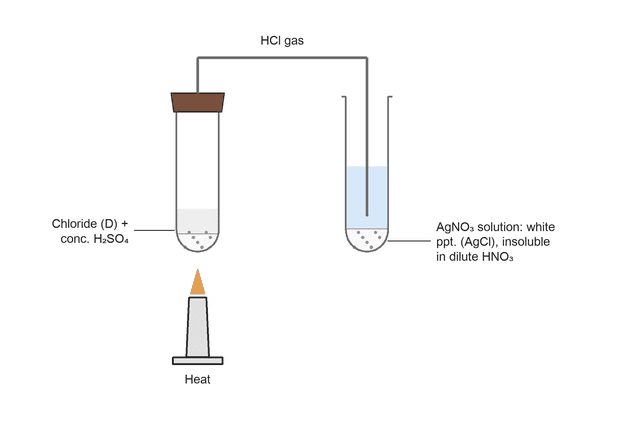
Step 2 — (b) Identify the gas from compound D.
Heated with conc. sulphuric acid, a chloride gives hydrogen chloride gas. Passed into silver nitrate solution, it forms a white precipitate of silver chloride, insoluble in dilute nitric acid. So the anion in D is the chloride ion, . Taking sodium chloride as D:
Watch out: In (b) the precipitate is insoluble in dilute NITRIC acid; that is what rules out a carbonate or sulphite, whose silver salts dissolve in it.
Therefore, the anion is (a) carbonate (CO₃²⁻) in C and (b) chloride (Cl⁻) in D.