
Question 203 marksAsked 2025Easy
Give one significant observation when:
(a) a solution of barium chloride is added to zinc sulphate solution.
(b) lead nitrate is heated in a test tube.
(c) chlorine gas is passed over moist starch iodide paper.
Confirming your payment
Sign up now and get 250 free tokens.
Previous Year Questions · Question 20 of 28
Give one significant observation when:
(a) a solution of barium chloride is added to zinc sulphate solution.
(b) lead nitrate is heated in a test tube.
(c) chlorine gas is passed over moist starch iodide paper.
Solution:
Concept: Each change is a standard laboratory test: barium chloride for a sulphate, the action of heat on a heavy-metal nitrate, and starch iodide paper for chlorine.
Step 1 — (a) Barium chloride with zinc sulphate.
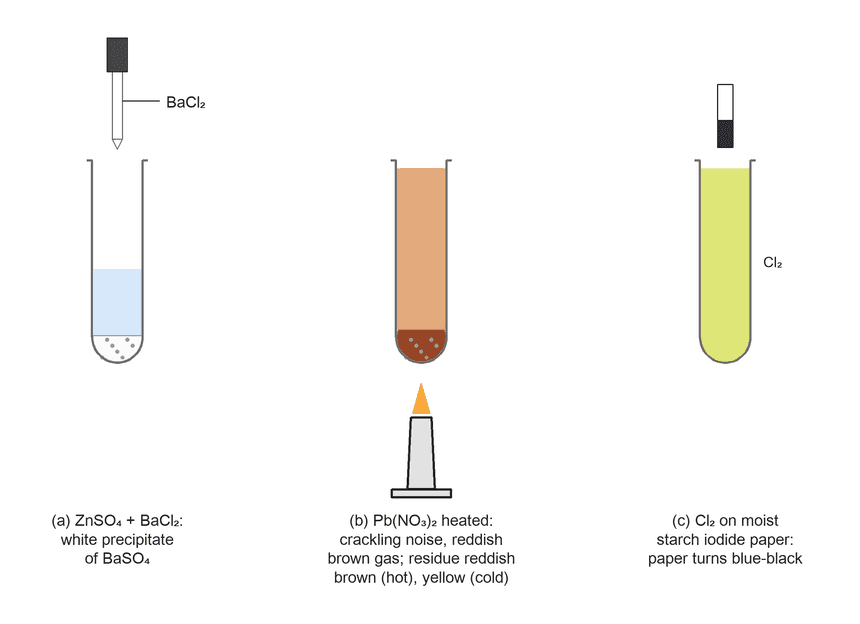
Zinc sulphate contains sulphate ions, so a white precipitate of barium sulphate forms. It does not dissolve in dilute HCl or dilute nitric acid.
Step 2 — (b) Lead nitrate heated.
The crystals crackle, reddish brown fumes of nitrogen dioxide are given off, and the residue of lead monoxide is reddish brown when hot and yellow when cold.
Step 3 — (c) Chlorine over moist starch iodide paper.
Chlorine is a stronger oxidising agent than iodine, so it sets iodine free from the potassium iodide, and the iodine turns the starch blue-black.
Watch out: In (a) the precipitate is barium SULPHATE; zinc chloride stays in solution.
Therefore, (a) a white precipitate of barium sulphate forms; (b) the crystals crackle, reddish brown fumes of nitrogen dioxide are given off and the residue is reddish brown when hot and yellow when cold; (c) the starch iodide paper turns blue-black.