Solution:
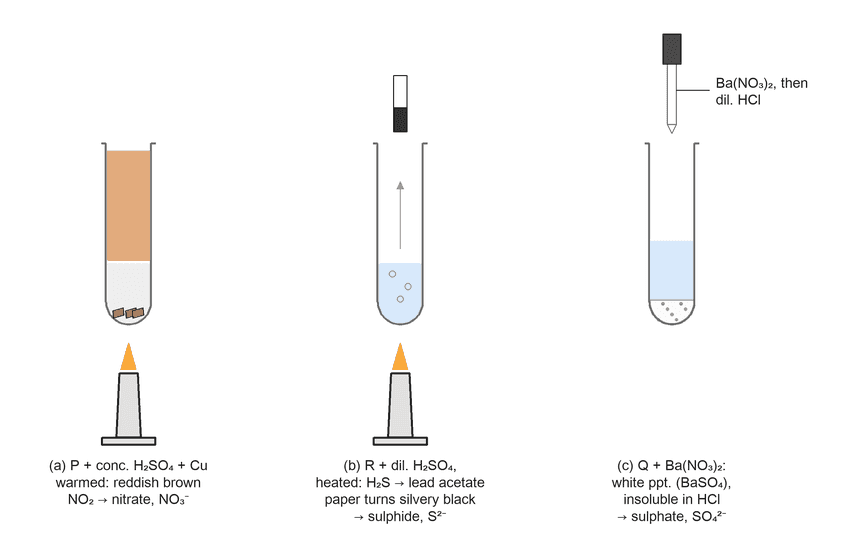
Concept: Each observation is the standard test for one anion: conc. H2SO4 with copper turnings for a nitrate, a dilute acid giving hydrogen sulphide for a sulphide, and barium nitrate giving an acid-insoluble white precipitate for a sulphate.
Step 1 — (a) Anion in P.
Conc. sulphuric acid turns a nitrate into nitric acid, and the nitric acid oxidises the copper turnings, giving reddish brown nitrogen dioxide. So the anion is the nitrate ion, NO3−. Taking potassium nitrate as P:
KNO3+H2SO4→KHSO4+HNO3
Cu+4HNO3→Cu(NO3)2+2H2O+2NO2↑
Step 2 — (b) Anion in R.
A colourless gas that turns moist lead acetate paper silvery black is hydrogen sulphide, which a dilute acid sets free from a sulphide. So the anion is the sulphide ion, S2−. Taking sodium sulphide as R:
Na2S+H2SO4→Na2SO4+H2S↑
Pb(CH3COO)2+H2S→PbS↓+2CH3COOH
Step 3 — (c) Anion in Q.
A white precipitate with barium nitrate that does not dissolve in HCl is barium sulphate, so the anion is the sulphate ion, SO42−. Barium sulphite and barium carbonate are also white, but they dissolve in dilute HCl. Taking sodium sulphate as Q:
Na2SO4+Ba(NO3)2→BaSO4↓+2NaNO3
Watch out: The 'insoluble in HCl' part is what proves a sulphate; without it the white precipitate could be a sulphite or a carbonate.
Therefore, the anions are (a) nitrate (NO₃⁻) in P, (b) sulphide (S²⁻) in R and (c) sulphate (SO₄²⁻) in Q.
