Identify only the anion present in the following compound
Question 162 marksAsked 2024Easy
Identify only the anion present in the following compound:
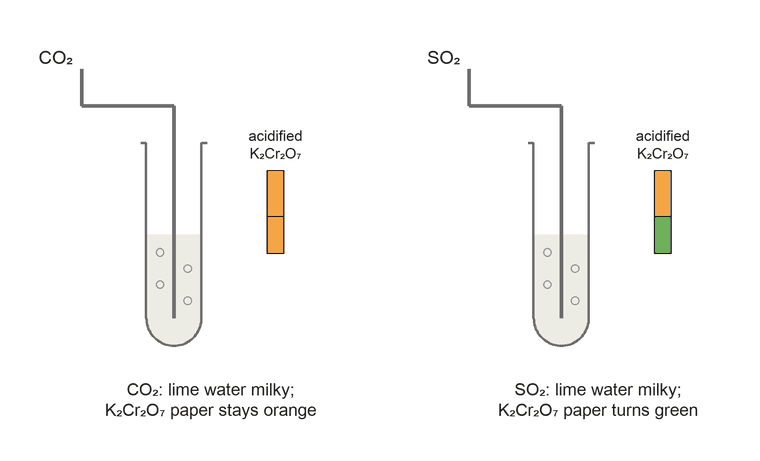
(a) The compound on heating produces a colourless, odourless gas which turns lime water milky and has no effect on acidified potassium dichromate solution.
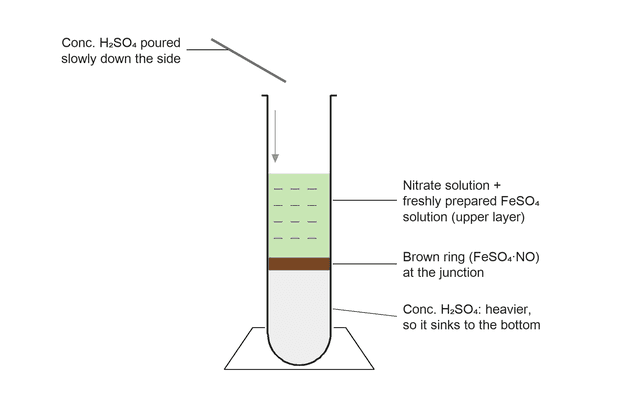
(b) The solution of the compound which on treating with concentrated sulphuric acid and freshly prepared ferrous sulphate solution produces a brown ring.
Solution:
Concept: Lime water turns milky with carbon dioxide and with sulphur dioxide, but only sulphur dioxide turns acidified dichromate green. The brown ring test detects a nitrate. Freshly prepared iron (II) sulphate solution is added to the nitrate solution and conc. sulphuric acid is poured slowly down the side; iron (II) ions reduce the nitrate to nitric oxide, which combines with more iron (II) sulphate to form brown nitroso ferrous sulphate where the two layers meet.
Step 1 — (a) Name the gas.
The gas is colourless and odourless, turns lime water milky and leaves acidified K2Cr2O7 unchanged. Sulphur dioxide has a smell and turns dichromate green, so the gas is carbon dioxide.
Step 2 — (a) Name the anion.
A compound that gives carbon dioxide on heating is a carbonate (other than sodium or potassium carbonate, which do not break down). So the anion is the carbonate ion, CO32−. Taking zinc carbonate as the compound:
ZnCO3ΔZnO+CO2↑
A hydrogen carbonate also gives carbon dioxide on heating, but the anion expected here is the carbonate.
Step 3 — (b) Name the anion.
A brown ring at the junction of the two layers, with conc. sulphuric acid and freshly prepared ferrous sulphate, is the brown ring test, which confirms the nitrate ion, NO3−. The iron (II) ions reduce the nitrate to nitric oxide, which then joins with more iron (II) sulphate:
FeSO4+NO→FeSO4⋅NO
Watch out: The question asks for the ANION only, so name the carbonate and nitrate ions, not whole compounds.
Therefore, the anion is (a) carbonate (CO₃²⁻) and (b) nitrate (NO₃⁻).