Choose the most appropriate compound which fits the descriptions (a) to (c) given below:
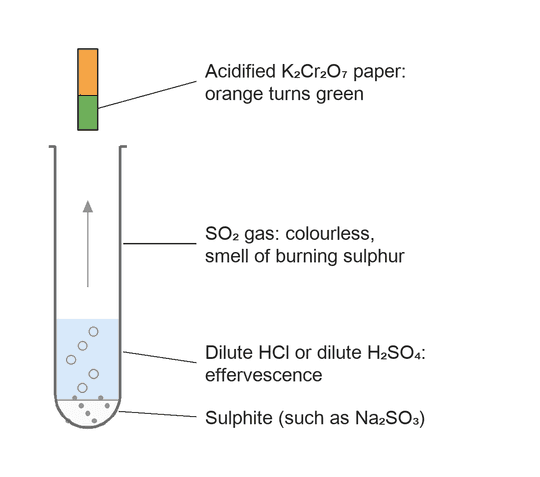
(a) A colourless gas which turns acidified K2Cr2O7 from orange to green.
(b) A yellow explosive oily liquid formed when excess chlorine gas reacts with ammonia gas.
(c) A yellow metallic oxide formed on thermal decomposition of PbCO3.
Solution:
Concept: Match each description to one property: the dichromate test picks out sulphur dioxide, ammonia with excess chlorine gives nitrogen trichloride, and lead carbonate on heating leaves lead monoxide.
Step 1 — (a) The colourless gas.
Carbon dioxide and sulphur dioxide in the box are both colourless, but only sulphur dioxide, a reducing agent, turns acidified potassium dichromate from orange to green. So the answer is SO2.
With excess chlorine, every hydrogen atom of ammonia is replaced by chlorine, giving nitrogen trichloride, a yellow, explosive, oily liquid. So the answer is NCl3.
NH3+3Cl2→NCl3+3HCl
Step 3 — (c) The yellow metallic oxide.
Lead carbonate breaks down on heating into lead monoxide and carbon dioxide; lead monoxide is yellow when cold. Lead dioxide, PbO2, is dark brown and is not formed. So the answer is PbO.
PbCO3ΔPbO+CO2↑
Watch out: In (b), excess AMMONIA gives nitrogen and ammonium chloride; only excess CHLORINE gives nitrogen trichloride.