Identify the gas P and Q in the reactions given below
Question 82 marksAsked 2022Easy
Identify the gas P and Q in the reactions given below:
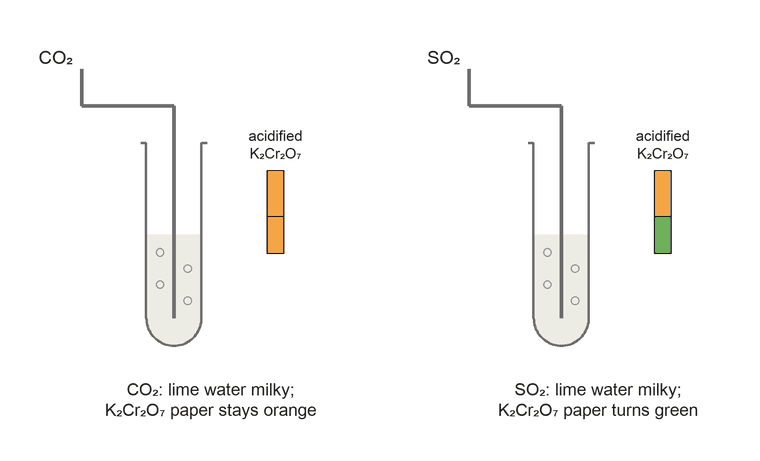
(a) A compound reacts with an acid to form gas P which has no effect on acidified K2Cr2O7 solution but turns lime water milky.
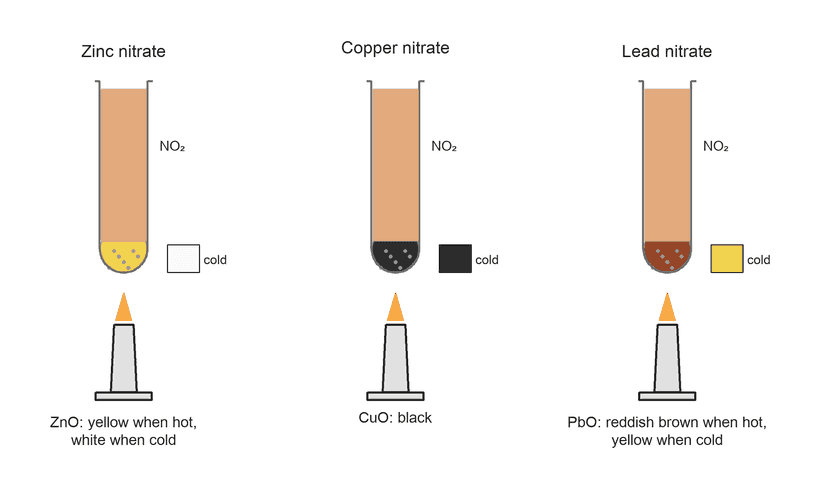
(b) A metallic nitrate reacts on heating gives oxygen gas along with a coloured gas Q.
Solution:
Concept: Carbon dioxide and sulphur dioxide both turn lime water milky. Only sulphur dioxide, a reducing agent, turns acidified potassium dichromate from orange to green and decolourises pink acidified potassium permanganate; carbon dioxide has no effect on either. Heavy-metal nitrates give oxygen together with a coloured gas on heating.
Step 1 — (a) Narrow down gas P.
Gas P turns lime water milky, so it is carbon dioxide or sulphur dioxide.
Ca(OH)2+CO2→CaCO3↓+H2O
Step 2 — (a) Decide with the dichromate test.
Sulphur dioxide would turn acidified K2Cr2O7 green, but gas P has no effect on it. So P is carbon dioxide. The compound is a carbonate or a hydrogen carbonate, which an acid decomposes.
Step 3 — (b) Identify gas Q.
A heavy-metal nitrate such as copper nitrate breaks down on heating into the metal oxide, oxygen and reddish brown nitrogen dioxide. Oxygen is colourless, so the coloured gas Q is nitrogen dioxide.
2Cu(NO3)2Δ2CuO+4NO2↑+O2↑
Watch out: The coloured gas is nitrogen dioxide, not nitric oxide; nitric oxide (NO) is colourless.
Therefore, gas P is carbon dioxide (CO₂) and gas Q is nitrogen dioxide (NO₂).