
Question 35 marksEasy
Name :
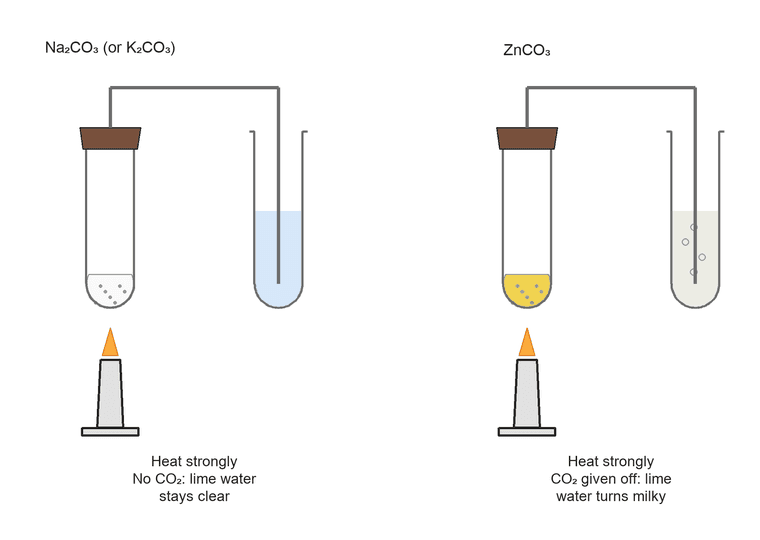
(a) Two carbonates which do not produce carbon dioxide on heating.
(b) A colourless gas which bleaches
(c) Gases which have sour taste
(d) Greenish yellow gas which also bleaches
(e) Gas with rotten egg smell.
Confirming your payment
Sign up now and get 250 free tokens.
Practical Work · Question 3 of 41
Name :
(a) Two carbonates which do not produce carbon dioxide on heating.
(b) A colourless gas which bleaches
(c) Gases which have sour taste
(d) Greenish yellow gas which also bleaches
(e) Gas with rotten egg smell.
Solution:
Concept: Carbonates of the most reactive metals (sodium, potassium) are stable to heat, while most other carbonates break up into the metal oxide and carbon dioxide. Gases can also be recognised by colour and smell.
Step 1 — (a) Carbonates that give no CO₂ on heating.
Sodium carbonate and potassium carbonate do not decompose on heating with a burner. In contrast, a carbonate such as zinc carbonate breaks up:
Step 2 — (b) A colourless gas which bleaches.
Sulphur dioxide is colourless, and it bleaches moist coloured matter by reduction.
Step 3 — (c) Gases with a sour taste.
Acidic gases such as carbon dioxide and sulphur dioxide (and hydrogen chloride) dissolve in water to form acids, and acids taste sour.
Step 4 — (d) A greenish yellow gas which also bleaches.
Chlorine is greenish yellow, and it bleaches moist coloured matter by oxidation.
Step 5 — (e) The gas with a rotten egg smell.
Hydrogen sulphide, , smells of rotten eggs. It is confirmed by turning moist lead acetate paper black.
Watch out: Never taste or deeply sniff a gas in the laboratory; 'sour taste' is a property quoted from the book, and a gas is smelled only by wafting a little towards the nose.
Therefore, (a) sodium carbonate and potassium carbonate; (b) sulphur dioxide; (c) carbon dioxide and sulphur dioxide; (d) chlorine; (e) hydrogen sulphide.