
Question 41 markMCQEasy
Carbon dioxide and sulphur dioxide gas can be distinguished by using.
Confirming your payment
Sign up now and get 250 free tokens.
Practical Work · Question 4 of 41
Carbon dioxide and sulphur dioxide gas can be distinguished by using.
(A) moist blue litmus paper
(B) lime water
(C) acidified potassium dichromate paper
(D) none of the above.
Answer: (C) acidified potassium dichromate paper
Concept: To tell two gases apart we need a test that only one of them passes. Sulphur dioxide is a reducing agent; carbon dioxide is not.
Step 1 — Test sulphur dioxide.
Sulphur dioxide reduces orange acidified potassium dichromate () to green chromium (III) sulphate, so the paper turns orange to green:
Step 2 — Test carbon dioxide.
Carbon dioxide cannot reduce the dichromate, so the paper stays orange. The two gases give different results, so this paper distinguishes them.
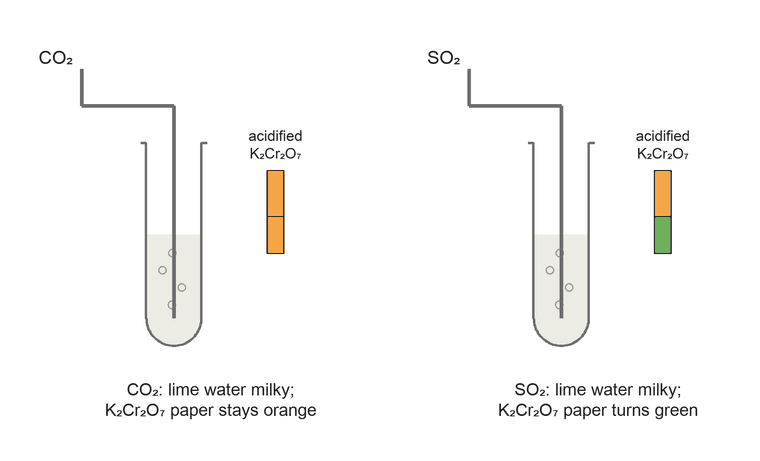
Watch out: Lime water is the usual test for carbon dioxide, but it cannot tell CO₂ from SO₂ because both turn it milky.
Why the other options are wrong:
Therefore, CO₂ and SO₂ are distinguished by acidified potassium dichromate paper, option (C).