
Question 24 marksEasy
Name the gases which
(a) extinguishes burning wooden splinter.
(b) turns moist red litmus blue.
(c) do no effect on moist litmus.
(d) affect the acidified paper and also turns lime water dirty milky.
Confirming your payment
Sign up now and get 250 free tokens.
Practical Work · Question 2 of 41
Name the gases which
(a) extinguishes burning wooden splinter.
(b) turns moist red litmus blue.
(c) do no effect on moist litmus.
(d) affect the acidified paper and also turns lime water dirty milky.
Solution:
Concept: Three simple tests sort the common gases: whether the gas supports burning, what it does to moist litmus, and whether it reduces acidified potassium dichromate ().
Step 1 — (a) Gases that put out a burning splinter.
A gas that does not support combustion puts out a burning wooden splinter. These are , HCl, , , , and . Hydrogen sulphide itself burns at the mouth of the jar, but a splinter pushed into the gas still goes out. Oxygen is the opposite case: it rekindles a glowing splinter.
Step 2 — (b) The gas that turns moist red litmus blue.
Only a basic gas does this. Ammonia is the only common basic gas; it dissolves in the water on the paper to form ammonium hydroxide, an alkali.
Step 3 — (c) Gases with no effect on moist litmus.
A neutral gas forms neither an acid nor an alkali with water, so red and blue litmus both stay unchanged. Examples are hydrogen and oxygen (nitrogen and carbon monoxide are also neutral).
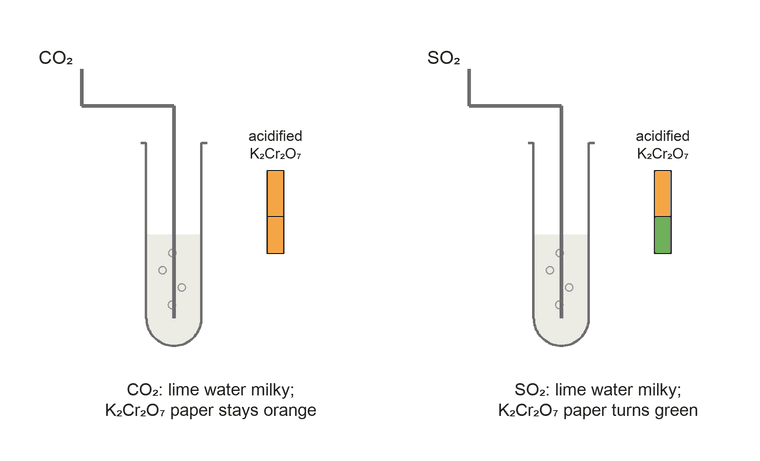
Step 4 — (d) The gas that affects acidified K₂Cr₂O₇ paper and turns lime water milky.
This is sulphur dioxide. It is a reducing agent, so it turns acidified potassium dichromate () paper from orange to green, and it also turns lime water milky:
Carbon dioxide also turns lime water milky but leaves the dichromate orange, so the dichromate test is what picks out .
Watch out: A gas that does not support burning may still burn itself (hydrogen sulphide); 'extinguishes a splinter' only means it does not let the wood go on burning inside it.
Therefore, (a) NH₃, HCl, SO₂, H₂S, CO₂, NO₂ and Cl₂; (b) ammonia; (c) hydrogen and oxygen; (d) sulphur dioxide.