(a) lead nitrate solution and sodium chloride solution are mixed.
(b) zinc chloride solution, zinc nitrate solution and zinc sulphate solutions are added individually to
(i) barium chloride solution,
(ii) lead nitrate solution.
(c) Decomposition of bicarbonates by dil. H2SO4
2NaHCO3+H2SO4→Na2SO4+2H2O+2CO2
2KHCO3+H2SO4→K2SO4+2H2O+2CO2
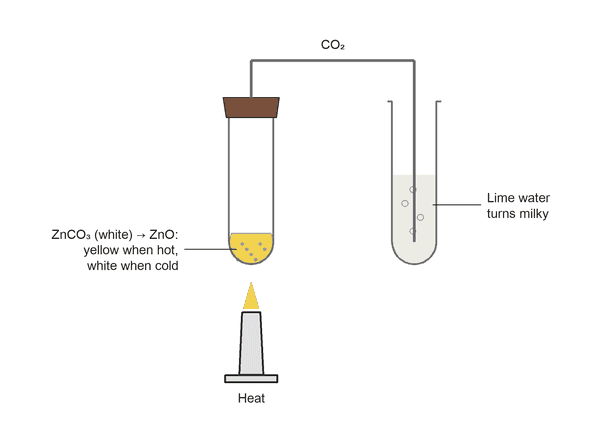
(d) Zinc carbonate is heated strongly.
(e) a piece of moist blue litmus paper is introduced in a jar of chlorine.
(f) paper soaked in potassium permanganate solution – is introduced in each case into a jar of sulphur dioxide.
(g) When moist starch iodide paper is introduced into chlorine gas.
Solution:
Concept: An observation is what is seen: a colour change, a precipitate, a gas, a smell. Each part below names the observation and then the reaction behind it.
Step 1 — (a) Lead nitrate and sodium chloride.
A white precipitate of lead chloride forms, because lead chloride is insoluble in cold water:
Pb(NO3)2+2NaCl→PbCl2↓+2NaNO3
Step 2 — (b) (i) The three zinc salts with barium chloride.
Only zinc sulphate gives a white precipitate of barium sulphate; zinc chloride and zinc nitrate show no change, because barium chloride and barium nitrate are soluble:
ZnSO4+BaCl2→BaSO4↓+ZnCl2
Step 3 — (b) (ii) The three zinc salts with lead nitrate.
Zinc chloride gives a white precipitate of lead chloride and zinc sulphate a white precipitate of lead sulphate; zinc nitrate shows no change, since all nitrates are soluble:
Step 4 — (c) Bicarbonates with dilute sulphuric acid.
There is brisk effervescence of a colourless, odourless gas that turns lime water milky: the gas is carbon dioxide, as in the equations given in the question.
Step 5 — (d) Zinc carbonate heated strongly.
The white solid turns yellow while hot and becomes white again on cooling (zinc oxide), and a colourless gas that turns lime water milky is given off:
ZnCO3ΔZnO+CO2↑
Step 6 — (e) Moist blue litmus in chlorine.
The paper first turns red, because chlorine forms acids with water, and is then bleached white by oxidation:
Cl2+H2O→HCl+HClO
Step 7 — (f) Potassium permanganate paper in sulphur dioxide.
The pink (purple) paper is decolourised, because sulphur dioxide is a reducing agent and reduces the permanganate.
Step 8 — (g) Moist starch iodide paper in chlorine.
The paper turns blue-black: chlorine sets free iodine from the iodide, and iodine turns starch blue-black:
Cl2+2KI→2KCl+I2
Watch out: In (e) the red colour lasts only a moment; the final observation is a bleached (white) paper.
Therefore, (a) white ppt (PbCl₂); (b) (i) white ppt only with ZnSO₄, (ii) white ppt with ZnCl₂ and ZnSO₄, none with Zn(NO₃)₂; (c) brisk effervescence of CO₂, lime water milky; (d) residue yellow when hot, white when cold, CO₂ given off; (e) blue litmus turns red, then is bleached; (f) pink permanganate paper is decolourised; (g) starch iodide paper turns blue-black.