Solution:
Concept: Experiment 1 is the sulphate test with barium chloride; Experiment 2 is the action of excess ammonium hydroxide on copper (II) hydroxide.
Step 1 — (a) Experiment 1.
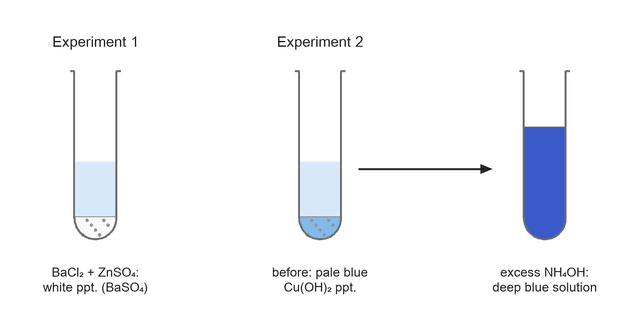
Zinc sulphate solution is poured into barium chloride solution. A white precipitate of barium sulphate forms:
ZnSO4+BaCl2→BaSO4↓+ZnCl2
Step 2 — (b) Experiment 2.
Ammonium hydroxide solution is poured onto the pale blue precipitate of copper (II) hydroxide. In excess, the precipitate dissolves to give a deep (inky) blue solution of tetraamminecopper (II) sulphate:
Cu(OH)2+(NH4)2SO4+2NH4OH→[Cu(NH3)4]SO4+4H2O
Watch out: The deep blue colour appears only when enough ammonium hydroxide is added; a few drops leave the pale blue precipitate.
Therefore, (a) a white precipitate (BaSO₄) forms; (b) the pale blue precipitate dissolves, giving a deep (inky) blue solution.

