Solution:
Concept: Each test gives one clue: litmus tells us whether the solution is acidic, barium chloride tells us the anion, and the flame test tells us the metal. Together they name the salt.
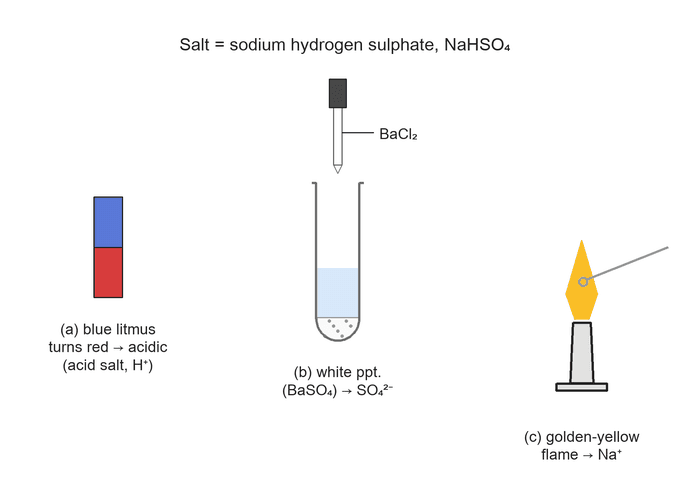
Step 1 — (a) Blue litmus turns red.
The solution is acidic. A salt whose solution is acidic here is an acid salt. It still contains replaceable hydrogen, and this hydrogen goes into the water as H+ ions.
Step 2 — (b) White precipitate with barium chloride.
The white precipitate is barium sulphate, so the salt contains the sulphate ion, SO42−.
Step 3 — (c) Persistent golden-yellow flame.
A persistent golden-yellow flame is given by the sodium ion, Na+.
Step 4 — Put the three clues together.
An acid salt of sodium that contains sulphate is sodium hydrogen sulphate, NaHSO4. With barium chloride it reacts as:
NaHSO4+BaCl2→BaSO4↓+NaCl+HCl
Watch out: A salt solution that turns blue litmus red is not always an acid salt in general (some normal salts hydrolyse), but with these three clues together the salt is sodium hydrogen sulphate.
Therefore, (a) the salt is an acid salt (gives H⁺ ions); (b) it contains the sulphate ion; (c) it contains the sodium ion; the salt is sodium hydrogen sulphate, NaHSO₄.
