
Opening your dashboard
Class 10 Maths Chapter 20: Cylinder, Cone and Sphere Solutions
130 textbook questions with step-by-step answers, free to read, for ICSE 2026-27.
Get talked through Ch 20, not just shown the answer
Reading a finished solution is not the same as being able to do it. The AI tutor takes one question at a time and works it with you, in your own words, until you can.
- Ask it out loud, in your own words
- It gives you the next step, not the answer
- Stuck on part (ii)? Start there
130 questions with solutions
1–3 marks · Mixed difficulty
The first 62 solutions are on this page. This chapter is a long one, so the rest open on their own page to keep this one quick to load.
- 11 mark
Question 1
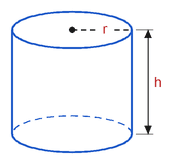
An open hollow cylindrical container, made of very thin metal sheet, has radius r cm and height h cm, its total surface area (in cm²) is :
 Solve with AI
Answer
(A) πr²h + 2πrh
(B) 4πrh + πr²
- Correct
(C) 4πrh + 2πr²
(D) 2πrh + 2πr²
Answer: (C) 4πrh + 2πr²
Concept: A container made of a very thin sheet has two faces, the outside and the inside, and the question asks for the area of both. An open cylinder has a base but no top. The curved surface of a cylinder of radius r and height h has area 2πrh, and a circular end has area πr².
Step 1 — List the surfaces of the container.
The container has a curved wall and one base (it is open at the top). Each of these is a thin sheet, so each has an outer face and an inner face.
Step 2 — Add the two faces of the curved wall.
Each face of the wall has area 2πrh, so both faces together give twice this.
Step 3 — Add the two faces of the base.
Each face of the base is a circle of area πr², so both faces give twice this.
Step 4 — Add the parts.
The total surface area is the sum of the wall and the base.
Watch out: There is no top, so only ONE circular end is counted, but its two faces are both counted.
Why the other options are wrong:
- (A) πr²h + 2πrh: πr²h is the volume of the cylinder, not an area, so it cannot be part of a surface area.
- (B) 4πrh + πr²: it counts both faces of the curved wall but only one face of the base.
- (D) 2πrh + 2πr²: this is the total surface area of a closed solid cylinder (one face of the wall and two ends); the container is open and its sheet has two faces.
Therefore, the total surface area is 4πrh + 2πr² cm², option (C).
- 21 mark
Question 2
The curved area of a solid cylinder is S cm² and the circumference of its base is C cm; the height of the cylinder is :
Solve with AIAnswer
(A) C × S
(B) C + S
- Correct
(C) S ÷ C
(D) S – C
Answer: (C) S ÷ C
Concept: The curved surface of a cylinder, cut along a vertical line and opened out, is a rectangle whose length is the circumference of the base and whose width is the height. So curved surface area = circumference of base × height.
Step 1 — Write the rule with the given letters.
The curved area is S cm² and the circumference is C cm, so with height h the rule gives the equation below.
Step 2 — Make h the subject.
Divide both sides by C to get the height on its own.
Watch out: An area (cm²) divided by a length (cm) gives a length (cm), which is what a height must be.
Why the other options are wrong:
- (A) C × S: C × S has units cm × cm² = cm³, a volume, not a height.
- (B) C + S: an area and a length cannot be added; C + S has no meaning as a height.
- (D) S – C: an area and a length cannot be subtracted; S − C has no meaning as a height.
Therefore, the height is S ÷ C cm, option (C).
- 31 mark
Question 3
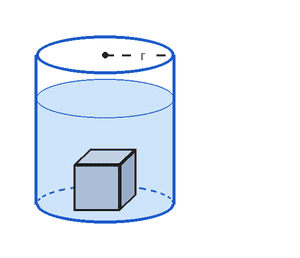
A cylindrical container has sufficient water to submerge a solid cubical object of its each edge a cm. If the radius of the container is r cm, the rise in level (h cm) of water in the container is :
 Solve with AI
Answer
(A)
(B)
- Correct
(C)
(D)
Answer: (C)
Concept: A solid that sinks completely in water pushes the water up by its own volume. In a cylindrical vessel of radius r the raised water is a cylinder of radius r and height h (the rise), so πr²h = volume of the solid.
Step 1 — Find the volume of the cube.
The cube has edge a cm, so its volume is a × a × a.
Step 2 — Write the volume of the raised water.
The water rises by h cm in a container of radius r cm, so the raised water is a cylinder of radius r and height h.
Step 3 — Equate and solve for h.
The raised water has the same volume as the cube, so we equate the two volumes and divide by πr².
Watch out: Divide by the area of the base πr², not by πr.
Why the other options are wrong:
- (A) : it divides by πr instead of the base area πr² and takes a square root; the volume equation πr²h = a³ has no square root in it.
- (B) : it uses a instead of a³ and a square root; neither comes from equating the volumes.
- (D) : it is the ratio turned upside down; for example r = 10 and a = 1 would give a rise of about 314 cm for a 1 cm cube.
Therefore, the rise in level is h = a³ ÷ πr² cm, option (C).
- 41 mark
Question 4
A solid cylinder of radius R cm and height H cm is melted and recast into smaller identical solid cylinders of height h cm and radius r cm. The number of smaller solid cylinders obtained is :
Solve with AIAnswer
(A)
- Correct
(B)
(C)
(D)
Answer: (B)
Concept: When a solid is melted and recast (or water is displaced), no material is lost or gained: the volume before equals the volume after. For n identical small solids made from one big one, n = volume of the big solid ÷ volume of one small solid.
Step 1 — Write the two volumes.
The big cylinder has radius R and height H; each small one has radius r and height h.
Step 2 — Divide to get the number.
The number of small cylinders is the big volume divided by one small volume; π cancels.
Watch out: Only the radii are squared in V = πr²h; the heights are not.
Why the other options are wrong:
- (A) : it forgets to square the radii.
- (C) : it squares the small height h, but heights are not squared in the volume formula.
- (D) : it squares the big height H and does not square the radii.
Therefore, the number of small cylinders is R²H ÷ r²h, option (B).
- 51 mark
Question 5
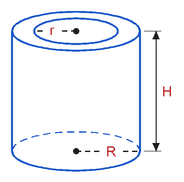
The total surface area of an open pipe of length H cm, external radius R cm and internal radius r cm, is :
 Solve with AI
Answer
(A) πR² – πr² + 2π(R – r)H
(B) 2πR² – 2πr² + 2πRH
(C) 2πRH – 2πrh + πR² – πr²
- Correct
(D) 2(πR² – πr²) + 2πRH + 2πrH
Answer: (D) 2(πR² – πr²) + 2πRH + 2πrH
Concept: A hollow cylinder (pipe) of external radius R, internal radius r and length h has volume of material π(R² − r²)h: the volume of the outer cylinder minus the volume of the hole. Its outer and inner curved surfaces are 2πRh and 2πrh, and each end is a ring of area π(R² − r²). An open pipe has no lids: its whole surface is the outer wall, the inner wall and the two end rings.
Step 1 — Outer curved surface.
The outside of the pipe is a curved surface of radius R and length H.
Step 2 — Inner curved surface.
The inside of the pipe is a curved surface of radius r and the same length H.
Step 3 — The two end rings.
Each end is a ring between the circles of radii R and r, and there are two ends.
Step 4 — Add all four parts.
The total surface area is the sum of these surfaces.
Watch out: The inner surface is ADDED (it is part of the surface you can touch), not subtracted.
Why the other options are wrong:
- (A) πR² – πr² + 2π(R – r)H: it has only one end ring and subtracts the inner curved surface (2π(R − r)H = 2πRH − 2πrH) instead of adding it.
- (B) 2πR² – 2πr² + 2πRH: it has both end rings and the outer surface but leaves out the inner curved surface 2πrH.
- (C) 2πRH – 2πrh + πR² – πr²: it subtracts the inner surface (and writes a small h that is not given) and has only one end ring.
Therefore, the total surface area is 2(πR² − πr²) + 2πRH + 2πrH cm², option (D).
- 63 marks
Question 6
The inner radius of a pipe is 2·1 cm. How much water can 12 m of this pipe hold ?
Solve with AIWritten solution
Solution:
Concept: The volume of a cylinder of base radius r and height h is V = πr²h, that is, area of the base × height. The water in a full pipe is a cylinder of the pipe's inner radius.
Given: Inner radius r = 2·1 cm, length of pipe = 12 m.
Step 1 — Use one unit.
The radius is in cm, so change the length of 12 m into cm.
Step 2 — Find the volume of water.
The water filling the pipe is a cylinder of radius 2·1 cm and height 1200 cm. Use π = 22/7.
Step 3 — Change to litres.
Since 1000 cm³ make 1 litre, divide by 1000.
Watch out: Convert every length to the same unit before multiplying (1 m = 100 cm, 1 m³ = 10,00,000 cm³, 1 litre = 1000 cm³).
Therefore, 12 m of the pipe can hold 16632 cm³ of water, that is 16·632 litres.
- 73 marks
Question 7
How many cubic metres of earth must be dug out to make a well 28 m deep and 2·8 m in diameter ? Also, find the cost of plastering its inner surface at ₹ 4·50 per sq. metre.
Solve with AIWritten solution
Solution:
Concept: A right circular cylinder of base radius r and height h has volume V = πr²h (area of the base × height), curved surface area 2πrh (circumference of the base × height) and total surface area 2πrh + 2πr² = 2πr(h + r) (curved surface plus the two circular ends). The earth dug out fills the shape of the well, and plastering covers its inner curved wall.
Given: Depth h = 28 m, diameter = 2·8 m, rate = ₹ 4·50 per m².
Step 1 — Find the radius.
The diameter is 2·8 m, so the radius is half of it.
Step 2 — Find the volume of earth dug out.
The well is a cylinder of radius 1·4 m and depth (height) 28 m.
Step 3 — Find the inner curved surface.
Only the inner wall is plastered (the top is open and the bottom is the ground), so we need the curved surface area.
Step 4 — Find the cost.
Each square metre costs ₹ 4·50, so multiply the area by 4·50.
So the plastering costs ₹ 1,108.80.
Watch out: Plaster the curved surface only; the well has no top and its floor is not part of the wall.
Therefore, 172·48 m³ of earth must be dug out, and plastering the inner surface costs ₹ 1,108.80.
- 83 marks
Question 8
What length of solid cylinder 2 cm in diameter must be taken to recast into a hollow cylinder of external diameter 20 cm, 0·25 cm thick and 15 cm long ?
Solve with AIWritten solution
Solution:
Concept: When a solid is melted and recast (or water is displaced), no material is lost or gained: the volume before equals the volume after. For n identical small solids made from one big one, n = volume of the big solid ÷ volume of one small solid. A hollow cylinder (pipe) of external radius R, internal radius r and length h has volume of material π(R² − r²)h: the volume of the outer cylinder minus the volume of the hole. Its outer and inner curved surfaces are 2πRh and 2πrh, and each end is a ring of area π(R² − r²).
Given: Solid cylinder: diameter 2 cm; hollow cylinder: external diameter 20 cm, thickness 0·25 cm, length 15 cm.
Step 1 — Find the radii of the hollow cylinder.
The external diameter is 20 cm, so R = 10 cm. The wall is 0·25 cm thick, so the internal radius is R minus the thickness.
Step 2 — Find the volume of metal in the hollow cylinder.
This is the outer cylinder minus the hole, for a length of 15 cm. We keep π as it is, because it will cancel.
Step 3 — Write the volume of the solid cylinder.
The solid cylinder has diameter 2 cm, so radius 1 cm; call its length L cm.
Step 4 — Equate the volumes.
The metal is only reshaped, so the two volumes are equal; divide both sides by π.
Watch out: The thickness is subtracted from the external radius, not from the diameter.
Therefore, a length of 74·0625 cm (about 74·06 cm) of the solid cylinder is needed.
- 93 marks
Question 9
A cylinder has a diameter of 20 cm. The area of the curved surface is 100 cm² (sq. cm). Find :
(i) the height of the cylinder correct to one decimal place.
(ii) the volume of the cylinder correct to one decimal place.
Solve with AIWritten solution
Solution:
Concept: A right circular cylinder of base radius r and height h has volume V = πr²h (area of the base × height), curved surface area 2πrh (circumference of the base × height) and total surface area 2πrh + 2πr² = 2πr(h + r) (curved surface plus the two circular ends).
Given: Diameter = 20 cm, curved surface area = 100 cm².
Step 1 — Find the radius.
The diameter is 20 cm, so the radius is 10 cm.
(i)
Step 2 — Use the curved surface area to find h.
The curved surface area 2πrh is given as 100 cm², so we put r = 10 and solve for h, using π = 22/7.
Step 3 — Round as asked.
Correct to one decimal place, 1·590… cm becomes 1·6 cm.
(ii)
Step 4 — Find the volume.
We can use the exact curved area instead of the rounded height: πr²h is r/2 times 2πrh.
Using the rounded height 1·6 cm instead would give 22/7 × 100 × 1·6 ≈ 502·9 cm³, which is less accurate; keep the exact value until the end.
Watch out: Round only the final answer. Rounding h first and then using it changes the volume.
Therefore, (i) the height is 1·6 cm, and (ii) the volume is 500·0 cm³.
- 103 marks
Question 10
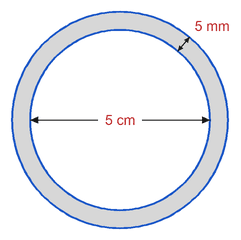
A metal pipe has a bore (inner diameter) of 5 cm. The pipe is 5 mm thick all round.
Find the weight, in kilogram, of 2 metres of the pipe if 1 cm³ of the metal weighs 7·7 g.
Solve with AIWritten solution
Solution:
Concept: A hollow cylinder (pipe) of external radius R, internal radius r and length h has volume of material π(R² − r²)h: the volume of the outer cylinder minus the volume of the hole. Its outer and inner curved surfaces are 2πRh and 2πrh, and each end is a ring of area π(R² − r²). Weight = volume × weight of 1 cm³.
Given: Inner diameter = 5 cm, thickness = 5 mm, length = 2 m, 1 cm³ of metal weighs 7·7 g.
Step 1 — Find the radii and the length in cm.
The bore (inner diameter) is 5 cm, so r = 2·5 cm; the metal is 5 mm, that is 0·5 cm, thick, so the outer radius is 2·5 + 0·5; the length 2 m is 200 cm.
Step 2 — Find the volume of metal.
The metal is the outer cylinder minus the bore.
Step 3 — Find the weight.
Each cm³ weighs 7·7 g, so multiply the exact volume by 7·7.
Step 4 — Change to kilograms.
There are 1000 g in 1 kg.
Watch out: 5 mm must be changed to 0·5 cm, and it is added to the inner radius (not the diameter) to get R.
Therefore, 2 metres of the pipe weigh 13·31 kg.
- 113 marks
Question 11
A cylindrical container with diameter of base 42 cm contains sufficient water to submerge a rectangular solid of iron with dimensions 22 cm × 14 cm × 10·5 cm.

Find the rise in the level of the water when the solid is submerged.
Solve with AIWritten solution
Solution:
Concept: A solid that sinks completely in water pushes the water up by its own volume. In a cylindrical vessel of radius r the raised water is a cylinder of radius r and height h (the rise), so πr²h = volume of the solid.
Given: Container diameter = 42 cm; iron block 22 cm × 14 cm × 10·5 cm.
Step 1 — Find the volume of the iron block.
The block is a cuboid, so its volume is length × breadth × height.
Step 2 — Find the area of the base of the container.
The diameter is 42 cm, so the radius is 21 cm.
Step 3 — Equate the volumes and find the rise.
The raised water (a cylinder of height h on this base) has the same volume as the block.
Watch out: The rise depends on the container's radius (21 cm), not on its diameter (42 cm).
Therefore, the water level rises by 2⅓ cm (about 2·33 cm).
- 123 marks
Question 12
A cylindrical container with internal radius of its base 10 cm, contains water up to a height of 7 cm.

Find the area of the wet surface of the cylinder.
Solve with AIWritten solution
Solution:
Concept: A right circular cylinder of base radius r and height h has volume V = πr²h (area of the base × height), curved surface area 2πrh (circumference of the base × height) and total surface area 2πrh + 2πr² = 2πr(h + r) (curved surface plus the two circular ends). The wet surface is every part of the container that the water touches.
Given: Internal radius r = 10 cm, height of water = 7 cm.
Step 1 — Decide which surfaces are wet.
The water touches the circular base and the curved wall up to a height of 7 cm. It does not touch the wall above the water or the top.
Step 2 — Area of the base.
The base is a circle of radius 10 cm.
Step 3 — Area of the wet wall.
The wet part of the wall is a curved surface of radius 10 cm and height 7 cm.
Step 4 — Add the two parts.
The wet surface area is the sum of the two parts.
Watch out: Use the height of the WATER (7 cm), not the height of the container, and include the base.
Therefore, the area of the wet surface is 754²⁄₇ cm², about 754·29 cm².
- 133 marks
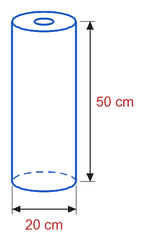
Question 13
Find the total surface area of an open pipe of length 50 cm, external diameter 20 cm and internal diameter 6 cm.
 Solve with AI
Written solution
Solution:
Concept: A hollow cylinder (pipe) of external radius R, internal radius r and length h has volume of material π(R² − r²)h: the volume of the outer cylinder minus the volume of the hole. Its outer and inner curved surfaces are 2πRh and 2πrh, and each end is a ring of area π(R² − r²). An open pipe has outer wall + inner wall + two end rings.
Given: Length h = 50 cm, external diameter 20 cm, internal diameter 6 cm.
Step 1 — Find the radii.
Halve the diameters to get the radii, and note the length h = 50 cm.
Step 2 — Outer curved surface.
The outside of the pipe has radius 10 cm and length 50 cm.
Step 3 — Inner curved surface.
The inside of the pipe has radius 3 cm and the same length.
Step 4 — The two end rings.
Each end is a ring of area π(R² − r²), and there are two of them.
Step 5 — Add all the parts.
The total surface area is the sum of the four surfaces.
Watch out: Do not forget the inner wall and BOTH end rings; leave the fractions in sevenths until the end to avoid rounding errors.
Therefore, the total surface area of the pipe is 4657⁵⁄₇ cm², about 4657·71 cm².
- 143 marks
Question 14
The height and the radius of the base of a cylinder are in the ratio 3 : 1. If its volume is 1029 π cm³; find its total surface area.
Solve with AIWritten solution
Solution:
Concept: A right circular cylinder of base radius r and height h has volume V = πr²h (area of the base × height), curved surface area 2πrh (circumference of the base × height) and total surface area 2πrh + 2πr² = 2πr(h + r) (curved surface plus the two circular ends). When two quantities are in a ratio a : b, write them as ax and bx.
Given: H : r = 3 : 1, volume = 1029π cm³.
Step 1 — Write r and h with one unknown.
The height and radius are in the ratio 3 : 1, so let r = x cm and h = 3x cm.
Step 2 — Use the volume.
Put r = x and h = 3x into the volume formula πr²h, equate it to 1029π, then divide both sides by 3π.
Step 3 — Find r and h.
So the radius is 7 cm and the height is 3 × 7 cm.
Step 4 — Find the total surface area.
Use TSA = 2πr(r + h), with π = 22/7.
Watch out: The ratio is height : radius = 3 : 1, so the HEIGHT is the larger one (h = 3x, not r = 3x).
Therefore, the total surface area is 1232 cm² (which is 392π cm²).
- 153 marks
Question 15
The radius of a solid right circular cylinder decreases by 20% and its height increases by 10%. Find the percentage change in its :
(i) volume
(ii) curved surface area
Solve with AIWritten solution
Solution:
Concept: A right circular cylinder of base radius r and height h has volume V = πr²h (area of the base × height), curved surface area 2πrh (circumference of the base × height) and total surface area 2πrh + 2πr² = 2πr(h + r) (curved surface plus the two circular ends). A percentage change is (new − old) ÷ old × 100%.
Step 1 — Write the new radius and height.
A 20% decrease leaves 80% of the radius, and a 10% increase makes the height 110% of what it was.
(i)
Step 2 — Find the new volume.
Put the new measurements into V = πr²h; the radius is squared.
Step 3 — Find the percentage change in volume.
Compare with the old volume πr²h.
The minus sign means a decrease.
(ii)
Step 4 — Find the new curved surface area.
Put the new measurements into 2πrh; here the radius is NOT squared.
Step 5 — Find the percentage change in the curved surface area.
Compare with the old curved surface area 2πrh.
Watch out: The volume uses r², so the 20% cut in the radius counts twice (0·8² = 0·64); you cannot simply add −20% and +10%.
Therefore, (i) the volume decreases by 29·6%, and (ii) the curved surface area decreases by 12%.
- 163 marks
Question 16
Find the minimum length in cm and correct to nearest whole number of the thin metal sheet required to make a hollow and closed cylindrical box of diameter 20 cm and height 35 cm. Given that the width of the metal sheet is 1 m. Also, find the cost of the sheet at the rate of ₹ 56 per m.
Find the area of metal sheet required, if 10% of it is wasted in cutting, overlapping, etc.
Solve with AIWritten solution
Solution:
Concept: A right circular cylinder of base radius r and height h has volume V = πr²h (area of the base × height), curved surface area 2πrh (circumference of the base × height) and total surface area 2πrh + 2πr² = 2πr(h + r) (curved surface plus the two circular ends). A closed box needs sheet for the curved wall and both ends. A sheet of width w and length L has area w × L.
Given: Closed box: diameter 20 cm, height 35 cm; sheet 1 m wide at ₹ 56 per m.
Step 1 — Find the area of sheet needed.
The box has radius 20 ÷ 2, that is 10 cm, and height h = 35 cm; it is closed, so we need its total surface area.
Step 2 — Find the length of the sheet.
The sheet is 1 m = 100 cm wide, so its length is the area divided by the width.
Correct to the nearest whole number, as the question asks, the length is 28 cm.
Step 3 — Find the cost.
The rate is ₹ 56 per metre of this sheet, and 28 cm = 0·28 m.
So the sheet costs ₹ 15.68.
Step 4 — Allow for the waste.
If 10% of the sheet bought is wasted, only 90% of it forms the box. So 90% of the required area must equal 2828·57 cm².
Watch out: The 10% is a part of the sheet BOUGHT, so divide by 0·9; multiplying 2828·57 by 1·1 would take 10% of the box's area instead. Also, a sheet of exactly 28 cm would be about 0·29 cm short; 28 cm is the length rounded as the question asks.
Therefore, the length of sheet is 28 cm, its cost is ₹ 15.68, and with 10% waste the area of sheet required is about 3142·86 cm².
- 173 marks
Question 17
3080 cm³ of water is required to fill a cylindrical vessel completely and 2310 cm³ of water is required to fill it upto 5 cm below the top.
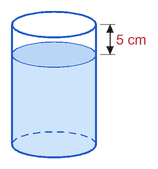
Find :
(i) radius of the vessel.
(ii) height of the vessel.
(iii) wetted surface area of the vessel when it is half-filled with water.
Solve with AIWritten solution
Solution:
Concept: A right circular cylinder of base radius r and height h has volume V = πr²h (area of the base × height), curved surface area 2πrh (circumference of the base × height) and total surface area 2πrh + 2πr² = 2πr(h + r) (curved surface plus the two circular ends). The difference between two amounts of water tells us the volume of the empty part between the two water levels.
Given: Full: 3080 cm³; filled to 5 cm below the top: 2310 cm³.
(i)
Step 1 — Find the volume of the top 5 cm.
Filling the last 5 cm takes the difference of the two amounts.
Step 2 — Find the radius.
The top 5 cm is a cylinder of radius r and height 5 cm, so its volume is πr² × 5.
(ii)
Step 3 — Find the height.
The full vessel holds 3080 cm³, so πr²h = 3080, with r = 7.
(iii)
Step 4 — Find the wetted surface when half full.
Half full means water 10 cm deep. The water touches the base and the curved wall up to 10 cm.
Watch out: The wetted surface includes the base; and 'half-filled' means half the HEIGHT (10 cm), not 5 cm below the top.
Therefore, (i) the radius is 7 cm, (ii) the height is 20 cm, and (iii) the wetted surface area when half-filled is 594 cm².
- 183 marks
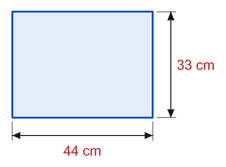
Question 18
Find the volume of the largest cylinder formed when a rectangular piece of paper 44 cm by 33 cm is rolled along its :
(i) shorter side. (ii) longer side.
 Solve with AI
Written solution
Solution:
Concept: The volume of a cylinder of base radius r and height h is V = πr²h, that is, area of the base × height. When a rectangular sheet is rolled into a cylinder (no overlap), the side along which it is rolled bends round into the circumference of the base, and the other side becomes the height.
Given: Rectangular paper 44 cm × 33 cm.
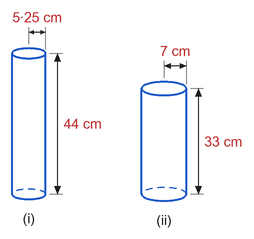
(i)
Step 1 — Read the circumference and height.
Rolled along the shorter side, the 33 cm side becomes the circumference and the 44 cm side becomes the height.
Step 2 — Find the radius.
Solve 2πr = 33, using π = 22/7.
Step 3 — Find the volume.
Use V = πr²h.
(ii)
Step 4 — Read the circumference and height.
Rolled along the longer side, the 44 cm side becomes the circumference and the 33 cm side becomes the height.
Step 5 — Find the radius.
Solve 2πr = 44, using π = 22/7.
Step 6 — Find the volume.
Use V = πr²h.
Watch out: The side that is rolled is the circumference 2πr, not the radius or the diameter.
Therefore, the volume is (i) 3811·5 cm³ when rolled along the shorter side, and (ii) 5082 cm³ when rolled along the longer side.
- 193 marks
Question 19
A metal cube of side 11 cm is completely submerged in water contained in a cylindrical vessel with diameter 28 cm.

Find the rise in the level of water.
Solve with AIWritten solution
Solution:
Concept: A solid that sinks completely in water pushes the water up by its own volume. In a cylindrical vessel of radius r the raised water is a cylinder of radius r and height h (the rise), so πr²h = volume of the solid.
Given: Cube of side 11 cm; vessel diameter 28 cm.
Step 1 — Find the volume of the cube.
The cube has side 11 cm.
Step 2 — Find the area of the base of the vessel.
The diameter is 28 cm, so the radius is 14 cm.
Step 3 — Find the rise.
The raised water, of height h on this base, has the same volume as the cube.
Watch out: The question gives a diameter; halve it to get the radius before using any formula.
Therefore, the water level rises by about 2·16 cm.
- 203 marks
Question 20
A circular tank of diameter 2 m is dug and the earth removed is spread uniformly all around the tank to form an embankment 2 m in width and 1·6 m in height.

Find the depth of the circular tank.
Solve with AIWritten solution
Solution:
Concept: When a solid is melted and recast (or water is displaced), no material is lost or gained: the volume before equals the volume after. For n identical small solids made from one big one, n = volume of the big solid ÷ volume of one small solid. An embankment of width w round a circular tank of radius r is a hollow cylinder (a thick ring) with inner radius r and outer radius r + w.
Given: Tank diameter 2 m; embankment 2 m wide and 1·6 m high.
Step 1 — Find the radii.
The tank has diameter 2 m, so its radius is 1 m. The embankment starts at the edge of the tank and is 2 m wide.
Step 2 — Find the volume of the embankment.
It is a ring of height 1·6 m; keep π, since it will cancel.
Step 3 — Write the volume of the tank.
Let the depth be d m; the tank is a cylinder of radius 1 m.
Step 4 — Equate and solve.
All the earth dug out forms the embankment, so the volumes are equal.
Watch out: The embankment's outer radius is 1 + 2 = 3 m (the width is added to the RADIUS of the tank).
Therefore, the depth of the tank is 12·8 m.
- 213 marks
Question 21
The sum of the height and the radius of a solid cylinder is 35 cm and its total surface area is 3080 cm²; find the volume of the cylinder.
Solve with AIWritten solution
Solution:
Concept: A right circular cylinder of base radius r and height h has volume V = πr²h (area of the base × height), curved surface area 2πrh (circumference of the base × height) and total surface area 2πrh + 2πr² = 2πr(h + r) (curved surface plus the two circular ends).
Given: R + h = 35 cm, total surface area = 3080 cm².
Step 1 — Use the total surface area.
TSA = 2πr(r + h), and r + h is given as 35 cm, so the formula becomes simple.
Step 2 — Find r.
The TSA is 3080 cm², so we solve 220r = 3080.
Step 3 — Find h.
The sum r + h is 35 cm.
Step 4 — Find the volume.
Use V = πr²h.
Watch out: Use r + h = 35 inside the factorised form 2πr(r + h); do not try to find r and h separately first.
Therefore, the volume of the cylinder is 12936 cm³.
- 223 marks
Question 22
The total surface area of a solid cylinder is 616 cm². If the ratio between its curved surface area and total surface area is 1 : 2; find the volume of the cylinder.
Solve with AIWritten solution
Solution:
Concept: A right circular cylinder of base radius r and height h has volume V = πr²h (area of the base × height), curved surface area 2πrh (circumference of the base × height) and total surface area 2πrh + 2πr² = 2πr(h + r) (curved surface plus the two circular ends).
Given: TSA = 616 cm², CSA : TSA = 1 : 2.
Step 1 — Split the total surface area.
CSA : TSA = 1 : 2, so the curved surface is half of 616 cm². The two ends make up the other half.
Step 2 — Find the radius.
The two ends have area 2πr².
Step 3 — Find the height.
The curved surface 2πrh is 308 cm² with r = 7.
Step 4 — Find the volume.
Use V = πr²h.
Watch out: The TSA includes TWO circular ends, so the ends give 2πr² (not πr²).
Therefore, the volume of the cylinder is 1078 cm³.
- 233 marks
Question 23
A cylindrical vessel of height 24 cm and diamater 40 cm is full of water. Find the exact number of small cylindrical bottles, each of height 10 cm and diameter 8 cm, which can be filled with this water.
Solve with AIWritten solution
Solution:
Concept: When a solid is melted and recast (or water is displaced), no material is lost or gained: the volume before equals the volume after. For n identical small solids made from one big one, n = volume of the big solid ÷ volume of one small solid.
Given: Vessel: height 24 cm, diameter 40 cm; bottle: height 10 cm, diameter 8 cm.
Step 1 — Find the radii.
Halve the diameters: the vessel has radius 20 cm and each bottle has radius 4 cm.
Step 2 — Write the two volumes.
The vessel has height 24 cm and each bottle 10 cm; we keep π because it cancels.
Step 3 — Divide.
The number of bottles is the vessel's volume divided by one bottle's volume.
Watch out: The question gives a diameter; halve it to get the radius before using any formula.
Therefore, exactly 60 bottles can be filled.
- 243 marks
Question 24
Two solid cylinders, one with diameter 60 cm and height 30 cm and the other with radius 30 cm and height 60 cm, are melted and recasted into a third solid cylinder of height 10 cm. Find the diameter of the cylinder formed.
Solve with AIWritten solution
Solution:
Concept: When a solid is melted and recast (or water is displaced), no material is lost or gained: the volume before equals the volume after. For n identical small solids made from one big one, n = volume of the big solid ÷ volume of one small solid.
Given: Cylinder 1: diameter 60 cm, height 30 cm; cylinder 2: radius 30 cm, height 60 cm; new height 10 cm.
Step 1 — Find the radii.
The first cylinder has diameter 60 cm, so radius 30 cm. The second has radius 30 cm. So both have radius 30 cm.
Step 2 — Add the volumes of the two cylinders.
Use V = πr²h for each and keep π.
Step 3 — Equate to the new cylinder.
The new cylinder has height 10 cm and radius r; its volume equals the total.
Step 4 — Find the diameter.
The diameter is twice the radius.
Watch out: The question asks for the DIAMETER of the new cylinder, so double the radius at the end.
Therefore, the diameter of the cylinder formed is 180 cm.
- 253 marks
Question 25
The total surface area of a hollow cylinder, which is open from both the sides, is 3575 cm²; area of its base ring is 357·5 cm² and its height is 14 cm.
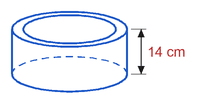
Find the thickness of the cylinder.
Solve with AIWritten solution
Solution:
Concept: A hollow cylinder (pipe) of external radius R, internal radius r and length h has volume of material π(R² − r²)h: the volume of the outer cylinder minus the volume of the hole. Its outer and inner curved surfaces are 2πRh and 2πrh, and each end is a ring of area π(R² − r²). We also use the identity R² − r² = (R + r)(R − r), and the thickness of the wall is R − r.
Given: TSA = 3575 cm², area of a base ring = 357·5 cm², height h = 14 cm.
Step 1 — Use the area of a base ring.
Each end ring has area π(R² − r²) = 357·5 cm².
Step 2 — Find the two curved surfaces.
The total surface is the two curved walls plus the two rings, so subtract the two rings from 3575 cm².
Step 3 — Find R + r.
Take out the common factor 2πh with h = 14 cm.
Step 4 — Find the thickness.
Divide R² − r² by R + r to get R − r.
Watch out: An open hollow cylinder has TWO rings, one at each end; subtract both before finding the curved surfaces.
Therefore, the thickness of the cylinder is 3·5 cm.
- 263 marks
Question 26
Two right circular solid cylinders have radii in the ratio 3 : 5 and heights in the ratio 2 : 3. Find the ratio between their :
(i) curved surface areas.
(ii) volumes.
Solve with AIWritten solution
Solution:
Concept: When two solids are compared, write each formula, divide one by the other and cancel the common factors (π, ⅓, 2, …); only the ratios of the given measurements are left. For cylinders, CSA = 2πrh and V = πr²h.
Step 1 — Write the given ratios.
Call the radii r₁, r₂ and the heights h₁, h₂.
(i)
Step 2 — Ratio of curved surface areas.
Divide 2πr₁h₁ by 2πr₂h₂; 2π cancels.
(ii)
Step 3 — Ratio of volumes.
Divide πr₁²h₁ by πr₂²h₂; π cancels and the radius ratio is squared.
Watch out: In the volume the radius ratio is SQUARED (9 : 25), but in the curved surface it is not.
Therefore, (i) the curved surface areas are in the ratio 2 : 5, and (ii) the volumes are in the ratio 6 : 25.
- 273 marks
Question 27
A closed cylindrical tank, made of thin iron-sheet, has diameter = 8·4 m and height 5·4 m. How much metal sheet, to the nearest m², is used in making this tank, if of the sheet actually used was wasted in making the tank ?
Solve with AIWritten solution
Solution:
Concept: A right circular cylinder of base radius r and height h has volume V = πr²h (area of the base × height), curved surface area 2πrh (circumference of the base × height) and total surface area 2πrh + 2πr² = 2πr(h + r) (curved surface plus the two circular ends). A closed tank needs sheet for its curved wall and both ends.
Given: Closed tank: diameter 8·4 m, height 5·4 m; 1/15 of the sheet used is wasted.
Step 1 — Find the area of the tank.
The radius is 8·4 ÷ 2 = 4·2 m and the height is 5·4 m, so r + h = 9·6 m.
Step 2 — Allow for the waste.
1/15 of the sheet actually used was wasted, so the other 14/15 of it forms the tank. Let the sheet used be A m².
Step 3 — Round as asked.
To the nearest m², 271·54… m² is 272 m².
Watch out: The waste is a fraction of the sheet USED (not of the tank's area), so the tank is 14/15 of the sheet; 253·44 × 16/15 would be wrong.
Therefore, about 272 m² of metal sheet is used.
- 281 mark
Question 28
The radius and height of a solid metallic cone are r cm each. The volume of the cone is :
Solve with AIAnswer
(A)
(B)
- Correct
(C)
(D)
Answer: (C)
Concept: A right circular cone of base radius r, height h and slant height l has l² = r² + h² (Pythagoras' theorem in the right triangle formed by the axis, a radius and a slant edge), volume V = ⅓πr²h, curved surface area πrl and total surface area πrl + πr² = πr(l + r).
Step 1 — Write the volume formula.
The volume of a cone is one-third of base area × height.
Step 2 — Put h = r.
The height equals the radius r, so replace h by r and multiply the powers of r.
Watch out: A volume always has a cube of a length (cm³); an answer with only r² cannot be a volume.
Why the other options are wrong:
- (A) : it leaves out the height (r), so it is an area-type expression (cm²), not a volume.
- (B) : it has the sphere's factor ⁴⁄₃ and only r², so it is neither a cone's volume nor a volume at all.
- (D) : ⁴⁄₃πr³ is the volume of a SPHERE of radius r, four times the cone's volume.
Therefore, the volume of the cone is ⅓πr³ cm³, option (C).
- 291 mark
Question 29
The radius of the base of a solid cone is r cm and its height is h cm; its curved surface area is :
 Solve with AI
Answer
(A)
- Correct
(B)
(C) πr(h + r)
(D) πr²(h + r)
Answer: (B)
Concept: A right circular cone of base radius r, height h and slant height l has l² = r² + h² (Pythagoras' theorem in the right triangle formed by the axis, a radius and a slant edge), volume V = ⅓πr²h, curved surface area πrl and total surface area πrl + πr² = πr(l + r).
Step 1 — Find the slant height.
The radius r, the height h and the slant height l form a right triangle with l as the hypotenuse, so Pythagoras' theorem gives l.
Step 2 — Put l into the curved surface area.
The curved surface area is πrl.
Watch out: The curved surface uses the SLANT height l, not the vertical height h.
Why the other options are wrong:
- (A) : the slant height is the hypotenuse, so the squares are ADDED; √(h² − r²) is not the slant height.
- (C) πr(h + r): πr(h + r) uses the vertical height h in place of l, and adds a base πr² that is not part of the curved surface.
- (D) πr²(h + r): πr²(h + r) has units cm³ (r² times a length), so it cannot be an area.
Therefore, the curved surface area is πr√(h² + r²) cm², option (B).
- 301 mark
Question 30
A conical toy tent-house, 28 cm in radius and 21 cm in slant height, is made from a rectangular sheet of paper 22 cm wide. The smallest length of the paper sheet required is :
Solve with AIAnswer
- Correct
(A) 84 cm
(B) 42 cm
(C) 72 cm
(D) 140 cm
Answer: (A) 84 cm
Concept: A right circular cone of base radius r, height h and slant height l has l² = r² + h² (Pythagoras' theorem in the right triangle formed by the axis, a radius and a slant edge), volume V = ⅓πr²h, curved surface area πrl and total surface area πrl + πr² = πr(l + r). A tent has no floor, so the paper needed is its curved surface area; a sheet of width w and length L has area w × L.
Step 1 — Find the paper needed.
The tent has radius 28 cm and slant height 21 cm, so its curved surface area is πrl.
Step 2 — Find the length of the sheet.
The sheet is 22 cm wide, so its length is the area divided by the width.
Watch out: Use the slant height given (21 cm) directly in πrl; do not add the base, since the tent has no floor.
Why the other options are wrong:
- (B) 42 cm: a sheet 42 cm long has area 22 × 42 = 924 cm², only half of the 1848 cm² needed.
- (C) 72 cm: a sheet 72 cm long has area 22 × 72 = 1584 cm², less than the 1848 cm² needed.
- (D) 140 cm: a sheet 140 cm long (area 3080 cm²) is enough, but it is not the SMALLEST length.
Therefore, the smallest length of paper is 84 cm, option (A).
- 311 mark
Question 31
For a cone, the ratio between the volume and area of its base is 11 : 6. The height of the cone is:
Solve with AIAnswer
(A) units
- Correct
(B) 5·5 units
(C) 11 units
(D) 5 units
Answer: (B) 5·5 units
Concept: A right circular cone of base radius r, height h and slant height l has l² = r² + h² (Pythagoras' theorem in the right triangle formed by the axis, a radius and a slant edge), volume V = ⅓πr²h, curved surface area πrl and total surface area πrl + πr² = πr(l + r).
Step 1 — Divide the volume by the base area.
The base is a circle of area πr², and the volume is ⅓πr²h, so πr² cancels.
Step 2 — Use the given ratio.
This ratio is 11 : 6, so h/3 = 11/6; multiply both sides by 3.
Watch out: The ratio V : base area is h/3, not h; remember to multiply by 3.
Why the other options are wrong:
- (A) units: 1⅚ = 11/6 is the value of h/3 itself; it forgets to multiply by 3.
- (C) 11 units: with h = 11, V : base area would be 11/3, that is 22 : 6, not 11 : 6.
- (D) 5 units: with h = 5, V : base area would be 5/3, that is 10 : 6, not 11 : 6.
Therefore, the height of the cone is 5·5 units, option (B).
- 321 mark
Question 32
The radii of two solid cones are equal and their slant heights are in the ratio 7 : 4. The ratio between their curved surface areas is:
Solve with AIAnswer
(A) 4 : 7
- Correct
(B) 7 : 4
(C) 16 : 49
(D) 49 : 16
Answer: (B) 7 : 4
Concept: A right circular cone of base radius r, height h and slant height l has l² = r² + h² (Pythagoras' theorem in the right triangle formed by the axis, a radius and a slant edge), volume V = ⅓πr²h, curved surface area πrl and total surface area πrl + πr² = πr(l + r). When two solids are compared, write each formula, divide one by the other and cancel the common factors (π, ⅓, 2, …); only the ratios of the given measurements are left.
Step 1 — Write the ratio of the curved surface areas.
Divide πr₁l₁ by πr₂l₂; the radii are equal, so π and r cancel.
Step 2 — Use the slant heights.
The slant heights are in the ratio 7 : 4, so the curved areas are in the same ratio.
Watch out: The curved surface area is proportional to l itself, not to l²; do not square the ratio.
Why the other options are wrong:
- (A) 4 : 7: 4 : 7 turns the ratio upside down; the cone with the longer slant height has the larger curved surface.
- (C) 16 : 49: 16 : 49 squares the ratio and turns it upside down; CSA = πrl is not proportional to l².
- (D) 49 : 16: 49 : 16 squares the ratio; CSA = πrl is proportional to l, not to l².
Therefore, the curved surface areas are in the ratio 7 : 4, option (B).
- 333 marks
Question 33
Find the volume of a cone whose slant height is 17 cm and radius of base is 8 cm.
 Solve with AI
Written solution
Solution:
Concept: A right circular cone of base radius r, height h and slant height l has l² = r² + h² (Pythagoras' theorem in the right triangle formed by the axis, a radius and a slant edge), volume V = ⅓πr²h, curved surface area πrl and total surface area πrl + πr² = πr(l + r).
Given: Slant height l = 17 cm, radius r = 8 cm.
Step 1 — Find the height.
The slant height l = 17 cm and the radius r = 8 cm are known, so Pythagoras' theorem gives the height.
Step 2 — Find the volume.
Use V = ⅓πr²h, with π = 22/7.
Watch out: The volume needs the vertical height h, not the slant height l = 17 cm.
Therefore, the volume of the cone is 1005⁵⁄₇ cm³, about 1005·71 cm³.
- 343 marks
Question 34
The curved surface area of a cone is 12320 cm². If the radius of its base is 56 cm, find its height.
 Solve with AI
Written solution
Solution:
Concept: A right circular cone of base radius r, height h and slant height l has l² = r² + h² (Pythagoras' theorem in the right triangle formed by the axis, a radius and a slant edge), volume V = ⅓πr²h, curved surface area πrl and total surface area πrl + πr² = πr(l + r).
Given: Curved surface area = 12320 cm², radius r = 56 cm.
Step 1 — Find the slant height.
The curved surface area πrl is 12320 cm² and r = 56 cm.
Step 2 — Find the height.
Use h² = l² − r² from Pythagoras' theorem.
Watch out: Πrl gives the SLANT height first; the height still has to be found with Pythagoras' theorem.
Therefore, the height of the cone is 42 cm.
- 353 marks
Question 35
The circumference of the base of a 12 m high conical tent is 66 m.

Find the volume of the air contained in it.
Solve with AIWritten solution
Solution:
Concept: A right circular cone of base radius r, height h and slant height l has l² = r² + h² (Pythagoras' theorem in the right triangle formed by the axis, a radius and a slant edge), volume V = ⅓πr²h, curved surface area πrl and total surface area πrl + πr² = πr(l + r). The air inside the tent fills a cone, so its volume is ⅓πr²h.
Given: Height h = 12 m, circumference of the base = 66 m.
Step 1 — Find the radius.
The circumference of the base, 2πr, is 66 m.
Step 2 — Find the volume of air.
The tent is a cone of radius 10·5 m and height 12 m.
Watch out: The circumference is 2πr, so divide by 2π (that is, 44/7), not by π.
Therefore, the volume of air in the tent is 1386 m³.
- 363 marks
Question 36
The radius and the height of a right circular cone are in the ratio 5 : 12 and its volume is 2512 cubic cm. Find the radius and slant height of the cone. (Take π = 3·14)
Solve with AIWritten solution
Solution:
Concept: A right circular cone of base radius r, height h and slant height l has l² = r² + h² (Pythagoras' theorem in the right triangle formed by the axis, a radius and a slant edge), volume V = ⅓πr²h, curved surface area πrl and total surface area πrl + πr² = πr(l + r). If the ratio r : h is 5 : 12, we write r = 5x and h = 12x.
Given: R : h = 5 : 12, volume = 2512 cm³, π = 3·14.
Step 1 — Write r and h with one unknown.
The ratio is 5 : 12, so let r = 5x cm and h = 12x cm.
Step 2 — Use the volume.
Put these into V = ⅓πr²h, with π = 3·14, and equate to 2512.
Step 3 — Find the radius and the height.
Put x = 2 into the expressions 5x and 12x.
Step 4 — Find the slant height.
Use Pythagoras' theorem, l² = r² + h².
Watch out: (5x)² = 25x², not 5x²; square the whole bracket.
Therefore, the radius is 10 cm and the slant height is 26 cm.
- 373 marks
Question 37
The diameters of two cones are equal. If their slant heights are in the ratio 5 : 4, find the ratio of their curved surface areas.
Solve with AIWritten solution
Solution:
Concept: A right circular cone of base radius r, height h and slant height l has l² = r² + h² (Pythagoras' theorem in the right triangle formed by the axis, a radius and a slant edge), volume V = ⅓πr²h, curved surface area πrl and total surface area πrl + πr² = πr(l + r). When two solids are compared, write each formula, divide one by the other and cancel the common factors (π, ⅓, 2, …); only the ratios of the given measurements are left.
Given: Equal diameters; slant heights in the ratio 5 : 4.
Step 1 — Note what is equal.
Equal diameters mean equal radii; call the common radius r.
Step 2 — Divide the curved surface areas.
Divide πrl₁ by πrl₂; π and r cancel, leaving the ratio of the slant heights.
Watch out: CSA is proportional to l (not l²), so the ratio is not squared.
Therefore, the curved surface areas are in the ratio 5 : 4.
- 383 marks
Question 38
There are two cones. The curved surface area of one is twice that of the other. The slant height of the latter is twice that of the former. Find the ratio of their radii.
Solve with AIWritten solution
Solution:
Concept: A right circular cone of base radius r, height h and slant height l has l² = r² + h² (Pythagoras' theorem in the right triangle formed by the axis, a radius and a slant edge), volume V = ⅓πr²h, curved surface area πrl and total surface area πrl + πr² = πr(l + r). When two solids are compared, write each formula, divide one by the other and cancel the common factors (π, ⅓, 2, …); only the ratios of the given measurements are left.
Step 1 — Name the measurements.
Let the first cone have radius r₁ and slant height l. Its curved surface is twice that of the second cone, whose slant height is twice the first's, 2l; call its radius r₂.
Step 2 — Write the condition as an equation.
CSA of the first = 2 × CSA of the second.
Step 3 — Simplify.
Divide both sides by πl.
Step 4 — Write the ratio.
Divide both sides by r₂.
Watch out: 'the latter' is the second cone (the one with the smaller curved surface), so it is its slant height that is 2l.
Therefore, the radii are in the ratio 4 : 1.
- 393 marks
Question 39
A heap of wheat is in the form of a cone of diameter 16·8 m and height 3·5 m.
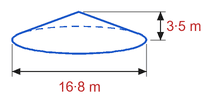
Find its volume. How much cloth is required to just cover the heap ?
Solve with AIWritten solution
Solution:
Concept: A right circular cone of base radius r, height h and slant height l has l² = r² + h² (Pythagoras' theorem in the right triangle formed by the axis, a radius and a slant edge), volume V = ⅓πr²h, curved surface area πrl and total surface area πrl + πr² = πr(l + r). The cloth that just covers the heap is its curved surface (the base is on the ground).
Given: Diameter 16·8 m, height 3·5 m.
Step 1 — Find the radius.
The diameter is 16·8 m, so the radius is half of it.
Step 2 — Find the volume.
The heap is a cone of radius 8·4 m and height 3·5 m.
Step 3 — Find the slant height.
Use l² = r² + h².
Step 4 — Find the cloth needed.
The cloth covers the curved surface πrl.
Watch out: The cloth covers only the curved surface; do not add the base, which lies on the ground.
Therefore, the volume of the heap is 258·72 m³, and 240·24 m² of cloth is required to cover it.
- 403 marks
Question 40
If you are given a rectangular canvas of 1·5 m in width, what length of this canvas would you require to make a conical tent that is 48 m in diameter and 7 m in height ? Note that 10% of the canvas is used (wasted) in folds and stitchings.
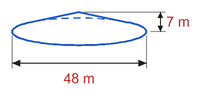
Also, find the cost of the canvas at the rate of ₹ 24 per metre.
Solve with AIWritten solution
Solution:
Concept: A right circular cone of base radius r, height h and slant height l has l² = r² + h² (Pythagoras' theorem in the right triangle formed by the axis, a radius and a slant edge), volume V = ⅓πr²h, curved surface area πrl and total surface area πrl + πr² = πr(l + r). Canvas of width w and length L has area w × L.
Given: Tent diameter 48 m, height 7 m; canvas 1·5 m wide at ₹ 24 per metre; 10% of the canvas is wasted.
Step 1 — Find the slant height.
The radius is 48 ÷ 2 = 24 m and the height is 7 m; use l² = r² + h².
Step 2 — Find the curved surface of the tent.
The canvas forms the curved surface πrl.
Step 3 — Allow for the waste.
10% of the canvas is used up in folds and stitching, so only 90% of the canvas forms the tent. Let the canvas be A m².
Step 4 — Find the length of canvas.
The canvas is 1·5 m wide, so divide the area by 1·5.
Step 5 — Find the cost.
Each metre of canvas costs ₹ 24.
So the canvas costs about ₹ 33,523.81.
Watch out: The 10% is a part of the canvas bought, so divide by 0·9 (not multiply by 1·1).
Note: if the 10% is instead read as extra canvas added to the tent's area, the length is 1885·71 × 1·1 ÷ 1·5 ≈ 1382·86 m and the cost ≈ ₹ 33,188.57.
Therefore, about 1396·83 m of canvas is required, costing about ₹ 33,523.81.
- 413 marks
Question 41
A solid cone of height 8 cm and base radius 6 cm is melted and recast into identical cones, each of height 2 cm and diameter 1 cm. Find the number of cones formed.
Solve with AIWritten solution
Solution:
Concept: When a solid is melted and recast (or water is displaced), no material is lost or gained: the volume before equals the volume after. For n identical small solids made from one big one, n = volume of the big solid ÷ volume of one small solid. A right circular cone of base radius r, height h and slant height l has l² = r² + h² (Pythagoras' theorem in the right triangle formed by the axis, a radius and a slant edge), volume V = ⅓πr²h, curved surface area πrl and total surface area πrl + πr² = πr(l + r).
Given: Big cone: height 8 cm, radius 6 cm; small cones: height 2 cm, diameter 1 cm.
Step 1 — Write the two volumes.
The big cone has r = 6 cm and h = 8 cm. Each small cone has diameter 1 cm, so r = 0·5 cm, and h = 2 cm. Keep ⅓π, which cancels.
Step 2 — Divide.
The number of cones is the big volume divided by one small volume.
Watch out: The small cones are given by DIAMETER (1 cm); their radius is 0·5 cm.
Therefore, 576 cones are formed.
- 423 marks
Question 42
The total surface area of a right circular cone of slant height 13 cm is 90 π cm².
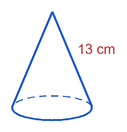
Calculate :
(i) its radius in cm.
(ii) its volume in cm³. [Take π = 3·14].
Solve with AIWritten solution
Solution:
Concept: A right circular cone of base radius r, height h and slant height l has l² = r² + h² (Pythagoras' theorem in the right triangle formed by the axis, a radius and a slant edge), volume V = ⅓πr²h, curved surface area πrl and total surface area πrl + πr² = πr(l + r).
Given: Slant height l = 13 cm, total surface area = 90π cm².
(i)
Step 1 — Write the equation for r.
The total surface area πr(l + r) is 90π, with l = 13 cm; divide both sides by π.
Step 2 — Factorise and solve.
We need two numbers with product −90 and sum 13: they are 18 and −5.
So r = −18 or r = 5. A radius cannot be negative, so r = 5 cm.
(ii)
Step 3 — Find the height.
Use h² = l² − r².
Step 4 — Find the volume.
Use V = ⅓πr²h, with π = 3·14 as asked.
Watch out: Reject the negative root of the quadratic; a length is always positive.
Therefore, (i) the radius is 5 cm, and (ii) the volume is 314 cm³.
- 433 marks
Question 43
The area of the base of a conical solid is 38·5 cm² and its volume is 154 cm³. Find the curved surface area of the solid.
Solve with AIWritten solution
Solution:
Concept: A right circular cone of base radius r, height h and slant height l has l² = r² + h² (Pythagoras' theorem in the right triangle formed by the axis, a radius and a slant edge), volume V = ⅓πr²h, curved surface area πrl and total surface area πrl + πr² = πr(l + r).
Given: Base area = 38·5 cm², volume = 154 cm³.
Step 1 — Find the radius.
The base area πr² is 38·5 cm².
Step 2 — Find the height.
The volume is ⅓ × base area × height = 154 cm³, so we can use the base area directly.
Step 3 — Find the slant height.
Use l² = r² + h².
Step 4 — Find the curved surface area.
Use CSA = πrl.
Watch out: The curved surface needs the slant height (12·5 cm), not the height (12 cm).
Therefore, the curved surface area of the solid is 137·5 cm².
- 443 marks
Question 44
A vessel, in the form of an inverted cone, is filled with water to the brim. Its height is 32 cm and diameter of the base is 25·2 cm.

Six equal solid cones are dropped in it, so that they are fully submerged. As a result, one-fourth of water in the original cone overflows. What is the volume of each of the solid cones submerged ?
Solve with AIWritten solution
Solution:
Concept: A right circular cone of base radius r, height h and slant height l has l² = r² + h² (Pythagoras' theorem in the right triangle formed by the axis, a radius and a slant edge), volume V = ⅓πr²h, curved surface area πrl and total surface area πrl + πr² = πr(l + r). A solid that sinks completely in water pushes the water up by its own volume. In a vessel that is full to the brim, the water pushed out (overflow) has the same volume as the solids dropped in.
Given: Vessel: inverted cone, height 32 cm, diameter 25·2 cm, full; six equal cones make ¼ of the water overflow.
Step 1 — Find the volume of water in the vessel.
The vessel is a cone of radius 25·2 ÷ 2 = 12·6 cm and height 32 cm.
Step 2 — Find the water that overflows.
One-fourth of this water overflows.
Step 3 — Find the volume of each solid cone.
The overflow equals the total volume of the six equal cones, so divide by 6.
Watch out: The overflow equals the volume of ALL six cones together; divide by 6 at the end.
Therefore, the volume of each solid cone is 221·76 cm³.
- 453 marks
Question 45
The volume of a conical tent is 1232 m³ and the area of the base floor is 154 m². Calculate the:
(i) radius of the floor, (ii) height of the tent, (iii) length of the canvas required to cover this conical tent if its width is 2 m.
Solve with AIWritten solution
Solution:
Concept: A right circular cone of base radius r, height h and slant height l has l² = r² + h² (Pythagoras' theorem in the right triangle formed by the axis, a radius and a slant edge), volume V = ⅓πr²h, curved surface area πrl and total surface area πrl + πr² = πr(l + r). Canvas of width w and length L has area w × L.
Given: Volume = 1232 m³, floor area = 154 m², canvas width = 2 m.
(i)
Step 1 — Find the radius of the floor.
The floor is a circle of area πr² = 154 m².
(ii)
Step 2 — Find the height.
The volume is ⅓ × floor area × height = 1232 m³.
(iii)
Step 3 — Find the slant height.
Use l² = r² + h².
Step 4 — Find the area of canvas.
The canvas covers the curved surface πrl.
Step 5 — Find the length of canvas.
The canvas is 2 m wide, so divide the area by 2.
Watch out: The canvas covers only the curved surface; the floor is not made of canvas.
Therefore, (i) the radius of the floor is 7 m, (ii) the height of the tent is 24 m, and (iii) 275 m of canvas is required.
- 461 mark
Question 46
A solid metallic sphere of radius 16 cm is melted to form small identical spheres each of diameter 4 cm. The number of spheres formed is :
Solve with AIAnswer
(A) 64
(B) 252
- Correct
(C) 512
(D) 1024
Answer: (C) 512
Concept: When a solid is melted and recast (or water is displaced), no material is lost or gained: the volume before equals the volume after. For n identical small solids made from one big one, n = volume of the big solid ÷ volume of one small solid. For a sphere of radius r, the volume is V = ⁴⁄₃πr³ and the surface area is 4πr². For a hemisphere of radius r, the volume is ⅔πr³, the curved surface area is 2πr² and the total surface area is 3πr² (curved part 2πr² plus the flat circle πr²).
Step 1 — Find the radius of a small sphere.
Each small sphere has diameter 4 cm, so its radius is 2 cm.
Step 2 — Divide the volumes.
The number of spheres is the big volume divided by one small volume; ⁴⁄₃π cancels, leaving the cube of the ratio of the radii.
Watch out: The small spheres are given by DIAMETER; use the radius 2 cm, not 4 cm.
Why the other options are wrong:
- (A) 64: 64 is (16/4)³: it uses the diameter 4 cm as if it were the radius.
- (B) 252: 252 does not come from the ratio of volumes, which is exactly (16/2)³ = 512.
- (D) 1024: 1024 is twice the correct number; a sphere's volume depends on r³, and (16/2)³ is 512.
Therefore, 512 spheres are formed, option (C).
- 471 mark
Question 47
A hemi-spherical bowl (as shown) has external radius R and internal radius r, the outer surface area of the bowl is :
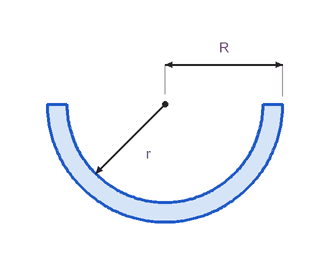 Solve with AI
Answer
(A) 2πR² + πr²
- Correct
(B) 3πR² – πr²
(C) 2πR² + 2πr²
(D) 2πR² – πr²
Answer: (B) 3πR² – πr²
Concept: For a sphere of radius r, the volume is V = ⁴⁄₃πr³ and the surface area is 4πr². For a hemisphere of radius r, the volume is ⅔πr³, the curved surface area is 2πr² and the total surface area is 3πr² (curved part 2πr² plus the flat circle πr²). A hollow bowl has an outer curved surface, an inner curved surface and a flat rim (a ring between the circles of radii R and r).
Step 1 — List the outside surfaces.
Seen from outside, the bowl shows its outer curved surface and the flat rim on top; the inner curved surface is inside the bowl, so it is not part of the outer surface.
Step 2 — Outer curved surface.
This is half of a sphere of radius R.
Step 3 — The rim.
The rim is a ring: the circle of radius R minus the circle of radius r.
Step 4 — Add.
The outer surface area is the sum of these two parts.
Watch out: The rim is a RING, π(R² − r²), not a full circle.
Why the other options are wrong:
- (A) 2πR² + πr²: it adds the whole inner circle πr² instead of the rim ring π(R² − r²).
- (C) 2πR² + 2πr²: it adds 2πr², which is the INNER curved surface of the bowl, not part of the outside.
- (D) 2πR² – πr²: it subtracts πr² from the curved surface but leaves out the πR² of the rim, so the rim ring is not counted.
Therefore, the outer surface area of the bowl is 3πR² − πr², option (B).
- 481 mark
Question 48
The ratio between the volumes of two spherical solids is 27 : 8. The ratio between their curved surface areas is :
Solve with AIAnswer
(A) 27 : 8
(B) 8 : 27
(C) 3 : 2
- Correct
(D) 9 : 4
Answer: (D) 9 : 4
Concept: For a sphere of radius r, the volume is V = ⁴⁄₃πr³ and the surface area is 4πr². For a hemisphere of radius r, the volume is ⅔πr³, the curved surface area is 2πr² and the total surface area is 3πr² (curved part 2πr² plus the flat circle πr²). When two solids are compared, write each formula, divide one by the other and cancel the common factors (π, ⅓, 2, …); only the ratios of the given measurements are left.
Step 1 — Find the ratio of the radii.
Volumes are in the ratio of the cubes of the radii, so take the cube root of 27 : 8.
Step 2 — Find the ratio of the surface areas.
Surface areas 4πr² are in the ratio of the squares of the radii.
Watch out: Go from volumes to radii with a CUBE root, then square for areas.
Why the other options are wrong:
- (A) 27 : 8: 27 : 8 is the ratio of the volumes, not of the surface areas.
- (B) 8 : 27: 8 : 27 is the volume ratio turned upside down.
- (C) 3 : 2: 3 : 2 is the ratio of the radii; the areas need its square.
Therefore, the surface areas are in the ratio 9 : 4, option (D).
- 491 mark
Question 49
A solid metallic sphere of radius 8 cm is melted and recast into 64 identical solid spheres. The diameter of each smaller sphere formed is :
Solve with AIAnswer
- Correct
(A) 4 cm
(B) 2 cm
(C) 8 cm
(D) 1 cm
Answer: (A) 4 cm
Concept: When a solid is melted and recast (or water is displaced), no material is lost or gained: the volume before equals the volume after. For n identical small solids made from one big one, n = volume of the big solid ÷ volume of one small solid. For a sphere of radius r, the volume is V = ⁴⁄₃πr³ and the surface area is 4πr². For a hemisphere of radius r, the volume is ⅔πr³, the curved surface area is 2πr² and the total surface area is 3πr² (curved part 2πr² plus the flat circle πr²).
Step 1 — Equate the volumes.
64 small spheres of radius r have the same volume as one sphere of radius 8 cm; ⁴⁄₃π cancels.
Step 2 — Find the diameter.
The diameter is twice the radius.
Watch out: The question asks for the DIAMETER; the radius 2 cm is only half of it.
Why the other options are wrong:
- (B) 2 cm: 2 cm is the radius of each small sphere, not its diameter.
- (C) 8 cm: 8 cm is the radius of the big sphere.
- (D) 1 cm: a diameter of 1 cm (radius 0·5 cm) would give 64 × 0·125 = 8 cm³ of r³ in total, not 512.
Therefore, the diameter of each smaller sphere is 4 cm, option (A).
- 501 mark
Question 50
r₁, r₂ and r₃ are the radii of three metallic spheres. If these spheres are melted to form a single solid sphere, the radius of sphere formed is :
Solve with AIAnswer
(A)
(B) r₁ + r₂ + r₃
(C) r₁³ + r₂³ + r₃³
- Correct
(D)
Answer: (D)
Concept: When a solid is melted and recast (or water is displaced), no material is lost or gained: the volume before equals the volume after. For n identical small solids made from one big one, n = volume of the big solid ÷ volume of one small solid. For a sphere of radius r, the volume is V = ⁴⁄₃πr³ and the surface area is 4πr². For a hemisphere of radius r, the volume is ⅔πr³, the curved surface area is 2πr² and the total surface area is 3πr² (curved part 2πr² plus the flat circle πr²).
Step 1 — Equate the volumes.
The new sphere (radius R) has the volume of the three spheres together.
Step 2 — Cancel and take the cube root.
Divide by ⁴⁄₃π, then take the cube root of both sides.
Watch out: Volumes add, radii do NOT: R is not r₁ + r₂ + r₃.
Why the other options are wrong:
- (A) : it takes a square root, but the volume involves cubes, so a cube root is needed.
- (B) r₁ + r₂ + r₃: adding the radii would give a sphere with a much larger volume; volumes add, not radii.
- (C) r₁³ + r₂³ + r₃³: r₁³ + r₂³ + r₃³ is R³, not R; the cube root is missing.
Therefore, the radius of the sphere formed is the cube root of r₁³ + r₂³ + r₃³, option (D).
- 513 marks
Question 51
The volume of a sphere is 38808 cm³; find its diameter and the surface area.
Solve with AIWritten solution
Solution:
Concept: For a sphere of radius r, the volume is V = ⁴⁄₃πr³ and the surface area is 4πr². For a hemisphere of radius r, the volume is ⅔πr³, the curved surface area is 2πr² and the total surface area is 3πr² (curved part 2πr² plus the flat circle πr²).
Given: Volume of the sphere = 38808 cm³.
Step 1 — Write the volume equation.
The volume ⁴⁄₃πr³ is 38808 cm³; use π = 22/7.
Step 2 — Solve for r.
Multiply by 21 and divide by 88, then take the cube root.
Step 3 — Find the diameter.
The diameter is twice the radius.
Step 4 — Find the surface area.
Use 4πr².
Watch out: 9261 = 21 × 21 × 21; spotting the cube saves time (21³ = 9261).
Therefore, the diameter is 42 cm and the surface area is 5544 cm².
- 523 marks
Question 52
A spherical ball of lead has been melted and made into identical smaller balls with radius equal to half the radius of the original one. How many such balls can be made ?
Solve with AIWritten solution
Solution:
Concept: When a solid is melted and recast (or water is displaced), no material is lost or gained: the volume before equals the volume after. For n identical small solids made from one big one, n = volume of the big solid ÷ volume of one small solid. For a sphere of radius r, the volume is V = ⁴⁄₃πr³ and the surface area is 4πr². For a hemisphere of radius r, the volume is ⅔πr³, the curved surface area is 2πr² and the total surface area is 3πr² (curved part 2πr² plus the flat circle πr²).
Step 1 — Write the two volumes.
Let the big ball have radius r; each small ball has radius r/2.
Step 2 — Divide.
⁴⁄₃π and r³ cancel, leaving the cube of 2.
Watch out: Halving the radius divides the volume by 2³ = 8, not by 2.
Therefore, 8 such balls can be made.
- 533 marks
Question 53
How many balls each of radius 1 cm can be made by melting a bigger ball whose diameter is 8 cm ?
Solve with AIWritten solution
Solution:
Concept: When a solid is melted and recast (or water is displaced), no material is lost or gained: the volume before equals the volume after. For n identical small solids made from one big one, n = volume of the big solid ÷ volume of one small solid. For a sphere of radius r, the volume is V = ⁴⁄₃πr³ and the surface area is 4πr². For a hemisphere of radius r, the volume is ⅔πr³, the curved surface area is 2πr² and the total surface area is 3πr² (curved part 2πr² plus the flat circle πr²).
Given: Small balls: radius 1 cm; big ball: diameter 8 cm.
Step 1 — Find the radius of the big ball.
The diameter is 8 cm, so the radius is 4 cm.
Step 2 — Divide the volumes.
⁴⁄₃π cancels, leaving the ratio of the cubes of the radii.
Watch out: The question gives a diameter; halve it to get the radius before using any formula.
Therefore, 64 balls can be made.
- 543 marks
Question 54
The volume of one sphere is 27 times that of another sphere. Calculate the ratio of their :
(i) radii, (ii) surface areas.
Solve with AIWritten solution
Solution:
Concept: For a sphere of radius r, the volume is V = ⁴⁄₃πr³ and the surface area is 4πr². For a hemisphere of radius r, the volume is ⅔πr³, the curved surface area is 2πr² and the total surface area is 3πr² (curved part 2πr² plus the flat circle πr²). When two solids are compared, write each formula, divide one by the other and cancel the common factors (π, ⅓, 2, …); only the ratios of the given measurements are left.
(i)
Step 1 — Ratio of the radii.
The volumes are in the ratio 27 : 1 and ⁴⁄₃π cancels, so the cubes of the radii are in this ratio; take the cube root.
(ii)
Step 2 — Ratio of the surface areas.
Surface areas 4πr² are in the ratio of the squares of the radii.
Watch out: Take the cube root for radii, then square for areas; 27 : 1 is not the area ratio.
Therefore, (i) the radii are in the ratio 3 : 1, and (ii) the surface areas are in the ratio 9 : 1.
- 553 marks
Question 55
If the number of square centimetres on the surface of a sphere is equal to the number of cubic centimetres in its volume, what is the diameter of the sphere ?
Solve with AIWritten solution
Solution:
Concept: For a sphere of radius r, the volume is V = ⁴⁄₃πr³ and the surface area is 4πr². For a hemisphere of radius r, the volume is ⅔πr³, the curved surface area is 2πr² and the total surface area is 3πr² (curved part 2πr² plus the flat circle πr²).
Step 1 — Write the condition.
The number for the surface area equals the number for the volume.
Step 2 — Solve for r.
Divide both sides by 4πr² (r is not zero) and then multiply by 3.
Step 3 — Find the diameter.
The diameter is twice the radius.
Watch out: The question asks for the DIAMETER, so double the radius.
Therefore, the diameter of the sphere is 6 cm.
- 563 marks
Question 56
A solid metal sphere is cut through its centre into 2 equal parts. If the diameter of the sphere is cm, find the total surface area of each part correct to two decimal places.
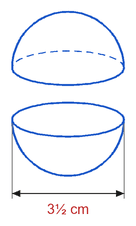 Solve with AI
Written solution
Solution:
Concept: For a sphere of radius r, the volume is V = ⁴⁄₃πr³ and the surface area is 4πr². For a hemisphere of radius r, the volume is ⅔πr³, the curved surface area is 2πr² and the total surface area is 3πr² (curved part 2πr² plus the flat circle πr²). Cutting a solid sphere through its centre gives two solid hemispheres; each has its curved surface and a new flat circular face.
Given: Diameter = 3½ cm.
Step 1 — Find the radius.
The diameter is 3½ cm, so the radius is 1·75 cm.
Step 2 — Find the total surface area of one part.
Each part has curved surface 2πr² plus a flat circle πr², that is 3πr².
Step 3 — Round as asked.
Correct to two decimal places, 28·875 becomes 28·88.
Watch out: Include the new flat face made by the cut; the total surface of a solid hemisphere is 3πr², not 2πr².
Therefore, the total surface area of each part is 28·88 cm².
- 573 marks
Question 57
The internal and external diameters of a hollow hemispherical vessel are 21 cm and 28 cm respectively.

Find :
(i) internal curved surface area,
(ii) external curved surface area,
(iii) total surface area,
(iv) volume of material of the vessel.
Solve with AIWritten solution
Solution:
Concept: For a sphere of radius r, the volume is V = ⁴⁄₃πr³ and the surface area is 4πr². For a hemisphere of radius r, the volume is ⅔πr³, the curved surface area is 2πr² and the total surface area is 3πr² (curved part 2πr² plus the flat circle πr²). A hollow hemispherical vessel has an inner curved surface (radius r), an outer curved surface (radius R) and a flat rim, which is a ring of area π(R² − r²). The material is the outer hemisphere minus the inner one: ⅔π(R³ − r³).
Given: Internal diameter 21 cm, external diameter 28 cm.
Step 1 — Find the radii.
Halve the diameters to get the inner radius r and the outer radius R.
(i)
Step 2 — Internal curved surface area.
Use 2πr² with r = 10·5 cm.
(ii)
Step 3 — External curved surface area.
Use 2πR² with R = 14 cm.
(iii)
Step 4 — Area of the rim.
The rim is the ring between the two circles.
Step 5 — Total surface area.
Add the inner surface, the outer surface and the rim.
(iv)
Step 6 — Volume of material.
Subtract the inner hemisphere from the outer one.
Watch out: The rim is a ring π(R² − r²); and the material is ⅔π(R³ − r³), not ⅔π(R − r)³.
Therefore, (i) the internal curved surface area is 693 cm², (ii) the external curved surface area is 1232 cm², (iii) the total surface area is 2194·5 cm², and (iv) the volume of material is about 3323·83 cm³.
- 583 marks
Question 58
A solid sphere and a solid hemi-sphere have the same total surface area. Find the ratio between their volumes.
Solve with AIWritten solution
Solution:
Concept: For a sphere of radius r, the volume is V = ⁴⁄₃πr³ and the surface area is 4πr². For a hemisphere of radius r, the volume is ⅔πr³, the curved surface area is 2πr² and the total surface area is 3πr² (curved part 2πr² plus the flat circle πr²). When two solids are compared, write each formula, divide one by the other and cancel the common factors (π, ⅓, 2, …); only the ratios of the given measurements are left.
Step 1 — Name the radii.
Let the sphere have radius a and the hemisphere radius b. The sphere's total surface is 4πa², and the solid hemisphere's total surface is 3πb².
Step 2 — Use the equal surface areas.
Equate the two areas and divide by π.
Step 3 — Divide the volumes.
The sphere's volume is ⁴⁄₃πa³ and the hemisphere's is ⅔πb³; π cancels.
Watch out: A SOLID hemisphere's total surface is 3πr² (it includes the flat circle), not 2πr².
Therefore, the volumes of the sphere and the hemisphere are in the ratio 3√3 : 4 (about 1·30 : 1).
- 593 marks
Question 59
Metallic spheres of radii 6 cm, 8 cm and 10 cm respectively are melted and recasted into a single solid sphere. Taking π = 3·1, find the surface area of the solid sphere formed.
Solve with AIWritten solution
Solution:
Concept: When a solid is melted and recast (or water is displaced), no material is lost or gained: the volume before equals the volume after. For n identical small solids made from one big one, n = volume of the big solid ÷ volume of one small solid. For a sphere of radius r, the volume is V = ⁴⁄₃πr³ and the surface area is 4πr². For a hemisphere of radius r, the volume is ⅔πr³, the curved surface area is 2πr² and the total surface area is 3πr² (curved part 2πr² plus the flat circle πr²).
Given: Radii 6 cm, 8 cm and 10 cm; π = 3·1.
Step 1 — Equate the volumes.
The new sphere (radius R) has the total volume of the three; ⁴⁄₃π cancels.
Step 2 — Take the cube root.
1728 = 12 × 12 × 12.
Step 3 — Find the surface area.
Use 4πR², with π = 3·1 as given.
Watch out: Add the CUBES of the radii, not the radii (6 + 8 + 10 = 24 cm would be wrong).
Therefore, the surface area of the sphere formed is 1785·6 cm².
- 601 mark
Question 60
A cone and a sphere have equal volumes. Their radii are also equal each being 10 cm; the height of the cone is :
Solve with AIAnswer
(A) 70 cm
- Correct
(B) 40 cm
(C) 50 cm
(D) 20 cm
Answer: (B) 40 cm
Concept: When a solid is melted and recast (or water is displaced), no material is lost or gained: the volume before equals the volume after. A right circular cone of base radius r, height h and slant height l has l² = r² + h² (Pythagoras' theorem in the right triangle formed by the axis, a radius and a slant edge), volume V = ⅓πr²h, curved surface area πrl and total surface area πrl + πr² = πr(l + r). For a sphere of radius r, the volume is V = ⁴⁄₃πr³ and the surface area is 4πr². For a hemisphere of radius r, the volume is ⅔πr³, the curved surface area is 2πr² and the total surface area is 3πr² (curved part 2πr² plus the flat circle πr²).
Step 1 — Equate the volumes.
The cone and the sphere have equal volumes and the same radius r = 10 cm.
Step 2 — Solve for h.
Divide both sides by ⅓πr².
Watch out: After cancelling ⅓πr², the height is 4r (four times the radius), not 4/3 of it.
Why the other options are wrong:
- (A) 70 cm: with h = 70 cm, the cone's volume would be 70/40, that is 7/4, of the sphere's, not equal to it.
- (C) 50 cm: with h = 50 cm, the cone's volume would be 50/40, that is 5/4, of the sphere's.
- (D) 20 cm: with h = 20 cm, the cone's volume would be only half of the sphere's.
Therefore, the height of the cone is 40 cm, option (B).
- 611 mark
Question 61
A sphere and a cone have equal volumes and equal radii. The ratio between the radius and height of the cone is :
Solve with AIAnswer
(A) 3 : 4
(B) 4 : 3
(C) 4 : 1
- Correct
(D) 1 : 4
Answer: (D) 1 : 4
Concept: A right circular cone of base radius r, height h and slant height l has l² = r² + h² (Pythagoras' theorem in the right triangle formed by the axis, a radius and a slant edge), volume V = ⅓πr²h, curved surface area πrl and total surface area πrl + πr² = πr(l + r). For a sphere of radius r, the volume is V = ⁴⁄₃πr³ and the surface area is 4πr². For a hemisphere of radius r, the volume is ⅔πr³, the curved surface area is 2πr² and the total surface area is 3πr² (curved part 2πr² plus the flat circle πr²).
Step 1 — Equate the volumes.
The cone and the sphere have the same radius r and equal volumes.
Step 2 — Find h in terms of r.
Divide both sides by ⅓πr².
Step 3 — Write the ratio.
Divide r by h.
Watch out: The question asks for radius : height, so the smaller number comes first.
Why the other options are wrong:
- (A) 3 : 4: r : h = 3 : 4, so h is 4r/3; the cone's volume would then be ⁴⁄₉πr³, not ⁴⁄₃πr³.
- (B) 4 : 3: r : h = 4 : 3, so h is 3r/4; the cone's volume would then be only ¼πr³.
- (C) 4 : 1: 4 : 1 is the ratio h : r turned round; r : h = 4 : 1 would make the cone's volume πr³/12.
Therefore, the radius and the height of the cone are in the ratio 1 : 4, option (D).
- 621 mark
Question 62
The radius and the height of a cone are in the ratio 2 : 1. The ratio between the volumes of a sphere and this cone (both having equal radii) is :
Solve with AIAnswer
(A) 1 : 4
(B) 4 : 1
- Correct
(C) 8 : 1
(D) 1 : 8
Answer: (C) 8 : 1
Concept: A right circular cone of base radius r, height h and slant height l has l² = r² + h² (Pythagoras' theorem in the right triangle formed by the axis, a radius and a slant edge), volume V = ⅓πr²h, curved surface area πrl and total surface area πrl + πr² = πr(l + r). For a sphere of radius r, the volume is V = ⁴⁄₃πr³ and the surface area is 4πr². For a hemisphere of radius r, the volume is ⅔πr³, the curved surface area is 2πr² and the total surface area is 3πr² (curved part 2πr² plus the flat circle πr²). When two solids are compared, write each formula, divide one by the other and cancel the common factors (π, ⅓, 2, …); only the ratios of the given measurements are left.
Step 1 — Find the height of the cone.
r : h = 2 : 1, so the height is half the radius.
Step 2 — Write both volumes.
Both solids have the same radius r.
Step 3 — Divide.
πr³ cancels.
Watch out: The ratio asked is sphere : cone, in that order.
Why the other options are wrong:
- (A) 1 : 4: 1 : 4 would make the cone four times as big as the sphere; in fact it is much smaller.
- (B) 4 : 1: 4 : 1 is the ratio when the cone's height equals its radius; here the height is only half the radius.
- (D) 1 : 8: 1 : 8 is the cone : sphere ratio, the order turned round.
Therefore, the volumes of the sphere and the cone are in the ratio 8 : 1, option (C).
- 631 mark
Question 63
A solid metallic cylinder is melted and formed into identical solid cones each having same radius and same height as that of the cylinder. The number of cones formed is :
- 641 mark
Question 64
A solid metallic cone of radius 10 cm and height 12 cm is melted to form a wire of uniform area of cross-section 1 cm². The length of wire formed is :
- 653 marks
Question 65
A solid sphere of radius 15 cm is melted and recast into solid right circular cones of radius 2·5 cm and height 8 cm. Calculate the number of cones recast.
- 663 marks
Question 66
A hollow sphere of internal and external diameters 4 cm and 8 cm respectively is melted into a cone of base diameter 8 cm.

Find the height of the cone.
- 673 marks
Question 67
The radii of the internal and external surfaces of a metallic spherical shell are 3 cm and 5 cm respectively. It is melted and recast into a solid right circular cone of height 32 cm.
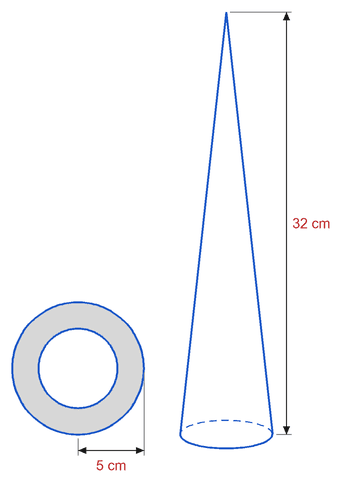
Find the diameter of the base of the cone.
- 683 marks
Question 68
Total volume of three identical cones is the same as that of a bigger cone whose height is 9 cm and diameter 40 cm. Find the radius of the base of each smaller cone, if height of each is 108 cm.
- 693 marks
Question 69
A solid rectangular block of metal 49 cm by 44 cm by 18 cm is melted and formed into a solid sphere. Calculate the radius of the sphere.
- 703 marks
Question 70
A hemispherical bowl of internal radius 9 cm is full of liquid. This liquid is to be filled into conical shaped small containers each of diameter 3 cm and height 4 cm. How many containers are necessary to empty the bowl ?
- 713 marks
Question 71
The total area of a solid metallic sphere is 1256 cm². It is melted and recast into solid right circular cones of radius 2·5 cm and height 8 cm. Calculate :
(i) the radius of the solid sphere,
(ii) the number of cones recast.
Take π = 3·14
- 723 marks
Question 72
The surface area of a solid metallic sphere is 2464 cm². It is melted and recast into solid right circular cones of radius 3·5 cm and height 7 cm. Calculate :
(i) the radius of the sphere.
(ii) the number of cones recast. (Take π = )
- 731 mark
Question 73
In the given figure, the radius of the cone is same as its height equal to 2 cm each. The volume of the whole body is :
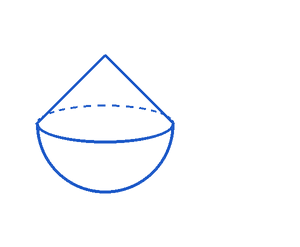
- 741 mark
Question 74
In the given figure, height of the conical part is 3 cm. The radius and the height of the cylindrical part are 1 cm each. The total volume of the body is :
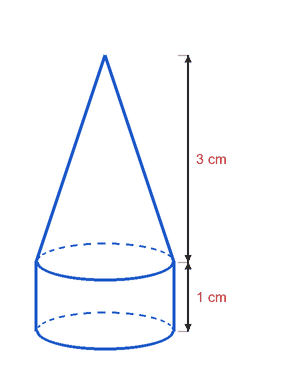
- 751 mark
Question 75
The given figure shows a solid cylinder of height h cm and radius r cm. If the slant height of the conical cavity is l cm, the total surface area of the remaining solid is :
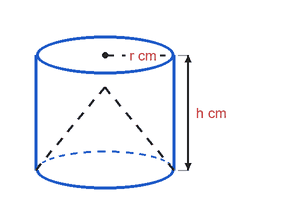
- 761 mark
Question 76
In the given figure, a solid cone is kept inverted in a closed cylindrical container such that the height of cone = height of cylinder = h, radius of cone = radius of cylinder = r and slant height of cone = l. If the remaining of cylinder is completely filled with water, the wetted surface area of the whole body is :
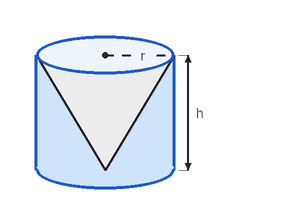
- 771 mark
Question 77
The given figure shows a solid sphere and a closed cylindrical container, both having the same height and same radii. The volume of air left in the cylinder is :
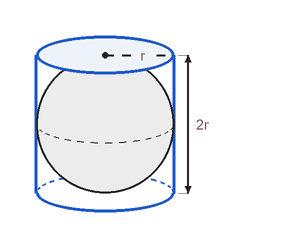
- 783 marks
Question 78
A cone of height 15 cm and diameter 7 cm is mounted on a hemisphere of same diameter.
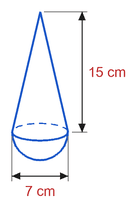
Determine the volume of the solid thus formed.
- 793 marks
Question 79
A buoy is made in the form of hemisphere surmounted by a right cone whose circular base coincides with the plane surface of hemisphere. The radius of the base of the cone is 3·5 metres and its volume is two-third of the hemisphere.

Calculate the height of the cone and the surface area of the buoy, correct to two places of decimal.
- 803 marks
Question 80
From a rectangular solid of metal 42 cm by 30 cm by 20 cm, a conical cavity of diameter 14 cm and depth 24 cm is drilled out.

Find :
(i) the surface area of remaining solid,
(ii) the volume of remaining solid,
(iii) the weight of the material drilled out if it weighs 7 gm per cm³.
- 813 marks
Question 81
A cubical block of side 7 cm is surmounted by a hemisphere of the largest size.

Find the surface area of the resulting solid.
- 823 marks
Question 82
A vessel is in the form of an inverted cone. Its height is 8 cm and the radius of its top, which is open, is 5 cm. It is filled with water up to the rim.
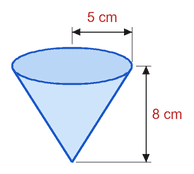
When lead shots, each of which is a sphere of radius 0·5 cm, are dropped into the vessel, one-fourth of the water flows out. Find the number of lead shots dropped in the vessel.
- 833 marks
Question 83
A hemi-spherical bowl has negligible thickness and the length of its circumference is 198 cm. Find the capacity of the bowl.
- 843 marks
Question 84
Find the maximum volume of a cone that can be carved out of a solid hemisphere of radius r cm.
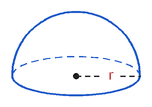
- 853 marks
Question 85
The radii of the bases of two solid right circular cones of same height are r₁ and r₂ respectively. The cones are melted and recast into a solid sphere of radius R. Find the height of each cone in terms of r₁, r₂ and R.
- 863 marks
Question 86
A cone and a hemisphere have the same base and the same height. Find the ratio between their volumes.
- 871 mark
Question 87
The volume of a solid cylinder and a solid cone are same. If their radii are also same, the ratio between the heights of cylinder and cone is :
- 881 mark
Question 88
The volume of the given solid is :
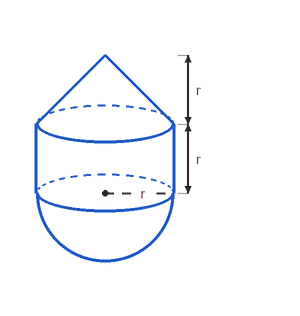
- 891 mark
Question 89
Eight identical metallic spheres, each of radius 1 cm are melted and recast into a solid sphere. The radius of the solid sphere formed is :
- 901 mark
Question 90
The ratio between the heights of two solid cones is 2 : 3 and ratio between their radii is 9 : 8. The ratio between their volumes is:
- 911 mark
Question 91
The radius of a solid cylinder is doubled keeping the height same. The percentage increase in its volume is :
- 923 marks
Question 92
From a solid right circular cylinder with height 10 cm and radius of the base 6 cm, a right circular cone of the same height and same base is removed.
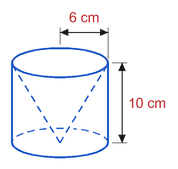
Find the volume of the remaining solid.
- 933 marks
Question 93
From a solid cylinder whose height is 16 cm and radius is 12 cm, a conical cavity of height 8 cm and of base radius 6 cm is hollowed out.
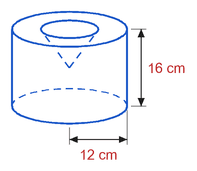
Find the volume and total surface area of the remaining solid.
- 943 marks
Question 94
A circus tent is cylindrical to a height of 4 m and conical above it. If its diameter is 105 m and its slant height is 80 m, calculate the total area of canvas required.
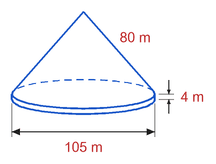
Also, find the total cost of canvas used at ₹ 15 per metre if the width is 1·5 m.
- 953 marks
Question 95
A circus tent is cylindrical to a height of 8 m surmounted by a conical part. If total height of the tent is 13 m and the diameter of its base is 24 m; calculate :

(i) total surface area of the tent,
(ii) area of canvas, required to make this tent allowing 10% of the canvas used for folds and stitching.
- 963 marks
Question 96
A cylindrical container with diameter of base 42 cm contains sufficient water to submerge a rectangular solid of iron with dimensions 22 cm × 14 cm × 10·5 cm.
Find the rise in level of the water when the solid is submerged.
- 973 marks
Question 97
Spherical marbles of diameter 1·4 cm are dropped into a beaker containing some water and are fully submerged. The diameter of the beaker is 7 cm.
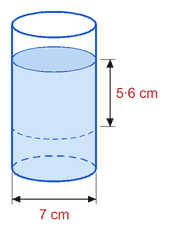
Find how many marbles have been dropped in it if the water rises by 5·6 cm ?
- 983 marks
Question 98
The given figure shows the cross-section of a water channel consisting of a rectangle and a semi-circle. Assuming that the channel is always full, find the volume of water discharged through it in one minute if water is flowing at the rate of 20 cm per second. Give your answer in cubic metres correct to one place of decimal.

- 993 marks
Question 99
An open cylindrical vessel of internal diameter 7 cm and height 8 cm stands on a horizontal table. Inside this is placed a solid metallic right circular cone, the diameter of whose base is cm and height 8 cm.

Find the volume of water required to fill the vessel.
If this cone is replaced by another cone, whose height is cm and the radius of whose base is 2 cm, find the drop in the water level.
- 1003 marks
Question 100
A cylindrical can, whose base is horizontal and of radius 3·5 cm, contains sufficient water so that when a sphere is placed in the can, the water just covers the sphere. Given that the sphere just fits into the can, calculate :
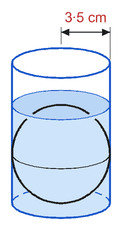
(i) the total surface area of the can in contact with water when the sphere is in it;
(ii) the depth of water in the can before the sphere was put into the can.
- 1013 marks
Question 101
A hollow cylinder has solid hemisphere inward at one end and on the other end it is closed with a flat circular plate. The height of water is 10 cm when flat circular surface is downward. Find the level of water, when it is inverted upside down, common diameter is 7 cm and height of the cylinder is 20 cm.

- 1021 mark
Question 102
The given figure shows a solid cylinder and a solid cone on it according to the given measurement, the total surface area of the solid in terms of π and r is :

- 1031 mark
Question 103
The radii of two solid spheres are 10 cm and 20 cm. The ratio between their volumes is :
- 1041 mark
Question 104
A cone and a sphere have equal volumes. If height of the cone = radius of the sphere = 10 cm, the radius of the cone is :
- 1051 mark
Question 105
A solid metal cuboid with dimensions 10 cm, 11 cm and 8 cm is melted and identical solid spheres, each of radius 1 cm, are formed. The number of spheres formed is :
- 1061 mark
Question 106
By applying force on an uniform metallic wire its length the wire is extended four times its length with uniform width. Then :
-
The volume of metal in both the cases is same.
-
The surface area of solid wires in both the cases is same.
Which of above statements is/are true ?
-
- 1071 mark
Question 107
The given figure shows a toy made of very thin metal sheet. The toy has a hemisphere a cylinder and a cone all of the same radius.
Assertion (A) : A minimum area of metal sheet required is : Curved surface area of the conical part + curved surface area of the cylinder part – curved surface area of the hemisphere part
Reason (R) : Metal sheet required = Curved surface area of (conical part + cylinderical part + hemispherical part)
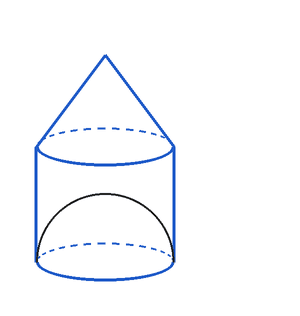
- 1081 mark
Question 108
The base radii of two right circular cones of the same height are in the ratio 3 : 5.
Assertion (A) : The ratio between their volumes is 9 : 25.
Reason (R) : As
- 1091 mark
Question 109
A solid cone of height 3 cm and radius 3 cm is recast into solid cylinders each of height 1 cm and radius 1 cm.
Assertion (A) : Number of cylinders formed = × 3 × 3 × 3
Reason (R) : Number of cylinders formed =
- 1101 mark
Question 110
A solid wooden cylinder is of height h cm and radius r cm. A conical cavity of the same height and the same radius is drilled out of the solid cylinder.
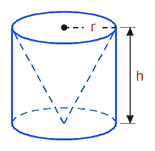
Statement (1) : The volume of the remaining wood = volume of solid cylinder – volume of the cone drilled.
Statement (2) : Volume of the remaining wood = πr²h – πr²h = πr²h.
- 1111 mark
Question 111
A solid sphere of radius 6 cm is melted and recast into solid spheres of diameter 2 cm each.
Statement (1) : The number of solid spheres formed is 6 × 6 × 6 = 216.
Statement (2) : If the smaller spheres formed are identical, the number of solid spheres formed =
- 1121 mark
Question 112
Water in a canal, 6 m wide and 2 m deep, is flowing with the speed of 18 km/h.
Statement (1) : The volume of water that flows through the canal in 20 minutes = 6 × 2 × × 20 × 60 m³
Statement (2) : The volume of water that flows through the canal = 6 × 2 × 18 × 20 m³
- 1133 marks
Question 113
What is the least number of solid metallic spheres, each of 6 cm diameter, that should be melted and recast to form a solid metal cone whose height is 45 cm and diameter 12 cm ?
- 1143 marks
Question 114
A largest sphere is to be carved out of a right circular cylinder of radius 7 cm and height 14 cm. Find the volume of the sphere. (Answer correct to the nearest integer).

- 1153 marks
Question 115
A right circular cylinder having diameter 12 cm and height 15 cm is full of ice-cream. The ice-cream is to be filled in identical cones of height 12 cm and diameter 6 cm having a hemi-spherical shape on the top.
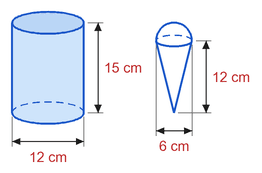
Find the number of cones required.
- 1163 marks
Question 116
A solid is in the form of a cone standing on a hemi-sphere with both their radii being equal to 8 cm and the height of cone is equal to its radius.

Find, in terms of π, the volume of the solid.
- 1173 marks
Question 117
The diameter of a sphere is 6 cm. It is melted and drawn into a wire of diameter 0·2 cm. Find the length of the wire.
- 1183 marks
Question 118
Determine the ratio of the volume of a cube to that of a sphere which will exactly fit inside the cube.
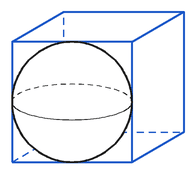
- 1193 marks
Question 119
An iron pole consisting of a cylindrical portion 110 cm high and of base diameter 12 cm is surmounted by a cone 9 cm high.
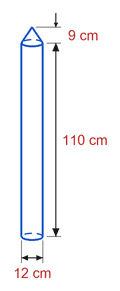
Find the mass of the pole, given that 1 cm³ of iron has 8 gm of mass (approx). (Take π = )
- 1203 marks
Question 120
The cross-section of a tunnel is a square of side 7 m surmounted by a semi-circle as shown in the adjoining figure. The tunnel is 80 m long. Calculate :
(i) its volume,
(ii) the surface area of the tunnel (excluding the floor) and
(iii) its floor area.
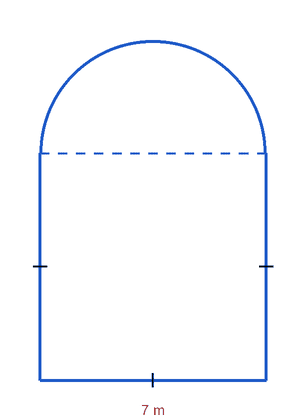
- 1213 marks
Question 121
A cylindrical water tank of diameter 2·8 m and height 4·2 m is being fed by a pipe of diameter 7 cm through which water flows at the rate of 4 m s⁻¹. Calculate, in minutes, the time it takes to fill the tank.
- 1223 marks
Question 122
Water flows, at 9 km per hour, through a cylindrical pipe of cross-sectional area 25 cm². If this water is collected into a rectangular cistern of dimensions 7·5 m by 5 m by 4 m; calculate the rise in level in the cistern in 1 hour 15 minutes.
- 1233 marks
Question 123
The given figure shows the cross-section of a cone, a cylinder and a hemisphere all with the same diameter 10 cm, and the other dimensions are as shown. Calculate :
(a) the total surface area,
(b) the total volume of the solid and
(c) the density of the material if its total weight is 1·7 kg.
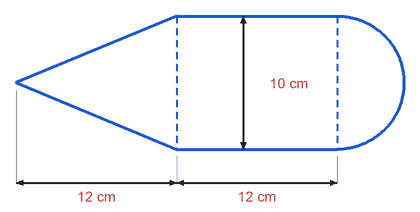
- 1243 marks
Question 124
A solid, consisting of a right circular cone standing on a hemisphere, is placed upright in a right circular cylinder, full of water, and touches the bottom. Find the volume of water left in the cylinder, having given that the radius of the cylinder is 3 cm and its height is 6 cm; the radius of the hemisphere is 2 cm and the height of cone is 4 cm.

Give your answer to the nearest cubic centimetre.
- 1253 marks
Question 125
A metal container in the form of a cylinder is surmounted by a hemisphere of the same radius. The internal height of the cylinder is 7 m and the internal radius is 3·5 m.

Calculate :
(i) the total area of the internal surface, excluding the base;
(ii) the internal volume of the container in m³.
- 1263 marks
Question 126
An exhibition tent is in the form of a cylinder surmounted by a cone. The height of the tent above the ground is 85 m and height of the cylindrical part is 50 m. If the diameter of the base is 168 m, find the quantity of canvas required to make the tent.
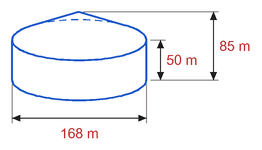
Allow 20% extra for fold and for stitching. Give your answer to the nearest m².
- 1273 marks
Question 127
A test tube consists of a hemisphere and a cylinder of the same radius. The volume of the water required to fill the whole tube is cm³, and cm³ of water is required to fill the tube to a level which is 4 cm below the top of the tube.
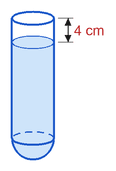
Find the radius of the tube and the length of its cylindrical part.
- 1283 marks
Question 128
A solid is in the form of a right circular cone mounted on a hemisphere. The diameter of the base of the cone, which exactly coincides with hemisphere, is 7 cm and its height is 8 cm. The solid is placed in a cylindrical vessel of internal radius 7 cm and height 10 cm. How much water, in cm³, will be required to fill the vessel completely ?
- 1293 marks
Question 129
A certain number of metallic cones, each of radius 2 cm and height 3 cm, are melted and recast into a solid sphere of radius 6 cm. Find the number of cones used.
- 1303 marks
Question 130
A conical tent is to accommodate 77 persons. Each person must have 16 m³ of air to breathe. Given the radius of the tent as 7 m, find the height of the tent and also its curved surface area.

What Class 10 Maths Ch 20 covers
The sections of the chapter, in the order the book takes them. Every question above comes from one of these.
- 01Cylinder (Right Circular Cylinder)
- 02Hollow Cylinder
- 03Cone (Right Circular Cone)
- 04Sphere
- 05Spherical Shell
- 06Hemisphere
More ways to study this chapter
The same chapter asked three other ways. Practise it, revise it, and see what the board has set on Ch 20 before.
- Competency-Based Questions (CBQ)Case study questions: a situation, and the part of the chapter that answers it.40questionsOpen
- Previous Year QuestionsQuestions that have actually appeared in board papers, each tagged with its year.30questionsOpen
- Practice QuestionsExtra questions per chapter, for when one attempt at a method is not enough.42questionsOpen
Ch 20 in past ICSE papers
The same chapter as the board has actually asked it. These are worded differently from the textbook exercise, which is the point of reading them.
- 13 marks
Board paper question 1
A certain number of metallic cones, each of radius 2 cm and height 3 cm are melted and recast into a solid sphere of radius 6cm. Find the number of cones.
Solve with AIWritten solution
Solution:
Concept: These facts are used here.
- Cone: volume , slant height , curved surface .
- Sphere: volume , surface .
- Melting and recasting: the volume of metal stays the same, so total volume before = total volume after.
Step 1 — Volume of one cone.
Each cone has radius 2 cm and height 3 cm. Keep as it is; it cancels later.
Step 2 — Volume of the sphere.
The sphere has radius 6 cm.
Step 3 — Number of cones.
All the metal of the n cones goes into the sphere, so n times one cone's volume equals the sphere's volume.
Watch out: Use the cube of the sphere's radius () but the square of the cone's radius ().
Therefore, 72 cones were melted.
- 23 marks
Board paper question 2
A conical tent is to accommodate 77 persons. Each person must have of air to breathe. Given the radius of the tent as find the height of the tent and also its curved surface area.
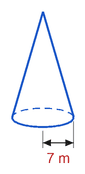 Solve with AI
Written solution
Solution:
Concept: Cone: volume , slant height , curved surface .
Step 1 — Volume of air needed.
77 persons each need , so the tent must hold:
Step 2 — Find the height.
Set the cone's volume equal to 1232, with m.
Step 3 — Find the slant height.
The radius, the height and the slant height form a right-angled triangle.
Step 4 — Curved surface area.
Use .
Watch out: The curved surface needs the SLANT height (25 m), not the vertical height (24 m).
Therefore, the height of the tent is m and its curved surface area is .
- 33 marks
Board paper question 3
The circumference of the base of a cylindrical vessel is 132 cm and its height is 25 cm. Find the
(i) radius of the cylinder
(ii) volume of cylinder. (use )
Solve with AIWritten solution
Solution:
Concept: These facts are used here.
- Cylinder: volume , curved surface , total surface .
- Circle: circumference .
Step 1 — Find the radius (part i).
The circumference of the base is .
Step 2 — Find the volume (part ii).
Use with cm.
Watch out: 132 cm is the circumference, , not ; dividing by alone gives the diameter.
Therefore, the radius is cm and the volume is .
- 44 marks
Board paper question 4
The following figure represents a solid consisting of a right circular cylinder with a hemisphere at one end and a cone at the other. Their common radius is 7 cm. The height of the cylinder and cone are each of 4 cm. Find the volume of the solid.
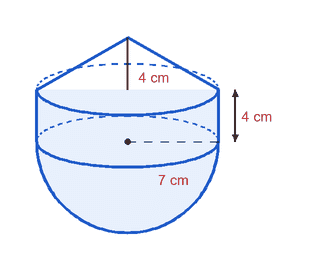 Solve with AI
Written solution
Solution:
Concept: These facts are used here.
- Hemisphere: volume , curved surface , total surface .
- Cylinder: volume , curved surface , total surface .
- Cone: volume , slant height , curved surface .
Step 1 — Add the three volumes.
The solid is a hemisphere, a cylinder and a cone, all of radius cm; the cylinder and the cone are each 4 cm high. Each volume has the factor , so take it out.
Step 2 — Simplify the bracket.
Put and .
Step 3 — Find the volume.
Multiply by .
Watch out: The hemisphere's volume is , half of a sphere's; do not use .
Therefore, the volume of the solid is .
- 54 marks
Board paper question 5
A solid metallic sphere of radius 6 cm is melted and made into a solid cylinder of height 32 cm. Find the:
(i) radius of the cylinder.
(ii) curved surface area of the cylinder.
Take
Solve with AIWritten solution
Solution:
Concept: These facts are used here.
- Sphere: volume , surface .
- Cylinder: volume , curved surface , total surface .
- Melting and recasting: the volume of metal stays the same, so total volume before = total volume after.
Step 1 — Equate the volumes.
The sphere (radius 6 cm) is recast into a cylinder of height 32 cm, so the volumes are equal; cancels.
Step 2 — Find the radius (part i).
Divide and take the square root.
Step 3 — Curved surface area (part ii).
Use with .
Watch out: Use , as the question says, not .
Therefore, the radius of the cylinder is cm and its curved surface area is .
- 64 marks
Board paper question 6
A hemispherical and a conical hole is scooped out of a solid wooden cylinder. Find the volume of the remaining solid where the measurements are as follows:
The height of the solid cylinder is 7 cm, radius of each of hemisphere, cone and cylinder is 3 cm. Height of cone is 3 cm.
Give your answer correct to the nearest whole number. Take .
 Solve with AI
Written solution
Solution:
Concept: These facts are used here.
- Cylinder: volume , curved surface , total surface .
- Hemisphere: volume , curved surface , total surface .
- Cone: volume , slant height , curved surface .
Step 1 — Volume of the cylinder.
Radius 3 cm, height 7 cm.
Step 2 — Volume of the hemispherical hole.
Radius 3 cm.
Step 3 — Volume of the conical hole.
Radius 3 cm, height 3 cm.
Step 4 — Remaining volume.
Take both holes away from the cylinder.
Watch out: Both holes are SUBTRACTED from the cylinder; nothing is added.
Therefore, the volume of the remaining solid is (to the nearest whole number).
All 30 board paper questions for this chapter, solved the same way.
Class 10 Maths Ch 20 questions students ask
How many questions are there in Class 10 Maths Ch 20?
130 questions. Every one is solved step by step on this page.
Are these Class 10 Maths solutions free?
Yes. Every question and its full working is free to read, with no account needed.
Can I download the Class 10 Maths Ch 20 solutions as a PDF?
There is no PDF to download. Every solution is on this page instead, which means it is searchable, always the current syllabus, and readable on a phone. Use your browser's print option if you want it on paper.