
Question 51 markMCQEasy
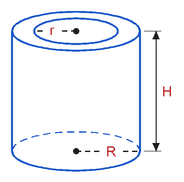
The total surface area of an open pipe of length H cm, external radius R cm and internal radius r cm, is :
Confirming your payment
Sign up now and get 250 free tokens.
Cylinder, Cone and Sphere · Question 5 of 130
The total surface area of an open pipe of length H cm, external radius R cm and internal radius r cm, is :
(A) πR² – πr² + 2π(R – r)H
(B) 2πR² – 2πr² + 2πRH
(C) 2πRH – 2πrh + πR² – πr²
(D) 2(πR² – πr²) + 2πRH + 2πrH
Answer: (D) 2(πR² – πr²) + 2πRH + 2πrH
Concept: A hollow cylinder (pipe) of external radius R, internal radius r and length h has volume of material π(R² − r²)h: the volume of the outer cylinder minus the volume of the hole. Its outer and inner curved surfaces are 2πRh and 2πrh, and each end is a ring of area π(R² − r²). An open pipe has no lids: its whole surface is the outer wall, the inner wall and the two end rings.
Step 1 — Outer curved surface.
The outside of the pipe is a curved surface of radius R and length H.
Step 2 — Inner curved surface.
The inside of the pipe is a curved surface of radius r and the same length H.
Step 3 — The two end rings.
Each end is a ring between the circles of radii R and r, and there are two ends.
Step 4 — Add all four parts.
The total surface area is the sum of these surfaces.
Watch out: The inner surface is ADDED (it is part of the surface you can touch), not subtracted.
Why the other options are wrong:
Therefore, the total surface area is 2(πR² − πr²) + 2πRH + 2πrH cm², option (D).