Answer: (A) 2πrh + πr² + πrl
Concept: The wetted surface is every surface that the water touches. A right circular cylinder of base radius r and height h has volume V = πr²h (area of the base × height), curved surface area 2πrh (circumference of the base × height). The curved surface of a cone of radius r and slant height l is πrl.
Step 1 — Picture the arrangement.
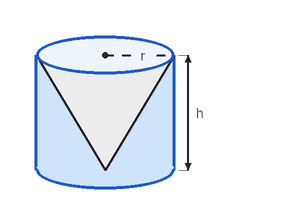
The cone is inverted: its base (radius r) fills the lid, and its vertex rests on the centre of the container's base, because the cone and the cylinder have the same height h. The water fills the space between the cone and the walls.
Step 2 — List the surfaces the water touches.
The water touches the curved wall of the container, the bottom of the container (the vertex only touches it at one point) and the slanting surface of the cone. It does not touch the lid, which is covered by the cone's base.
Curved wall=2πrh
Bottom=πr2
Cone’s curved surface=πrl
Step 3 — Add.
The wetted surface area is the sum of these three.
Wetted area=2πrh+πr2+πrl
Watch out: Only ONE circular face (the bottom) is wet; the lid is covered by the cone's base.
Why the other options are wrong:
- (B) 2πrh + πrl: it leaves out the bottom of the container, πr², which the water covers.
- (C) 2πrh + 2πr² + πrl: it counts both circular faces, 2πr², but the lid is covered by the cone's base and is not wet.
- (D) 2πrh – πr² + πrl: it subtracts the bottom πr², which is in fact a wetted surface to be added.
Therefore, the wetted surface area is 2πrh + πr² + πrl, option (A).