
Question 751 markMCQEasy
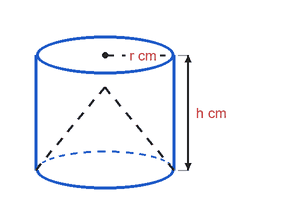
The given figure shows a solid cylinder of height h cm and radius r cm. If the slant height of the conical cavity is l cm, the total surface area of the remaining solid is :
Confirming your payment
Sign up now and get 250 free tokens.
Cylinder, Cone and Sphere · Question 75 of 130
The given figure shows a solid cylinder of height h cm and radius r cm. If the slant height of the conical cavity is l cm, the total surface area of the remaining solid is :
(A) πrl + 2πrh + 2πr²
(B) πr² + πrl + 2πrh
(C) 2πr² – πrl + 2πrh
(D) (πrl + πr²) + 2πr² + 2πrh
Answer: (B) πr² + πrl + 2πrh
Concept: The volume of a solid made of simple parts is the sum of the volumes of the parts. Its surface area is the sum of only the surfaces you can see and touch: faces where two parts are joined are hidden and are left out. A right circular cylinder of base radius r and height h has volume V = πr²h (area of the base × height), curved surface area 2πrh (circumference of the base × height). The inside of a conical cavity of radius r and slant height l has area πrl.
Step 1 — See what the cavity removes.
The cavity has the same radius r as the cylinder and is cut into its base, so the whole circular bottom face is removed. In its place there is the inside surface of the cavity.
Step 2 — List the remaining surfaces.
The remaining solid has the top face, the curved wall and the inside of the cavity.
Step 3 — Add.
The total surface area is the sum of these three.
Watch out: The bottom circle is GONE (it is the opening of the cavity), so only one circular face remains.
Why the other options are wrong:
Therefore, the total surface area of the remaining solid is πr² + πrl + 2πrh cm², option (B).