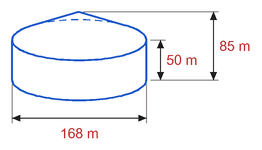
An exhibition tent is in the form of a cylinder surmounted by a cone.
Question 1263 marksEasy
An exhibition tent is in the form of a cylinder surmounted by a cone. The height of the tent above the ground is 85 m and height of the cylindrical part is 50 m. If the diameter of the base is 168 m, find the quantity of canvas required to make the tent.
Allow 20% extra for fold and for stitching. Give your answer to the nearest m².
Solution:
Concept: The volume of a solid made of simple parts is the sum of the volumes of the parts. Its surface area is the sum of only the surfaces you can see and touch: faces where two parts are joined are hidden and are left out. The canvas covers the curved surface of the cylinder and of the cone (no floor). '20% extra' means 120% of the tent's area.
Given: Total height 85 m; cylinder 50 m high; base diameter 168 m; 20% extra.
Step 1 — Find the measurements.
The radius is 168 ÷ 2 = 84 m, the cylinder is 50 m high, and the cone is 85 − 50 = 35 m high; its slant height follows from l² = r² + h².