Solution:
Concept: The volume of a cylinder of base radius r and height h is V = πr²h, that is, area of the base × height. For a sphere of radius r, the volume is V = ⁴⁄₃πr³ and the surface area is 4πr². For a hemisphere of radius r, the volume is ⅔πr³, the curved surface area is 2πr² and the total surface area is 3πr² (curved part 2πr² plus the flat circle πr²). The difference of two amounts of water is the volume of the part of the tube between the two levels.
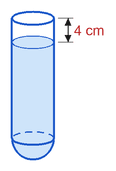
Given: Whole tube holds 5159/6 cm³; filled to 4 cm below the top it holds 4235/6 cm³.
Step 1 — Volume of the top 4 cm.
The top 4 cm of the tube is a cylinder; it holds the difference of the two amounts.
V=65159−64235=6924=154 cm3
Step 2 — Find the radius.
This cylinder has height 4 cm.
722×r2×4=154
r2=88154×7=12.25
r=3.5 cm
Step 3 — Volume of the hemisphere.
The bottom of the tube is a hemisphere of radius 3·5 cm.
Vh=32×722×3.53=6539 cm3
Step 4 — Find the length of the cylindrical part.
The cylindrical part holds the whole volume minus the hemisphere; its base area is 22/7 × 3·5² = 38·5 cm².
38.5×h=65159−6539=770
h=38.5770=20 cm
Watch out: Subtract the hemisphere before dividing by the base area; the whole tube is not a cylinder.
Therefore, the radius of the tube is 3·5 cm and the length of its cylindrical part is 20 cm.