
Question 673 marksEasy
The radii of the internal and external surfaces of a metallic spherical shell are 3 cm and 5 cm respectively. It is melted and recast into a solid right circular cone of height 32 cm.
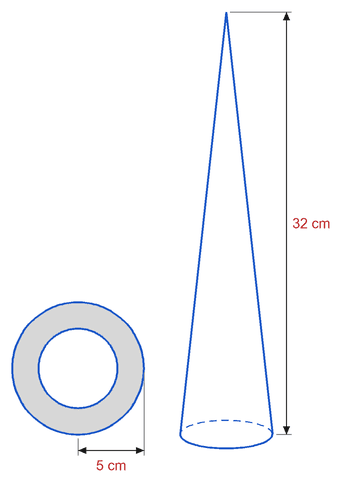
Find the diameter of the base of the cone.
Confirming your payment
Sign up now and get 250 free tokens.
Cylinder, Cone and Sphere · Question 67 of 130
The radii of the internal and external surfaces of a metallic spherical shell are 3 cm and 5 cm respectively. It is melted and recast into a solid right circular cone of height 32 cm.
Find the diameter of the base of the cone.
Solution:
Concept: When a solid is melted and recast (or water is displaced), no material is lost or gained: the volume before equals the volume after. For n identical small solids made from one big one, n = volume of the big solid ÷ volume of one small solid. The metal in a spherical shell is ⁴⁄₃π(R³ − r³). A right circular cone of base radius r, height h and slant height l has l² = r² + h² (Pythagoras' theorem in the right triangle formed by the axis, a radius and a slant edge), volume V = ⅓πr²h, curved surface area πrl and total surface area πrl + πr² = πr(l + r).
Given: Shell radii 3 cm (inside) and 5 cm (outside); cone height 32 cm.
Step 1 — Equate the volumes.
The shell (R = 5 cm, r = 3 cm) becomes a cone of height 32 cm and base radius r; multiply both sides by 3 and divide by π.
Step 2 — Solve for r.
Divide 392 by 32 and take the square root.
Step 3 — Find the diameter.
The diameter is twice the radius.
Watch out: The question asks for the DIAMETER of the base; double the radius.
Therefore, the diameter of the base of the cone is 7 cm.